The following was posted in the feed of an art teacher group I am part of. I completely agree with the message. We need to be teaching our students how to think like artists. We need to teach them how to problem solve. We need to teach them that mistakes are okay. That exploration leads to artistic growth. That, as Cindy Foley implies, ambiguity is okay.
Tag Archives: reflections
Helping Students to “Get It”
Sometimes kids just don’t get it. No matter how hard you try, there is some disconnect between what you are saying and what they are comprehending. I recently had this issue.
Art 1 is working under the theme of “Environment”. We discussed and had a brainstorming session of what an environment is and what it could be. They came up with some wonderful ideas in our padlet session. I really thought they knew where to go from there.
A few days pass, students finish up new media practice sheets, and they begin to work on sketches for their artworks. I walked around taking peeks here and there to see what they were doing. I began to notice that I was seeing a whole bunch of the same thing…lots of sunsets over water and lots of generic landscapes. Nothing seemed as creative as their last artworks.
What was I doing wrong? What were they not getting from me? Where was the misconnection? I asked some colleagues on the FB TAB teacher group and they helped me to see what was missing. One person suggested that maybe it was in the wording. Another asked what types of images I had shown them.
I thought about their suggestions. I realized that it was a wording issue and that my choice of intentionally not showing any examples backfired. I quickly made a pinboard of an wide array of environments. The next morning I had a sort of “show and tell” with my students. I showed them an image and had them tell me about the environment. I asked them what environment it was. I asked how they came to that conclusion. I asked what the artist did to help create that environment. I told them that another word for environment was “setting”. We then moved on to the next activity for that class period.
The next day I walked around, again peeking at what they were sketching. This time I saw images that were more thought out. They had subject matters that were put into a surrounding. I saw kids becoming more “into” what they were creating. I was happy, and things felt “right” again.
A Student’s Story about Problem Solving
I wanted to take a moment to brag on one of my ceramic students. Lately I’ve been talking so much about my art 1 and art 2 classes and how their immersion into TAB has been off the chain. I feel like I’ve been neglecting my other classes…my ceramic classes. They do make up half of my class load after all, they should not be looked over.
It has been slow going in the beginning classes as we were waiting for clay and slabs are getting to a working state that isn’t so floppy. (I have to say I can’t wait until we are past the first project so kids have more than one thing to work on.)
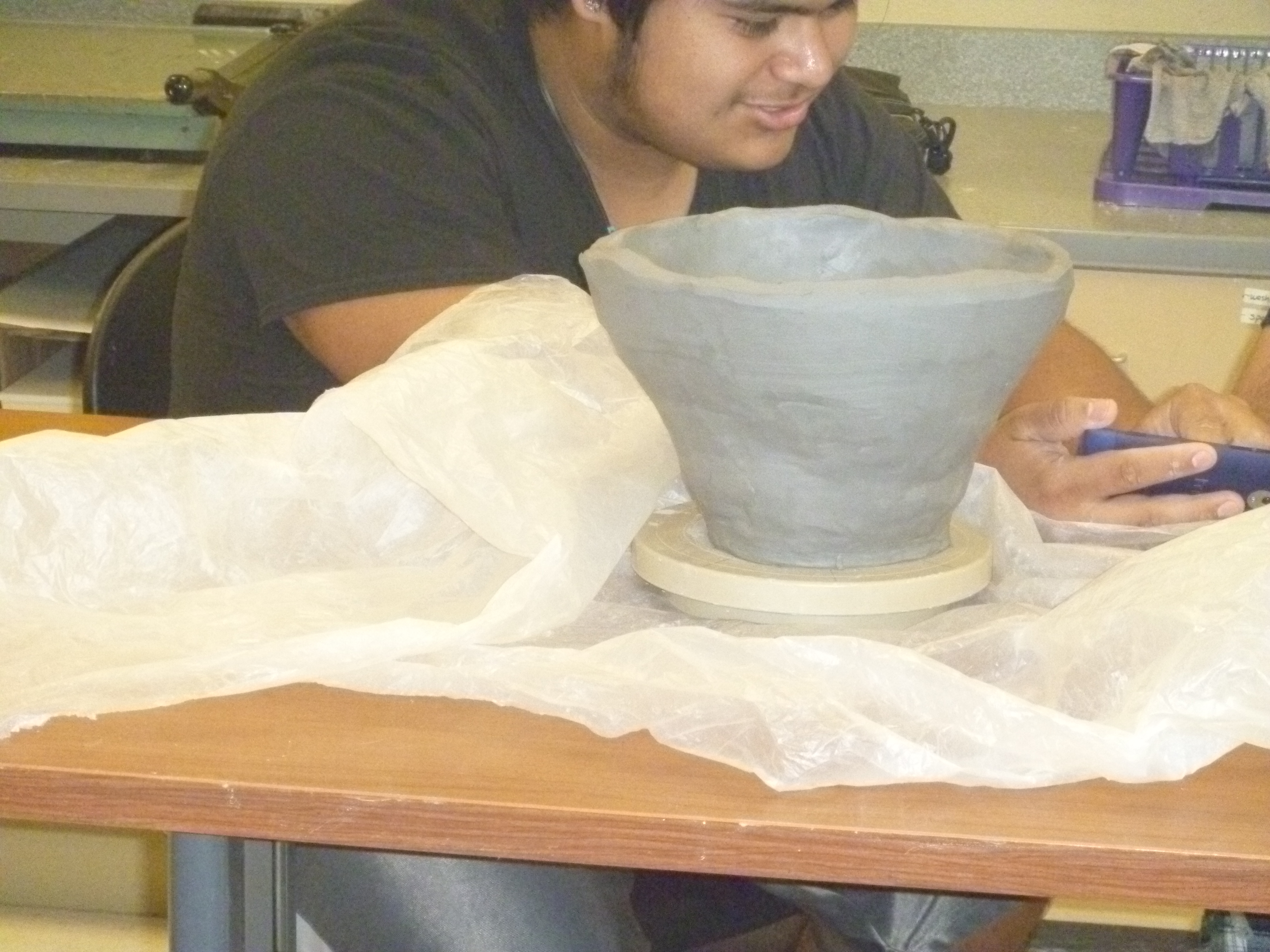
My intermediate/advanced class is creating enlarged organic objects. I asked them to bring in an organic object, but of course, only one student did. Luckily I predicted this and found a ton of things for them. One of the objects was the flower pod from the cactuses here in Texas. Paul chose that object.
It started out fresh and bulbous and he jumped right in building it 5 times as big. It was going to be an awesome piece. However, over the course of the time we’ve been working, the pod began to shrivel as the moisture left. Neither of us thought of this possibility. As Paul was close to finishing, I told him if he wanted to just pretend the piece hadn’t shriveled, I was cool with that. He said ok.
I went about my business and towards the end of class came back to Paul and saw that he had incorporated the shrivels. His piece looked way more awesome than it did before. There is now so much more life to his sculpture. I am so proud of him. This is his best work to date. I love that he encountered a problem and instead of getting mad, he ran with it and brought his work to another level.
Student/Teacher Collaboration
Should we influence our students’ artworks? And if so, how much? I struggled with this the other day. As I walk around my classroom, I stop and watch students work. I stare at them staring at their work and eventually ask what they are struggling with or what they are thinking. This has started some wonderful conversations and lead to some collaboration.
I listen carefully to what they have to say and I form my questions with great intention to pull out of them where I think they need to head in their artistic journey: what things they need to consider, what are they trying to say with their work, what is the relationship between this and that. I wait for them to think and answer. And in the moments of silence, I start to think too. Based upon their answers, I come up with some suggestions. I can see the unknown in their eyes and I say, “what if you…?”
As I offer up ways to go with their pieces, I started to think to myself, am I giving them too much and not letting them figure it out on their own? Am I taking something away from them? Maybe yes, maybe no. I like to think I am helping to open their minds to the world of possibilities and that art can be so much more than what they have seen in their little rural town.
The possibilities of where they can take their artwork and how they can bring it to another level excites me. It makes me love art and teaching even more. But, am I teaching or am I directing?
What do you think?
My TAB Classroom Is a Living Entity and Must Be Treated As Such
I’ve been at this TAB thing in my classroom for about 2 weeks. I have implemented it in my Art 1, and my Art 2. My ceramic classes aren’t quite there yet, but they will be. I started Art 2 first on the TAB path. I showed short demos and had them practice using the techniques. We talked about out main theme of man/machine. I plan on revisiting tomorrow.
I feel I made some mistakes in my approach, so after a week of monster pinch pots and bobble heads in Art 1, I had a chance to have a mulligan. I changed how I had them practice. And after the first day, I even added a practice exercise that I didn’t do with my Art 2.
As I go along, I am learning just as much, if not more than my students. I think that is important in the TAB classroom. You have to be flexible. You have to take a step back and re-evaluate. And, if you are lucky, like I am, you can get a mulligan and try a new way within a few days and not have to wait until the next unit in a few weeks to try something new.
However, as I watched my Art 2 students finished the final practice before re-visiting our brainstorm session of man/machine, I felt that how I was having them practice just wasn’t right. I feel they weren’t really having a good go at the different techniques/media. I plan on finishing up with Art 1 how I completed Art 2, but over the course of the next few weeks, I will come up with some new ideas on how to practice. Because hey, what worked at one time may not work at another time. That’s just how the TAB classroom works.
“If there is no struggle, there is no progress.” -Frederick Douglass
“To improve is to change; to be perfect is to change often.” -Winston Churchill
“If we don’t change, we don’t grow. If we don’t grow, we aren’t really living. ” -Gail Sheehy
Jumping in Feet First into Tab
Today I decided my art 2: painting/drawing was just going to jump in, feet first, into TAB. Let me tell you, it was nerve wracking. We started off with a Padlet activity. I introduced our first theme of man/machine and we brain stormed what they thought of when I said the word “man” and when I said the word “machine”. This was the most talkative the class was all period. Next I told them of the facebook art teacher group I am part of and how I asked my fellow teachers what artwork and what artists they thought of when I gave the topic of man/machine the list was so varied. I showed my students examples from the suggestions. I wanted them to see that there was no wrong answer. That everyone has different images when told a theme, and that was okay. In fact, it was encouraged.
The last thing I did today was a few demos on ways of creating value. Our first unit based on “Man/Machine” is all about b/w drawing media. I am excited about the artist dictionary they will be creating over the year from their practice of the demos that I do. I don’t think I made the right choice in how I went about handing things out and the order of that. I think next time (and I will have a chance to try again in a week or so with art 1), I will do the demo then hand out the practice sheets because even though I told them not to draw what I was drawing, many of them did. I really want them to practice something and really try the technique out and not just do the short little “thing” I do.
As I mentioned before the loudest they were was during the brainstorming. It really was a little freaky how quiet a 9th period class was. I am really hoping they were just overwhelmed because it wasn’t “normal” art class and they were trying to take it all in. I really hope they were not bored. I hope as we go along and this becomes “routine” they act more comfortable in class.
I look forward to tomorrow.
Shifting Focus
A new school year is upon us and with that comes great changes to the art room. I am excited to shift the focus in my classroom. We will be working with a “new” way of becoming artists. We will focus on building artistic behaviors and creating artwork from conception to final work. The students will have more control and choice over materials and techniques to solve “problems” given to them. And we will be writing about the process and the decisions made along the way. This is a way of teaching art called TAB (Teaching for Artistic Behavior).
~First blog entry on my art classes’ new website.
Why am I shifting focus? Sometime last year I had found this Facebook group for art teachers and it was a gold mine. Here was this group of people like me from all over the world wanting to share and discuss all things about teaching art. It was from this group that I was introduced officially to this idea of choice or modified-choice in the art room. Some of it was familiar as I was starting to offer more choice to my kids, but I was still a mostly “teacher-focused” art room.
One day as I was standing in the hallway between classes (as teachers are supposed to do) I was focused on the display cases in front of me and something occurred to me: every single painting in the case was identical. I mean there were some differences in the trees and the clouds and the mountains, but for all intents and purposes they were the same. It was then and there that I decided no more. I wanted my kids to think, to have a voice, to create something “original”. And choice was going to be the way.
Back to the Facebook group. It was from this group that I was introduced to Katherine Douglas, a pioneer in TAB, Ian Sands, Melissa Purtee and the other art teachers at Apex High School in North Carolina, and Colleen Rose, an art teacher from Ontario. Along with a few other TAB teachers, they helped me to understand what TAB could do for me and, more importantly, for my students. The teachers at Apex wrote this 5 part series on choice in the HS art classroom. This helped me to see how wonderful it could be. (parts: 1, 2, 3, 4, 5) I would like to thank them for all their help over the past few months.
I tried out choice several times during this past school year (here, here, and here), well, sort of choice. I guess it was more of a modified choice. I learned a lot about how my students would handle have such “freedom”. I learned what I could handle. And I saw first hand what my students could create without me. That was the best one.
So, I decided to make the shift from a teacher-focused classroom to a student-focused classroom. I no longer wanted to come up with the lesson where the outcome has already been decided. I want to be surprised. I want my students to go through journeys similar to the journeys I go through when I make art. I want them to know why they made a certain choice. I want them to be able to talk about their work. I want them to stop copying others. I want them to learn from their mistakes and to take chances. I want my classroom motto (stolen from Ms. Frizzle of Magic School Bus fame) of “Take Chances. Make Mistakes. Get Messy.” to actually mean something.
And, I think this fall, it will.
Looking Back: 2013-14
School wrapped up on a Friday with Graduation like it always does. It is always a bittersweet moment for me. I love watching my students finish their grade school careers and seeing the excitement in their eyes as they move onto the next chapter of their lives. But, it is sad to say good-bye. This year was the toughest yet. It was the first time in my career that I had several students for 3-4 years in my classes. I had never done that before. I had know those kids like I had know no others.
But, enough sad stuff. Let’s look back at this year. I think it was my best year yet at THS, and at being a teacher. I learned a lot–not only about myself as a teacher, but also about where I want to go and how I want to get there. And, the journey is just as important, if not more so, than the destination.
I met some great people along the way this year through an art teacher FB group and a splinter group for HS TAB teachers. They have helped me tremendously. I was really able to examine who I was as a teacher and how/what I was teaching through reading what others posted about. I saw things I didn’t like and would not like in my classroom. And, I saw fabulous things that I do want in my classroom. I was forced to think and explore this year. Did I always put my students first and have their best interest in mind? Yes. Was it always successful? No, but sometimes you have to break a few dishes.
I learned so much about my teaching and what lights the fire inside of me as a teacher and what bores me to death. I think if I am not passionate about what I am teaching, then the kids will pick up on that and they won’t want to invest in it. I improved in my working with others. I still have a long road, but I am further along than I thought and it’s a good thing.
I know I made the right decision when it came to switching my sculpture class to a ceramics class. In the short months we focused solely on ceramics, students grew so much more than my sculpture students did over the course of 2-3 years. The program is still a work in progress, but the path is bright and growing larger. My numbers for beginning sculpture/ceramics almost tripled. I am excited and scared of this at the same time.
Some of my favorite moments from this year: The first HS art show. It was hard and fun all wrapped into one. I loved the relationships I created with some of my painting/drawing students. The sculpture field trip to the Umlaf Sculpture Garden is one I will never forget. My freshmen this year were so much fun. I love that so many decided they wanted to be with me again next year. I loved altered books and egg carton balance and mixed media collages. I love that I saw 2 boys, boys that would probably get lost in the system, come to life when I put clay in their hands. And, I love that they are taking ceramics next year (and hopefully for the rest of their hs careers.) I was honored that the principals did recognize me and my efforts to name me November teacher of the month. I am proud of my monthly parent newsletter–I’ve been wanting to do this forever, and finally got it done. I am proud of all that was accomplished this year. I had a blast.
All in all, it was a great year. But, as usual, I have already moved on and working on next year. Stay tuned….it’s gonna be a good one!
This Book I Read…
Lately I’ve had several issues on my mind that seem to revolve around the same similar topics: copying, tracing, originality, etc. I feel these are in the same vein, if you will, of something that we as artists need to understand what is acceptable and what is not. I also feel we as art teachers need to teach our students the same things.
Several months ago I “started reading for free” this book by Austin Kleon called Steal Like an Artist. In other words, Kindle let me read a small amount of the book for free to see if I wanted to buy the book. I never bought the book for my Kindle. However, last week I needed something to fill my cart on Amazon so I could get free shipping. I put this book in because it was 40% off. I AM SO GLAD I FINALLY PURCHASED THIS BOOK!!!
I thought it would just be just a cute book. It’s a quick read, but one full of lots of food for thought about these topics that have been on my mind lately. I am sure that not everyone will feel about this book like I do, but it really resonated with me and the ideals I want to teach my kids about making art, or just being creative in general. I highly recommend it.
Some of my favorite parts include:
“What to copy is a little bit trickier. Don’t just steal the style, steal the thinking behind the style. You don’t want to look like your heroes, you want to see like your heroes. ~page 36.
“Imitation is about copying. Emulation is when imitation goes one step further, breaking through into your own thing.” ~page38.
“Remember ‘Garbage in, garbage out’? You’re only going to be as good as the people you surround yourself with.” ~page 102
I want my students to read this book. Not all of my students, but my art 2 and higher students. I think it will help them to think deeper about what they are creating and HOW they create it. Or, at the very least, it will give pause when they begin to create that next artwork for class or themselves.
Dealing with Disappointment
Recently one of my classes took on the monumental task of creating a cardboard “city”. I had shown them a photo I found on Pinterest. I asked them if they were interested in this and they said they were and were excited to try and build something in the same vein. I knew that it would be difficult. I save cardboard for ever it seemed. I also knew the skill level of my students. I would never had expected them to rise to this level. But I did expect more.
My students originally thought they would make a ship, but somehow they changed it to a castle. I thought, that is going to be great. They will cut out brick and make it look like a bas relief. Wonderful. One of the students even said she would make a dragon to go with it.
As time went on and I checked on their progress, I grew more and more disappointed with the castle. It had a great basic shape, but other than that…it looked like something I would order out of one of those catalogs for prom. The covered the whole thing with craft paper and drew squares. These were my seniors, my advanced sculpture students, and they had over 2 months to work on this. How could this be what they created?
Now it is over a month later and I have had time to think about it. I still don’t know how to deal with the disappointment of this project. Should I consider it a project flop that Ian Sands could put in his book? Should I just brush it off as a early case of senioritis? Was I expecting too much? Did I not push them enough to do more? I know they learned a lot about creating something so large and working in a group. As a teacher, I appreciate what they learned from this project. But shouldn’t sometimes the product be important too?
I don’t know.
How do you deal with disappointment in projects? What do you as a teacher learn from it?
By the way, the dragon head turned out awesome.

