Tag Archives: art

Skill vs Creativity

Standard

As a teacher that has embraced the Teaching for Artistic Behavior (TAB) philosophy for almost a decade and a half, I still find myself struggling sometimes with with debate around skill and its importance. I know it’s important for artists to have technical skills and for them to continue building those skills. Buuuutttt…. should that be the most important thing in the high school art room (or any art room for that matter?)

I was doom scrolling the other day, and I came across this reel in my IG feed and I finally felt a little bit of validation. The artist talked about an art teacher he had that pretty much said what I had felt in my art heart all these years.

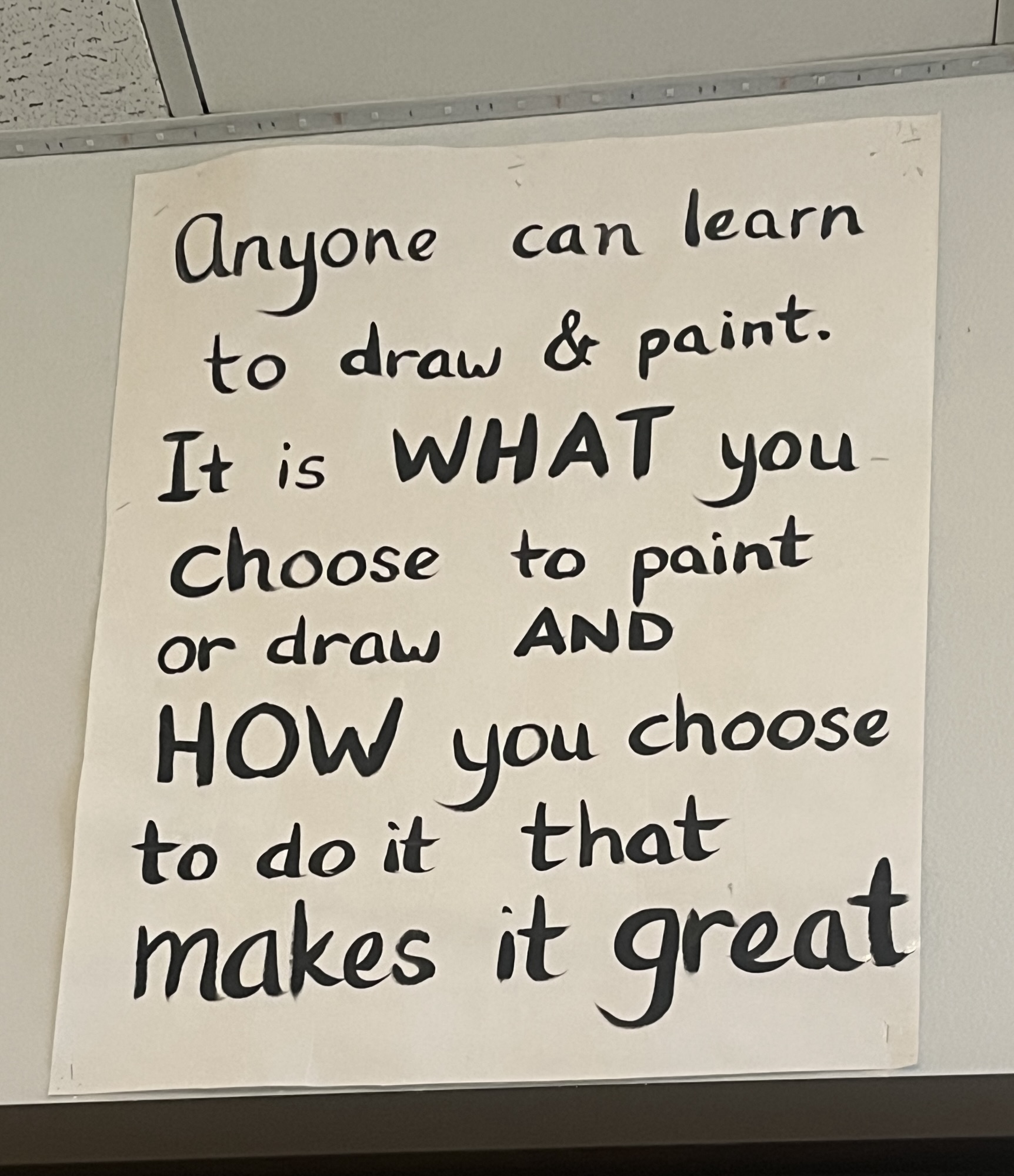
Gabriel talked about an art teacher he had who said that “technical skill is extremely overrated. And she had visited a school that prioritized the technical ability versus teaching the students creativity. And while their paintings were very technically well done, they were super dead, boring, not inspiring whatsoever.” He goes on to say that he thinks we put technical ability on a pedestal way too much, and that there isn’t enough credit to the creativity. Skill is still important, but it is a means to show that creativity.

I couldn’t agree more. There are times when I go to conferences and see “award winning” art, or I scroll through Facebook looking at other high school programs and I feel a sense of insecurity. I begin to question if I am doing a disservice to my students by focusing on the process, on creativity, and on what they have to say over spending day in and day out just learning and practicing technical skills and realism. But then I pause and picture in my mind’s eye the work my students are producing. Some of my students are very skilled. Others still have ways to go on their journey. But their work is so expressive. It has life. You can tell they explored new things. You can see the energy in their marks. I think of their faces and conversations when they are in our classroom studios creating, and it fills me with joy. I watch them push themselves to be better than the day before.

It’s not that I don’t teach skill. It’s not that I don’t encourage practice to make better. I do those things. I just don’t preach that it’s the pinnacle of art making. I teach new skills for my students to have in their tool boxes. We practice technical skills every time we make in the art room. It’s just that I put the onus on my students to choose which technical skills they want to practice to get better at. There are so many mediums and techniques that I can’t teach them all, and I am not going to choose which ones are more important than others to focus on. I will let my students decide what is important to them. I let them guide me when it’s time to explore new mediums and techniques.

In the end, I am not saying that those classes that focus on technical skill are wrong. If that is what you want your focus to be, then that’s your prerogative. What I am saying is that I am proud of my students and the work they create. I am proud of my program. They are proud of their work and their growth! Personally, I would rather have my students make work that carries their feelings and emotions out to the world, than a bunch of pretty pictures that are technically well done.

Restoration of a Practice

Standard

As we enter the third week of the new semester, I thought I would update on my “restoration” of the school year. (Confused? See this post for some clarity.) I know it has been a short time, but I am starting to really feel like I am getting a hold of the school year. Maybe I should say it’s been a long time. I mean, it is January, and we’ve been in school for about 4 months already.

img_20200123_183235_2816965594421370195777.jpg       img_20200122_110002_4556652781830567087963.jpgI came into this semester in a different frame of mind. I realized in December that I needed to change what was happening in my art studio, what was happening with my students. I felt they weren’t getting the best out of our TAB studio. And, I knew it wasn’t really them, but it was me. I was doing what felt right last school year…what worked for last year’s students. I was doing what I thought I should be doing. I wasn’t really seeing what my kids were missing.

So, over winter break I sat down with notebooks and made lots of notes. I figured out what my students were needing, and got to planning.

20200124_0857018934901901214536620.jpg

We started off with an exploration of the human face. It was very teacher-led, but it was a good way to start off the new semester. It got them engaged because teens love drawing eyes and lips. It helped to build their skills, and it was a nice ease back into art after 2+ weeks of sitting around.

But, it was what I decided to do after that I think is really making the difference. In art 1, we had been working through “The 9”, packets designed by Ian Sands that offer a lot of choice, but on a more basic, general subject matter (landscape, nature, architecture, etc.) These have been helpful, but I felt my art 1 students

20200124_0856444252853371711185527.jpg

needed more. At one point in my TAB journey, we worked with themes. I felt it was time to incorporate themes again. What I ultimately decided was that students would have a choice of a new packet (this time portraits due to the exploration we did), any previous packet we have visited this year, and a theme. And, so far, so good. Students are much more engaged with the larger choice, and because everyone isn’t doing the same packet, there is much more delving into the ATP (Artistic Thinking Process). Also, the required student-teacher meeting between development and creation has really helped them as well.

I20200116_1003544689872620955959336.jpg am finally fully engaged this school year, and all it took was some deep reflection and a few tweaks to restore my passion for TAB and teaching.

“What’s So TAB…?”

Standard

I often see people asking questions along the lines of “What’s so great about TAB?” Sometimes the question is sarcastic. Other times, you can catch the wif of a true curiosity. Someone who really wants to know why so many have made the switch to this philosophy of “asking what it is that artists do”, and of “believing students are the artists and the classroom is their studio”.

This post is for you…all of you. Both the sarcastic, who *think* they don’t want to know, AND the curious, who *know* they want to know.

There are many things that make Teaching For Artistic Behavior (TAB) great. Many of the reasons are common among TAB teachers, but just as each TAB studio is different, each TAB teacher has her/his top reason for it’s greatness.

Let’s get to it.

  • It’s budget friendly. Whether you have a large budget or a almost non-existent one, since you don’t need class sets of everything anymore, it allows for a wider range of materials and tools.
  • It’s a relationship builder. Because each student is working on a more “independent’ style artwork, you can find out more about each student. Because they are adding more of themselves into each artwork, and because you aren’t policing step by step instructions, you can spend more time talking with them.
  • Deeper Thinking and Connections. I’ve found that when I’ve asked my students to plan the artwork, from the beginning, even with a theme, (instead of me designing the whole unit) my students have gone deeper into the meat of their artwork, and the connections between ideas, themselves and their art have increased ten fold.
  • More Exploration. Letting students decide what medium(s) they want to use and how they want to use them is a game changer in creativity. Students are continually asking me, “what if I?” or “what happens when?” it leads to discovery and conversation and wonderfulness.
  • Differentiation. This one is a big one. Because a TAB teacher is not expecting a student’s work to look like an example, and because we are looking at the underlying aspects of art making (the artistic process, choice making, problem solving, skill building, etc.), it is much easier to meet students where they are, and to help them achieve goals that are suited to them, and not everyone else.
  • A Philosophy, not a Curriculum. TAB is a way of thinking about art education. It’s not a curriculum you can buy on TPT. There are no set lesson plans, no explicit rules to be followed. This allows TAB teachers to be flexible in what they teach and how they convey it to students. It allows for campus and district expectations to be met. It allows for a teachers’ level of comfort when it comes to giving up “control” to the students. It gives teachers flexibility when deciding to follow state or national standards. And it allows for more time to focus on the behaviors of artists instead of only exploring every medium that can be fit in during a school year.

It is that last bullet point that is my top reason for what makes TAB so great. TAB has allowed for so many deep, meaningful things to happen with my students. I’ve seen so much growth and connection making since I changed to TAB. Once I realized it wasn’t about me, but about them, and I changed the way I taught to reflect that…

I have never worked harder as a art teacher than I have as a TAB teacher. Yes, physically I did more work when I taught in a more traditional manner, but I wasn’t as happy. Now, the hard work comes mentally–reflecting on what my students need (which changes year to year, and even from semester to semester), reflecting on my teaching practices, reflecting on myself as an artist and a member of my school community, and how I can bring those things into what I am teaching. It’s draining, but so worth it and fulfilling.

If you are a TAB teacher, what is your top reason for why it’s so great? If you are not, what is stopping you from really checking it out?

The Power of One Challenge

Standard

I had hit a slump.  There were 2 packets of “The 9” left to complete for the year, but I wasn’t feeling either one of them.  I considered doing a watercolor exploration, but then decided my art 1 students really didn’t need anymore media explorations at this point in the year.  So, I did what any TAB teacher would do, I asked my TAB colleagues for suggestions.  It was there that I decided I would create a challenge based on Phil Hansen’s Ted Talk, “Embrace the Shake“.  Thus, the Power of One Challenge was born.

We started the challenge by watching the Ted Talk.  We had already watched it earlier in the year, but I told them we were going to watch it again as it was very important to what they were about to be asked to do.  Next, I gave them the run-down of the challenge.

Screen Shot 2019-04-19 at 10.44.23 AM

Screen Shot 2019-04-19 at 10.44.35 AM

Screen Shot 2019-04-19 at 10.44.51 AM

I didn’t give much other information.  I told them to think back to the video and the work that Phil Hansen made and HOW he made it.  I gave time for questions, and time for research.  They had a day and a half to look up info needed and to print it out before losing computers.  I limited computers because I have a love/hate relationship with out 1:1 school.  I really wanted them to concentrate on art making without the distraction of games and movies and whatever else it is they do on their laptops.

Some kids got the concept of the challenge right away.  Others took the whole day and half to grasp what was being asked of them.  Once they started, I just sat back and watched them learn, answering questions when asked.  They problem solved.  They were creative.  They all weren’t so original, but that often happens in an art class–one student sees another doing something they feel as cool, so they want to do it too.

I really enjoyed this 2 week challenge.  It gave me time to recoup as a teacher, but was super beneficial to my students.  When I go to do this challenge again, I will change how we present when all is finished.  And, I might change when we do it, and have it be their final exam.

This slideshow requires JavaScript.

Watch through the slideshow to see what each artists “1 thing” was.  I am so proud of these kids.

A Week of Clay Exploration

Standard

I’ve been a TAB teacher now for more than half my teaching career, and even I still struggle sometimes with creating exploration camps for my students that are open enough to give kids a taste of “new” mediums. One of these that I struggle with is clay. I know, I know, I teach ceramics, how could I struggle with this one? Giving students a week and a half to explore a medium that takes practice to understand is hard. I wanted to give them as much freedom as I could, but still limit some things due to practical aspects such as the amount of clay I have and the many students I have.

I had planned just on letting 2 of my 4 classes explore, but then decided I was too lazy to have 2 different explorations going on at the same time. And, I’m glad that I had all of them explore. Out of my almost 100 students, I had 95% engagement all week. I had about 3 kids decide they never want to touch clay again and I had several kids say they are signing up for ceramics next year–kids that I thought would stick with our 2D path. So, bonus for me and my program.

How did I run the exploration camp? I showed 2 quick demos on Monday, pinchpot and coil, with lots of finished examples of pieces created using those methods. Then on Tuesday I showed slab building. We talked about the term vessel, a hollow container, and how I was very open to how they could interpret that term. Then I let them go. They were to build a vessel of their choosing with any hand-building technique or combination of them they wanted.

If you have a lot of kids working at once, I would advise creating some damp boxes to help store as the kids work all week. See this post on how to create a damp box. It was a game changer on storage and keeping 90+ pieces workable all week. And, over a weekend for the handful that needed/wanted more studio time. I had been wanting to make some for my ceramic students, but never had time. This week forced me to make them. So glad I did.

I don’t have many pictures to share this time as we were having so much fun, I got caught up and forgot to pill out my phone.

Working with “The 10”: Ceramics Packet Reflection

Standard

My friend, Ian Sands, developed a system called “the 9“.  They are packets based around the basics of subjects of art that artists create.  It’s not about content, but more about category that art would fall into.  The packets include: the object, architecture, nature, landscape, figure, portrait, imagination, non-representational, and conceptual.  He introduced them to me some time last school year, and I thought they were wonderful.  I’ve been successfully using them with my art 1 students this year.  They are a great introduction to art categories, while allowing my TAB students to make lots of meaningful choices.

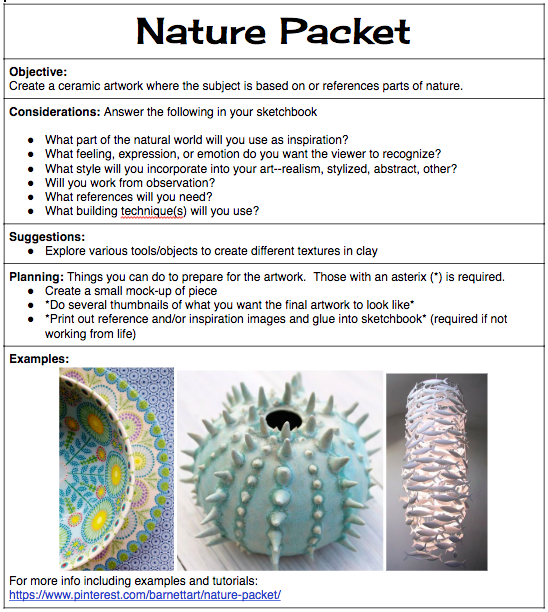
I tested them out last year with one of my classes, and thought that they would be a great tool for working with my ceramics students as they move along their artistic journey.  Sometime last spring, I began planning how to use Ian’s model for my ceramics program.  I began researching and decided that for the most part, ceramics artists’ works fall into most of the same categories.  But, I discovered that there are 10 categories, instead of 9.  They include: nature, animal, architecture, “figure”-ative, functionality, imagination, non-representation, portraiture, the object, and conceptual/installation.

Following Ian’s template, I created consideration questions for each packet, changed up the suggestions and geared the planning around requirements I have for my students.  I am very happy with the development of my packets.

Now, here’s where I am dissatisfied with “The 10”.  I rolled them out in a way that I find isn’t working the way I hoped.  I thought it would make my students more independent, so I introduced it with my intermediate and advanced students.  (They meet at the same time.)  I think this was my mistake.  I should have used it with my beginners after we completed the “have-to” portion of our class.  Seeing how my art 1 students are growing using “The 9”, helped me to see this.  Currently with my beginners, we do ceramic artistic behavior units right after finishing our “have to” section.  We just began our first unit, Ceramic Artists are Inspired by Nature, but I think that after this unit, we will pass out sketchbooks and move onto the next packet.  Nature is one of the packets after all.  We will continue through the rest of the year going through packets, picking up next fall with where we left off.  Then we will dive into deeper meaning with Ceramic Artistic Behavior units.

I will continue with my upper ceramic students in the way we are working. With the exception of one student, they are all seniors, and I’m not too worried about it.  They are working and learning and growing.

They say it takes 3 years to really build up a program.  Like I previously stated, this is the 5th year of the program.  I’ve been playing around with it, trying new things each year to replace things that weren’t working.  I feel I finally have a great grasp on the program and the progression it should take to truly have my students behaving and thinking like artists.  The timing of “The 10” was the final piece of the puzzle that finally fell into place.


Screen Shot 2018-11-01 at 9.05.55 AM

Example of “The 10: Nature Packet”


The 2017-18 School Year in Review

Standard

Another school year has come to a close.  That makes 11 for me.  The 2017-18 school year was a good year for me.  I had a couple of bumps in the road–that one student who felt she no longer needed to be here (luckily she is still here ♥) and the whole grading issue with me not being in compliance.  Overall, it was a fun and happy year.  So, without further ado, let’s take a look back and see what went down.

⇒ I entered 3 students this year into Scholastic Art and Writing.  We didn’t get any awards or even mentions, but I am proud that I was able to enter the work of these 3 young women.  I think we were robbed, but life goes on, right.

⇒ I was honored when Diane Jacquith and Kathy Douglas asked me to have a small part in the 2nd edition of their book, Engaging Learners Through Artmaking.  I speak of how I include current artists in my curriculum through an activity called Artist Monday.  Students watch a short video and then answer some questions about the artist and what they create.  Artists are always current, and many create art in ways that go beyond the traditional ways my students know about art making.

⇒I took my upper ceramic students on a field trip…on a Saturday!  It was so much fun.  We went to the Texas Clay Festival in Gruene, TX.  My students got to see a woman who was burnishing a pot and talking about terra sigillata.  They saw a variety of artists and got to see what people would be willing to pay for ceramics.  And, they got to watch a raku firing.  I am so glad that we went.  The fact that they were willing to give up a Saturday to go on a field trip was tremendous.  I hope to make this a yearly activity.

Seattle 2018.  This year’s NAEA conference was in Seattle.  I was lucky to be able to present not once, but twice at this year’s conference.  And bonus for me, both were with my very good friend and amazing TAB teacher, Elizabeth Honeysett.  We presented on Single Media and the TAB Classroom.  Liz talked about her jewelry classes and I talked about my ceramics classes.  We also did a ticketed event–The Secondary Choice Demo Room.  This was extra fun for me because I got to see adults make art.   Seattle was a blast.

FB_IMG_1522036718517.jpg

Restorative Discipline was brought into my school in the 2016-17 school year.  Each year they train a small amount of teachers.  I was lucky to be asked to be part of the 2017-18 cohort (cohort 2).  I really like restorative discipline because it focuses on relationships and community building.  It stresses being proactive instead of being reactive.  It was a great fit for me because I am all about relationships and community in my classroom.  We had many trainings throughout the year, which kept me always reflecting on my teaching.  I reflect anyways, but the reflections from the RD perspective made me think about things I sometimes gloss over.

⇒ RD brought the academic circle into my teaching practice.  In RD, there are many types of circle activities you can do with your students and the academic circle is one I really liked.  I utilized it in my ceramics classes.  There had been a disconnect between what my students researched on a artistic behavior and the art making that went along with it.  The academic circle filled the gap.  It allowed me to check what my students learned on their own. It allowed my students to share and connect with each other.  It allowed for questions.  It allowed for students to see ceramic art their peers were drawn to.  And, it helped to clarify the big idea for the students before they moved to the creation of their work.

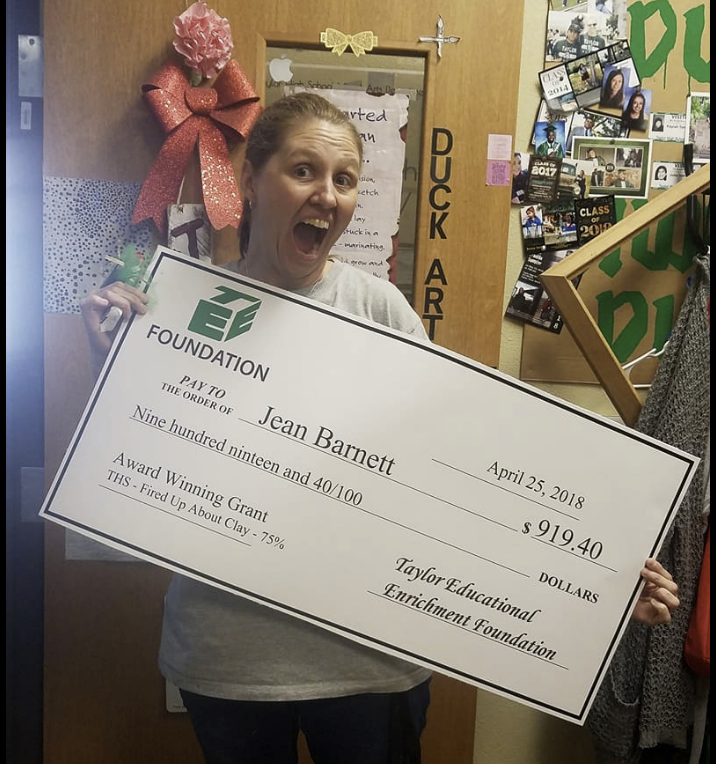
⇒ I applied for a grant and was award it!  In our community, there is a Screen Shot 2018-05-27 at 11.42.27 AMfoundation called the Taylor Educational Enrichment Foundation (TEE) that offers thousands of dollars in grants annually.  I finally got the courage to write a grant proposal for a raku kiln kit.  When the day finallyarrived when we would find out who would be awarded, I’ll admit, I was nervous.  I heard the band and the cheerleaders coming down the hall.  I kept hoping they were coming to me and not going to walk on by.  My principal ducked his head into my office and told me to come out into the hallway.  I was so excited.  I was dancing around my classroom.  I have since ordered and received the kit and I can’t wait to set it up and teach my students how to raku this fall.

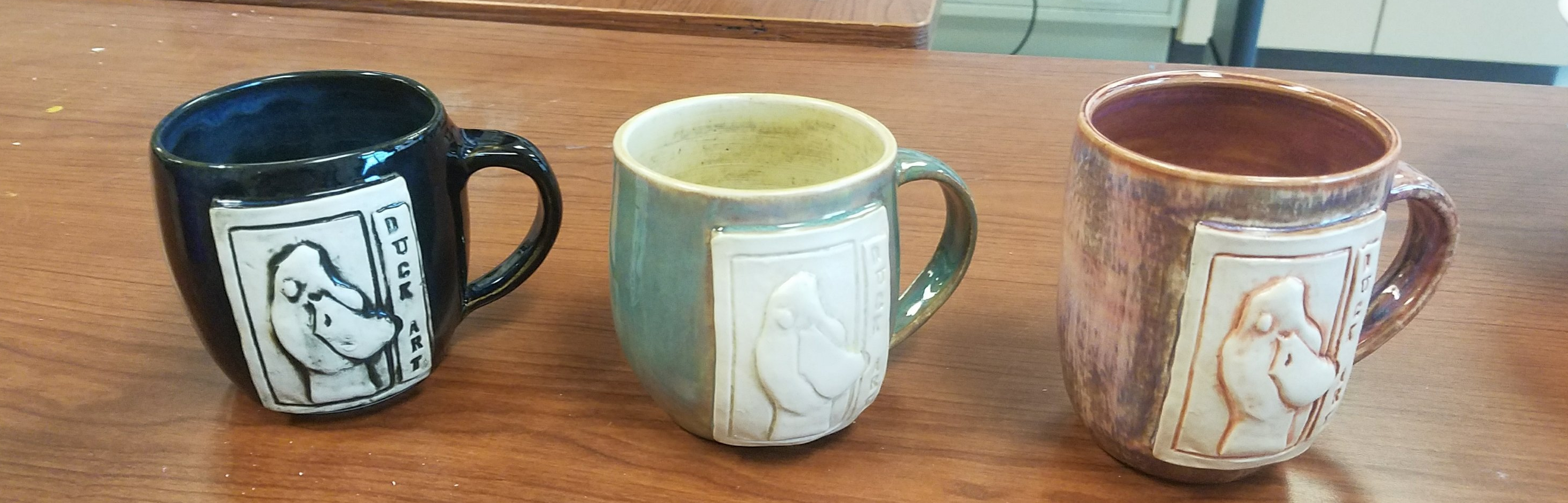
⇒For a few years, I make and gift some special seniors a piece of “Duck Art” pottery.  It started when some seniors bugged the crap out of me for cereal bowls.  So, as an end of year gift, I made bowls and gave them each one.  On the inside of the bowl, there was a duck.  The next year the seniors weren’t into cereal so much as they were coffee.  So, the image was transferred to a mug.  Each year, the duck image changed, but the sentiment was the same.  I made X# of mugs–all similar in shape, color, and image–and handed them out to the lucky ones I had forged relationships with.  This year, I wanted something different.  I really don’t like being a production potter.  I don’t like making the same thing over and over.  I decided to make each mug different and glaze each mug different.  The only thing that was my thru-line was the Duck Art medallion I made.  I made a sprig, which was a good lesson for the students, and went from there.  At the end, the students got to pick which mug they wanted according to their tastes and what fit well in their hands.  This has become the new and final senior Duck Art Mug.


20180521_1245161636134650.jpg

The Duck Art Mug!!

20180430_0817051451780997.jpg

The lefties

Those are really the bigs things that happened this year.  Like I said, it was a good year.  I made some stronger relationships with both students and colleagues.  I am sad that my ceramics seniors are gone.  They were a great group of kids.  But, I am excited for those returning next year.  I learned a lot about my teaching and how I want to move forward.  I really understand the end goal I have for my students–both those that will be with me for a year and those that will continue on.  I have worked hard (and continue to) on how to help my students meet those goals.  I have much in store for next year…I hope to implement “the 9”, courtesy of Ian Sands, with my art 1 class.  I have taken the 9 and created my own version–“the 10”–which is geared for my upper ceramics kiddos.  And, our principal decided to split the AP Studio art program between my co-worker and myself…so that will be interesting.  I am happy with my 11th year, and I look forward to another fun-filled TAB-tastic year in the Duck Art Studio.  But, until then, I will relax and enjoy my summer.

Artists Tackle Social Issues

Standard

I have been wanting to have my art 2 students take their work to a deeper level–to really bring in their voices.  Don’t get me wrong, I have a couple of students that already do, but most still create artworks that haven’t quite broken the surface.  I’ve tried doing a unit on stereotypes before, but it seems that I get the usual suspects.  So, this year, I decided it was the year to “bring it on”, so to speak.  I decided to challenge my students with the tackling of social issues.

They first started by defining some “common” words… opinion, social issue, society, commentary, and parody.  I also asked them to consider why an artist would want to us social issues in their work.  That question seemed to be a hard one for them.  I asked them to watch either a video on Maxwell Rushton and his “Left Out” project or on Favianna Rodriguez, a Latina printmaker, and make connections between the what they watched and our unit idea of using social issues in art.  The final part of their research was to find artworks that used social issues.  And, they couldn’t show any that I showed them for our intro to the unit.

To help my students get warmed up for creating their own artwork, I gave them a challenge.  They had 2 choices.  Choice one: talk to 5 different people about some “hot topic issues” of today, and create a sketch of a possible artwork based on their “favorite” opinion.  Choice two: Pick a social issue that is hot today, create a slideshow of at least 5 different artworks around that issue (on either side), and present to the class.

These girls gave me permission to share the links to their slideshows.  I think they did some great work.

Gender Inequality

Islamophobia

The best part for me about this unit was how invested in their artwork the kids became.  I didn’t have to prod the kids to get going.  They quickly had a social issue they wanted to talk about and set off creating.  I am so impressed with their work, and their voices.

2016-17 Year in Review

Standard

It’s that time.  Another school year has come to an end.  And, in honor of me finishing out my 10th year, I will count down the 10 biggest things that happened this year.   Not everything that happened this year was good.  In fact, it was kind of a crappy year.  But, I did learn a lot and made some great relationships with me students.  So, without anymore drivel from me, let’s do this.

10. UNITY:  I will admit, I saw the Unity Project video on Facebook, and I was in.  I emailed my principal and he was all in.  I created a gofundme project for it and through the kindness of others, the project was funded quickly and I was able to go shopping for materials.  It was a great way to kick off the year.  I had so much support from other teachers and our student body.  While there was a few hiccups along the way (one being when a students thought he could climb on a pvc pole and he broke it), in the end, it was an amazing installation.

9. THE PURPLE HOODIE: I had a tough student this year.  He was hard to reach.  He didn’t talk much, and he often had his purple hoodie pulled up over his head.  I started the year off by giving him some space, and by asking his monitor teacher for some strategies with him.  It took a while, but we built a relationship.  He spent much of his time during his class in my office, but he would do the work I asked him to do.  And believe me, he did not like making or talking about art.  After a while, he would come in during lunch to hang out and chat.  He did this at other times as well.  We built a relationship where I could be honest with him and give him a fair dose of snark and it was all okay.

There was this one day that was bittersweet.  It both made me sad and touched my heart at the same time.  He came into my office one morning during tutorials, but there were already like 6 other kids in my office.  I said hi, and he looked at me, but then left as quickly as he came in.  I sensed something was off.  I figured I would ask him later that day.  He didn’t show up to class.  When he returned the next day, he told me where he was…talking to some people in the office.  When he told me why, I was saddened.  I won’t go into details about why.  And I know this is weird, but it touched me that I was the 2nd person he came to find to talk with him.  The first wasn’t in her office, so he came to me. I care very much about this young man.  And, I am glad I gained his trust.  Sadly, he has moved to another city with his father.  But, rumor has it, he will be back next year. Relationships can sometimes matter more than art making.

8. ESCALATION: I have a co-worker that has been teaching with me for the past 10 years.  We get along on the surface, but when you look closely, you will notice we couldn’t be more different.  For starters, we teach on complete different ends of the art spectrum…he’s dbae and I’m TAB.  We don’t play well together and it has been building up for years.  I finally got up the courage to talk to an admin about the situation; I went in with the intention of seeking advice in how to make our department better and how to work with him.  It was suggested that we circle up, a restorative discipline term.  Basically, it was like mediation.  He basically refused, and one day it escalated between us in my classroom.  Luckily, I was on conference and I held my cool. We still haven’t worked things out, and I have been told our head principal will eventually talk with us, but I’m not holding my breath.

Why am I adding this?  Well, this was a big event that happened this year.  I think it needed to happen.  I would have liked to go to mediation, but I am mostly okay with the outcome.  The fact that I spoke up and I was honest about my feelings and that I took ownership that I wasn’t innocent in any of it was big for me.  I don’t like confrontation, nor to like to create waves in my workplace.

7. SCHOLASTIC ART: This year, I finally got up the nerve to enter my students work in the Scholastic Art contest.  I was so nervous.  I see the potential and awesomeness in my students’ works, but do others.  My kids don’t make “normal” pieces, and often times it’s not what “they” consider gold seal work–one reason I don’t enter into our state art event.  But, I was told Scholastic was different.  My kids didn’t win anything, and after looking at what did win for my region, I wondered about the judges.  But, that is neither here nor there.  I am so proud of my students for trusting me.  I still think they were shafted because their work was super cool.  I know, I’m biased.  I look forward to next year and entering more student works.

6. DALLASThis year’s Texas Art Ed Assoc held it’s yearly conference in Dallas.  I presented not once, but twice.  I presented once about grading and TAB…it kind of bombed.  I was told it was fine, but I know better.  The other presentation was a overview of HS TAB.  It went really well.  Beyond the presentations, I participated in my first live twitter chat, got to have great burgers and beer with a friend who I met in Chicago at NAEA16, I met the terraforma cards guys, and I got to throw some bowls for a local empty bowls event.  It was a pretty fun time, I must admit.  It was a much needed and much appreciated work-cation.

img_20161117_153704.jpg

5. THE BIG APPLE NAEA17 was held in my old stomping ground…NYC!  There was no way I was going to miss a chance to go “home”.  I don’t even know where to begin.  I got to room with 2 of my favorite TAB ladies.  I got to finally meet and hangout with Melissa Purtee.  I stayed in a hotel in midtown.  I lived in Queens, so the hotel stay was new and so cool.  I got to go to the MOMA, which is in a completely different location from the last time I went there…over 20 years ago.  I had a fabulous dinner with other TABbers, provided by my fabulous mentors, Diane and Kathy.  Times Square had become something I couldn’t believe…so bright and shiny.  And, I got to have a reunion with one of my closest friends from college.

4. 4th Annual THS Art Show:  Six years into my time at THS I asked if we could have a high school art show.  Up until that point, there wasn’t any.  This year marks the 4th year that I have put up a show that celebrates all art made at our school.  I don’t just show off my students and my co-worker’s students.  We include any other elective where art is created–welding, fashion, photography, floral design, culinary, and we include our teachers.  It is a lot of work, but in the end, it is so worth it.  This year I was worried that it wouldn’t go off well.  (See the escalation paragraph above.)  But, I put that aside and just focused on the art.  I think it was a great turn out.  Students sold their work, and not just to their parents.  The rain stayed away (every year it rains at the beginning of the show) during the show itself; I do believe it rained earlier in the day though.  I found a better way of hanging the paintings, almost none fell down this year…the rain always brings the humidity and that doesn’t play nice with how we used to hang out artworks. Granted no one from central office showed up, even though they were sent formal invitations, but I’ve come to expect that.  And quite frankly, those who are important, like parents, friends, teachers, and the community, showed up in support.  I look forward to celebrating our students again for years to come.

art show poster (1)

3. A SMILE LIKE I’VE NEVER SEEN: Art is a funny yet fabulous thing.  It can grab hold of the most unlikely and unexpected people.  This year I was lucky enough to witness this.  I watched a student finish a project early and ask me if I could show him how to use the wheel.  We weren’t slated to use the wheel for months, but who am I to stop a student from learning to art.  That week, I knew art had put her hooks in him.  Over the next few months, I watched him grow, and learn, and create.  I watched him create bowl after bowl, vase after vase, each time honing his skills, and using every ounce of clay we had.  But, it was more than that.  I saw the passion for what he was doing rise in him.  I saw a smile, and a light in his face when we talked about ceramics and his work.  I am so glad that he decided to sign up for beginning ceramics.  If only he found it before his senior year.

2. RESTORATIVE DISCIPLINE: Our school started to implement a new behavior management system.  It is called restorative discipline, and for the most part, it is meant to be proactive instead of reactive.  It is not something that the entire campus learns at one time.  It is done in stages.  I know that seems odd, but after learning about it, it makes sense.  I was lucky enough to have been asked to be in cohort #2, which began it’s training 2 weeks before school ended.  It is so much about community and building relationships…which is right up my alley, and why I was asked to be in the 2nd cohort.  I personally think it was cool to be asked knowing why they asked me.  (Some were asked because they thought that teacher was lacking in that area.)  Anyway, so far, so good.

But, more than being part of the next cohort, I did participate in a couple of tier 2 circles this year…these are reactive, but they can make such a difference.  I had one student who I kept butted heads with, and if she kept it up, we knew she was headed to our alternative center.  We circled up and we both spoke our piece and listened to the other person.  We made a contract and tried to implement it.  We hit a bump and had to re-circle.  But, that time worked.  We now have an amazing relationship, and don’t tell her, but I will miss having her in class next year.

1. NO MORE THEMES: This year I dropped the themes for my art 1 and art 2 classes.  I instead went with artistic behaviors for major units.  We worked our way through: artists solve problems, artists communicate, artists, observe, artists steal, artists represent, artists abstract/don’t represent, and artists work in a series.  This was a major step forward for me and my students in our TAB studio.  I think it really was more meaningful to them to really understand what artists do.  It really made a huge difference, the switch that is.  I could see it in their work; I could see it in their exploration; I could see it in their understanding of art making; and I could see it in their growth.  And, at the end of the year, I had the least amount of work left behind I have had since making the leap to TAB.

IMAG1038_1

It has been a very interesting decade of art teaching for me.  I have changed so much.  My teaching has changed so much.  I like to think it’s all for the better.  I keep learning new things, about art, about teaching, about students, and most importantly, about myself.  I often wonder what is going to happen next, which is something that keeps me interested and wanting to go to work every day.   What obstacles will I face and will I overcome them?  What new things will I learn?  What new things can I teach someone?  What new relationships will I make?   What new surprises will I find?  I think it’s this last one that I really enjoy because I love being surprised by what my students do and learn and create and tell me.  It is what makes it all worth it.