Category Archives: Uncategorized

Skill vs Creativity

Standard

As a teacher that has embraced the Teaching for Artistic Behavior (TAB) philosophy for almost a decade and a half, I still find myself struggling sometimes with with debate around skill and its importance. I know it’s important for artists to have technical skills and for them to continue building those skills. Buuuutttt…. should that be the most important thing in the high school art room (or any art room for that matter?)

I was doom scrolling the other day, and I came across this reel in my IG feed and I finally felt a little bit of validation. The artist talked about an art teacher he had that pretty much said what I had felt in my art heart all these years.

Gabriel talked about an art teacher he had who said that “technical skill is extremely overrated. And she had visited a school that prioritized the technical ability versus teaching the students creativity. And while their paintings were very technically well done, they were super dead, boring, not inspiring whatsoever.” He goes on to say that he thinks we put technical ability on a pedestal way too much, and that there isn’t enough credit to the creativity. Skill is still important, but it is a means to show that creativity.

I couldn’t agree more. There are times when I go to conferences and see “award winning” art, or I scroll through Facebook looking at other high school programs and I feel a sense of insecurity. I begin to question if I am doing a disservice to my students by focusing on the process, on creativity, and on what they have to say over spending day in and day out just learning and practicing technical skills and realism. But then I pause and picture in my mind’s eye the work my students are producing. Some of my students are very skilled. Others still have ways to go on their journey. But their work is so expressive. It has life. You can tell they explored new things. You can see the energy in their marks. I think of their faces and conversations when they are in our classroom studios creating, and it fills me with joy. I watch them push themselves to be better than the day before.

It’s not that I don’t teach skill. It’s not that I don’t encourage practice to make better. I do those things. I just don’t preach that it’s the pinnacle of art making. I teach new skills for my students to have in their tool boxes. We practice technical skills every time we make in the art room. It’s just that I put the onus on my students to choose which technical skills they want to practice to get better at. There are so many mediums and techniques that I can’t teach them all, and I am not going to choose which ones are more important than others to focus on. I will let my students decide what is important to them. I let them guide me when it’s time to explore new mediums and techniques.

In the end, I am not saying that those classes that focus on technical skill are wrong. If that is what you want your focus to be, then that’s your prerogative. What I am saying is that I am proud of my students and the work they create. I am proud of my program. They are proud of their work and their growth! Personally, I would rather have my students make work that carries their feelings and emotions out to the world, than a bunch of pretty pictures that are technically well done.

Goal Setting

Standard

School’s been in session for just a month now, so of course that means it’s time for me to decide on my yearly goal for my T-Tess. That’s the evaluation system my district in Texas uses. While I’m not sure that the system in general has helped me as a teacher, I did decide to actually take my goal seriously this year.

In the past, I wrote goals that seemed easy to achieve and collect data on so that I could easily check that box off and spend most of my time focusing on the fun part of my job. When we had to work on our goal during our PD earlier this month, I started off with the same attitude and just copied a goal from about 5-6 years ago. But as the month went on and I thought about it, something in my brain switched and I began to take the goal seriously and really figure out ways to help me learn from my goal.

This year’s goal falls under the professionalism domain, as I am going to work on reflecting on my practice. I normally reflect on my practice throughout the year. I make notes. I think about what worked, what didn’t work, and changes I can make. But after 17 years, I think that’s not enough.

I know they say if it’s not broke, don’t fix it. Somehow, that doesn’t seem to apply this year. This year has come with some changes that I didn’t anticipate, and I am struggling with finding my place in our system this year. I know I have been a strong and effective teacher for years, but something feels different this year. I feel I’ve been focusing so much on being a great TAB teacher and being true to the philosophy that I believe in so much, that I’m missing something else. I am hoping to figure what that is.

I have been working on gathering some strategies to really help me reflect on the different facets of being a TAB teacher. I hope to write more reflective posts this year, not just ones that give advice on technique or incorporating TAB. I really want to look closely at how I deliver information, at how I am communicating to students and colleagues, at how I scaffolding the important concepts as I lead my students towards understanding the artistic thinking process and ultimately independent thinking. I plan on watching other teachers teach, from a variety of disciplines. I am essentially an island, in more ways than the obvious. I think seeing how others approach their classrooms can shine many lights on what I do and choose not to do. I have contacted several teachers that I respect and asked if I could come and observe them. I received much enthusiasm and am excited to start. I will go to my first observation next week. I am pretty excited about it.

How do you choose your yearly goals? Is it part of your evaluation process? Do you take it seriously or do you do it to check the boxes? I have just written goals in the past that easily allowed me to look good. But, the longer I teach, I don’t want to get stagnant or stale and just do what has always worked. I am looking forward to learning more about teaching and myself through this process.

Typical Days in the HS TAB Studio

Standard

As we get closer and closer to the start of the year, many people are asking what a typical day in the high school TAB studio/classroom is like. And well, it’s anything but typical. Just kidding. TAB classrooms are just like any other art classroom, just there is more independent thinking happening and less teacher-led projects. But, other than that, it’s pretty normal. We have routines just like any other classroom.

I thought I would create a small post outlining my day and my week as a high school TAB teacher. I see my students daily, all year long. This year we are back up to 50 minute classes. Woo hoo!! I teach Art 1, Art 3, and beginning through advanced Ceramics. Sometimes I teach AP or an Art 4, but those are on case by case bases. Unless it’s AP 3D, then that’s definitely me.

I like to have a routine that my students get used to, so they are comfortable and there’s not huge chaos every day. I have a white board, which when my room is not under construction, the students pass by as they come into class and they are encouraged to read the board so they know what they need to get out.

Mondays start off with either Artist Monday or Style/Movement Monday, for all my classes. We come in, watch a video and then the students answers questions, either in their sketchbooks (art 1) or on a slide deck (everyone else). That generally takes about 15 minutes of class total. After that, we go into one of 2 things, we get back to notes/practice of skills or studio time. Every other Wednesday, in art 1, we have a drawing test. Then, similarly to Mondays, the students pick up where they left off the day before. In my upper classes (art 3 and ceramics 2 & 3), I designate a day (usually every other Friday) for digital portfolio time.

Beyond those few fixed things, I typically don’t like to take much of the time away from arting. Kids will ask me what are we doing, and I say to look at the board. At some point, whether they need their sketchbooks or not, art 1 students will come in and grab it before sitting down. It has become a habit. Sometimes I address the class right at the beginning to do some house keeping, like reminding students of who I still need to go over ideas and development or when the last studio day for a unit is. Other times, I just let them get to work and don’t address the whole class until about 7 minutes left when it’s time to come to a convenient stopping point to begin clean-up.

When we do need to learn new skills (composition, perspective, facial features, etc.), we sit and take notes in our sketchbooks. After there is usually a small assignment in their sketchbooks to practice the new skills. New media explorations take about a week, while other smaller skills assignments take between 2-3 days (notes and practice time together.) When I do demos, where we (students and I) aren’t doing them simultaneously, I try to keep them under 10 minutes. That way, they still have at least a half hour of arting time.

There you have it. The biggest difference in my experience between when I was a more “traditional” teacher and a TAB teacher is that there is much more independent art making and exploring time. I circle the room more and talk to students more. There is not magic secret or formula. This is what feels right for my students and for me. It’s relaxed and safe and successful.

PoTAYto, PoTato, Semantics Sometimes Matter

Standard

I will admit, I am a TAB purest and sometimes I get fired up when it comes to spreading the love for TAB and helping teachers understand the philosophy and ways to implement the intricacies of the philosophy into the classroom. Now, I am a high school teacher, so the way I TAB is not going to be the same as the way an elementary teacher TABs. Heck, it won’t be the same as another high school TAB teacher. But, at the heart of the matter, we all believe the core tenets, the guiding principles if you will, of the philosophy, and we build our programs around them.

One thing that I try to combat when I talk about TAB (Teaching for Artistic Behavior) is the misconceptions about what the pedagogy is and isn’t. About 5 years ago, I wrote this post about TAB vs. Modified TAB. I wanted to revisit the meat of that post–TAB, Modified TAB and some of the in between. Again, TAB is a philosophy, meaning it’s an art eduction belief system and is at the heart of the decisions we make when figuring out how to run our curriculum and classes. The TAB philosophy is guided by 3 sentences:

  • What do Artists Do?
  • The Child is the Artist
  • The Classroom is their Studio

How a teacher runs their classroom and sets up their curriculum to help their students become artists (who think of their own ideas and can do all the things artists do) is called the Methodology. This typically comes in the form of choice. There are many levels to choice and why you would vary them. You can read here about the choice continuum. TAB teachers vary how much, when, and what types of choice dependent upon a variety of things. But, they don’t vary how much or how little they believe in the philosophy.

This is where semantics comes in. When someone says they are doing a “Modified TAB” classroom, I believe what they are really talking about is the level of choice they are offering–maybe opening centers slowly, or limiting materials. They are not talking about the philosophy and their only believing in 1 or 2 of the 3 core tenets. But, this becomes confusing to those just starting out as a TAB teacher or someone trying to learn a new way to continue to teach art so that they love their career again. Wording it this way also makes it seem like a Choice-Based classroom and a TAB classroom are one and the same. I like to tell my students that all thumbs are fingers, but not all fingers are thumbs. I think this 100% applies here. All TAB classrooms are Choice-Based, but not all Choice-Based classrooms are TAB. Sometimes choice-based teachers are still doing a lot of the important decisions of art making, thus not really helping their students to become independent artists. So, the semantics do become important here.

I know that some people may think this is “gate keepery” or elitist, and it probably feeds into the stereotype of TAB teachers thinking they are “better” (which is not something we actually think.) I believe that one thing that makes TAB so wonderful is that the philosophy allows for many implementations. It is differentiation at its best. The goal remains the same for all TAB teachers–creating independent thinking artists. But we realize that every student is different, so how we get them to that point will look different for everybody. Therefore, as we spread the TAB love, let’s be sure to help people new to the philosophy understand the difference between being TAB and running a TAB classroom, and our choice of words does matter when it comes to understanding. In the end, it’s okay to have varying levels of choice, but the belief in all the guiding principles of TAB doesn’t vary.

Open Studio and Evaluation/Grading

Standard

Some things have changed, for the better I think, in my art department. We have finally split the level by teacher instead of both of us teaching all levels. This is better for both the students and for us. It lessens the amount of preps for each of us, and it really makes sure that each student gets similar experiences after art 1, and the best each of us as teachers have to offer. Art students would have my partner for Art 2 and learn/practice lots of technique (that is his strength). Then when they come over to my room for Art 3, we would focus on the Artistic Process, finding their voices, and developing a studio practice. They return to him for Art 4 / AP, with the hopes that the year in my room really helps prepare them for the next level–especially creating a portfolio for AP. (Just as an aside, it did not lessen my preps this year, I have 7–one of which is AP. Such is life in a growing district with less than the ideal number of teachers. But I digress.)

I usually run my Art 3 like an Open Studio, where students follow their own interests in both subject matter and media. This year, I did find that many students do need help with the ATP (specifically ideation), so I brought in themes to help them. In previous years, it really was an open studio, but you have to adjust to the students you have if you want to be an effective teacher. I also use this studio format in my upper ceramics classes–Art 3: Ceramics still has themes where Art 4: Ceramics is fully student-led.

The biggest hurdle I have run into with these classes is how to evaluate my students and ultimately how to turn that into grading. I decided the main things to be evaluated should be the studio practice habits of each student. I evaluate them bi-weekly on their studio practices. It has taken a lot of trial and error to come up with a rubric that I feel works for what I want them to get from their time in my class. Evaluating their studio practices gives the students a lot of leeway on what and how they want to create.

Photo credit K. Douglas & C. Fralick

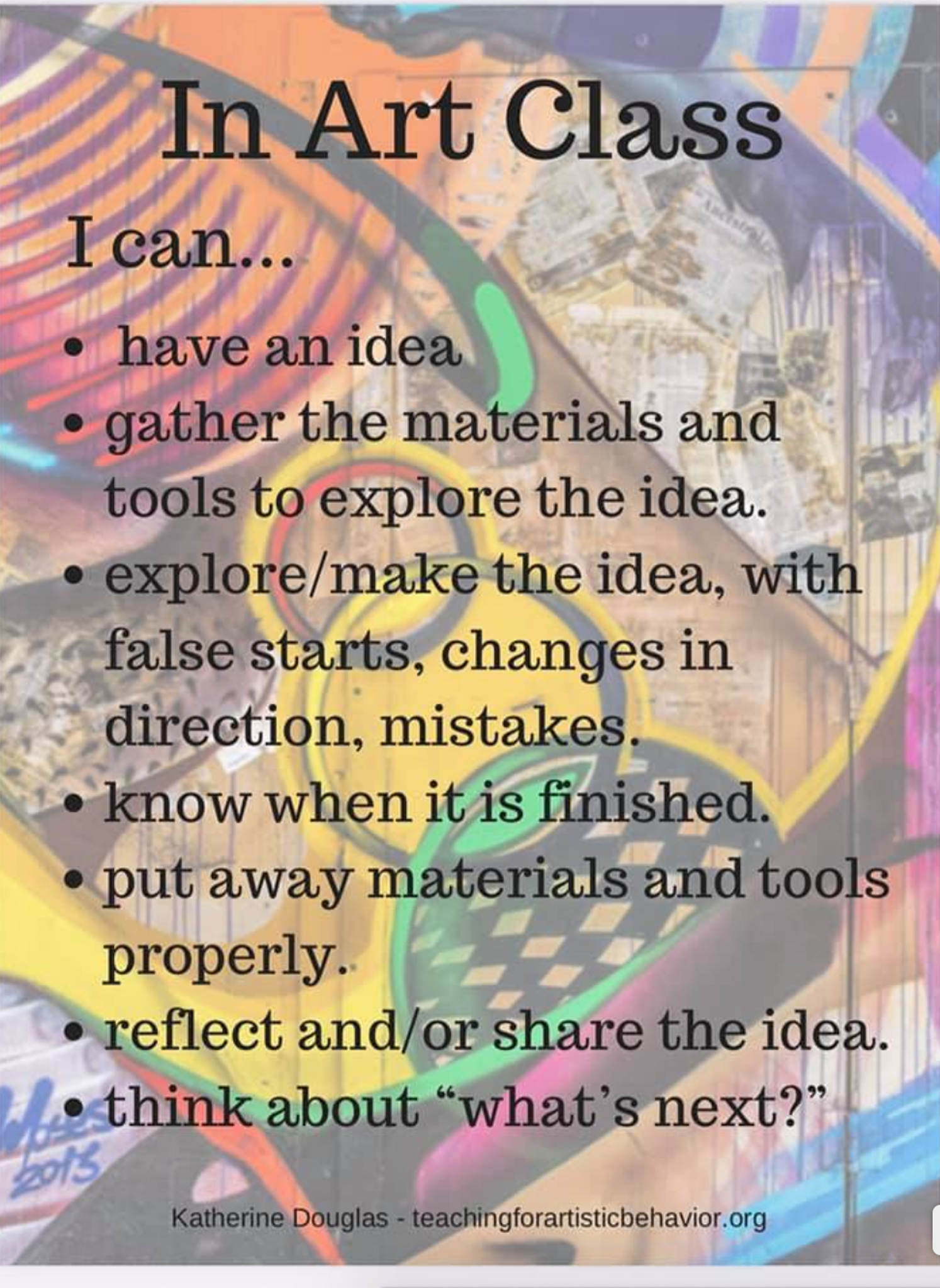
I based my rubric on the 7 Goals of Art Class from Katherine Douglas. I thought that while the goals were created those for elementary students, they apply to any studio practice. I created a rubric that is based on these studio habit goals that are incorporated into the ATP (Artistic Thinking Process) stages. Coming up with a point system was a not so easy task, but I ultimately decided that every habit is equally important. Engagement is the highest because that really reflects their attitudes and productivity during the studio time each week. I use this rubric to determine my bi-weekly major grade for my upper level classes. 

Studio Habits Bi-Weekly Grade

As time goes on and I reflect upon my students and my teaching, I keep tweaking the rubric to be a better reflection of what I hope they are learning and practicing as emerging artists. But so far, this has worked well and I think is an accurate reflection of my students’ studio habits and practices. 

It’s been a while.

Standard

It’s been over a year since I last published anything on this site. It’s not that I didn’t want to because I recall many times where I said to myself, “self, you should really write a new post!” But, I never listened to myself.

A lot has happened in the year and a half that I’ve been silent—good, bad, and sad. I was named Teacher of the Year in 2022. It was a major honor for me to be recognized for the hard work I put in. My favorite principal left to go to another district. (I keep hoping he’ll come back one day soon). A bond passed in my district. While it is very CTE heavy, there is the glimmer because it did include a Visual Arts Expansion. That means we are getting a 3rd art room, and possibly in the future a 3rd art teacher. And I published an article in School Arts.

But, probably the best thing that happened was I was asked to lead the high school cohort at the 2023 TAB Institute at MassArt. It was the first time back in person since the before times. I was shocked and completely honored that Melissa P and Jen R-Z had that much faith in me and my abilities to do it. It was so much fun, and I am pleased to say that the amazing group I worked with agreed to have me back.

I’m not sure there’s really a point to this post. I just wanted to say hi and let you know that I’m gonna try to write some more posts. I think it’s important to share my knowledge and my trials and tribulations of being a high school TAB teacher. While I have a partner, he’s not TAB, and I often feel like an island. I know there’s others of you like me out there, so I hope as I pick up the pen, so to say, to write about my experiences, I can help more people navigate the TAB philosophy and find what fits for you.

2 Philosophies, 1 Program

Standard

I wanted to take a moment to talk about my program. As many of you know, I am a TAB (Teaching for Artistic Behavior) teacher and have been for the majority of my 15-year career. What I am not sure people know is that my partner is not a TAB teacher. Yes, he sometimes gives choices to his students, our students, but for the most part, he is a traditional art teacher who assigns whole-class projects.

We have been working together for 15 years, and it has taken us 14 of those years to finally get our act together and create a program that not only allows cohesiveness for our students, but also allows for each us to teach to our own philosophy and to our strengths.

What does this look like? We were fortunate to have had a principal who trusted us as experts and allowed us to choose which class levels we wanted to teach. We both teach Art 1 classes due to the sheer number of class sections we have. (Texas requires one fine art credit for graduation, and the majority of students pick art as that FA credit.) We split the Art 1 sections as evenly as we can. The experiences for the students in our respective classes is different, but we are okay with that. The students get to know us as teachers and people, they get to learn about our program, they get to make some art, they have fun, and for about half, they get that credit they need so they can move to the pathway they are really interested in.

It’s when the students decide to continue in the art pathway that things really start to make sense for how we have structured the Duck Art Program. We have split the remaining sections of courses by levels between us. My partner teaches all sections of art 2, I teach all art 3, then the seniors return to him for art 4 and AP Studio. He teaches both AP 2D sections. I teach AP 3D, but I am also the ceramics teacher, so that is what makes sense for us.

Splitting the classes this way works to our strengths. He is really good at teaching techniques and materials, so the art 2 students benefit from all having this shared experience where they get to focus on skills and learning new materials. They come to back to me in art 3. We focus more on the ATP (Artistic Thinking Process), studio habits, and creating original art. My class helps them to really consider content and finding what media they like to work with, what types of subjects they like, and what they want to explore. AND they really start to find and develop their voice. So…..when they return to Art 4/AP, they have a well-rounded background and can create amazing art. It was hard in the past to have kids that were all over the map because we taught the same level in totally different styles. I understand that as a TAB teacher, I always meet students where they are, but this isn’t about meeting students at their artistic level, this is about the students have a common base knowledge that allows both teachers to better meet the students needs.

It took us forever to learn to play together, and play together well, but better late than never I say. I am excited for this coming year because we will be able to really see how well this will benefit our students and our program. It was time to stop being an island in a department of 2 and instead come together as 1. It is possible to work with those that don’t follow a TAB philosophy like you do. You just need to check your ego and remember what is really important and the focus of your art program–the students and helping them in their journeys to becoming artists.

Meaningful Grading? An oxymoronic dilemma.

Standard

At the end of the year, I start to think about the next year. I like to have some ideas written down so I can leisurely work out details over the summer so I am ready for the year in August when I return. This coming year, one thing I really want to work on is my grading system. I have been using a “Level of Engagement” system for some years now, but I’ve become disillusioned with it because I feel it is too much like a participation grade and doesn’t really show any sort of progress towards mastery or whatever it is grades are “supposed” to show.

Before I go any further, I want to say that if you are reading this post with the anticipation of some kind of answer to the meaningful grading question, I’m not sure you’re going to find it. In fact, you might end up walking away with more questions. Also, I am writing with high school grading in mind, which is a huge beast that is often wrong in what it represents.

If you Google “purpose of grading in education”, you will find that basically grades are meant to communicate learning progress and achievements. But, as we all know, grades don’t really show that at all…meaning that final number doesn’t actually show progress in learning. Because, if you get a 70 in the first marking period because you are still developing a skill/studio habit, and then you get a 100 in the final marking period because you finally mastered the skill/studio habit, you won’t receive a 100 for the year. Your grade will appear as if you just were average or proficient, even though you did what the point of learning is–you progressed and eventually mastered. Who goes to look at all the grades over the course of the year to see that your grade steadily improved? Only that final number is looked at.

As I have written about in the past, and it has be talked about over and over, grading =/= assessment. And perhaps that is why grading becomes such the dilemma. Should we, under the system we have to use, try to have our grades match our assessments that show actual progress over time, or should we just give out grades for participation? I know this is my dilemma. It’s something I’ve dealt with for years of being a TAB teacher. When I was DBAE, I used rubrics and based grades on students’ artworks having certain elements and principles, depending upon the project, as well as “good” craftsmanship and effort. But now, those things are not as important to me because of the current purpose of my teaching. I am trying to teach my students a way of thinking, a way of behaving, and having a variety of lines in an artwork shouldn’t be up to me, but up to the students. I know that some students will understand the artistic process faster than others. I know that some will demonstrate Studio Habits of Mind easily and others will need more time to develop those habits. I know that all of my student will grow artistically, both in behaviors and skills from where they were when they stepped into the classroom. I know each journey is different. What I don’t know is how to show that in our society’s “beloved” grading hierarchy.

Image credit Katherine Douglas and Clark Fralick

I feel like I am digressing a little here. I was talking about moving on from engagement grading to something more meaningful. I feel like I have figured out what I want to assess my non-first level students on this coming year and beyond. Katherine Douglas shared with me a poster about the things that artists can do in art class. I am in the process of creating an assessment chart for my artists based on this image. I know it was originally meant for elementary, but the behaviors truly span through to any artist at any stage/age. Where I get stuck is the grading part. The chart is easily used as a rubric for assessing students’ artistic thinking processes, but translating that to a numerical grade sucks. There is no other way to say that. I mean, I figured out a point system that makes sense and correlates to emerging, proficient, and mastery levels. But, it does not work well with our antiquated grading system. Their report card just shows some average number that doesn’t accurately show anything meaningful to their learning.

I know that some schools have changed their grading systems, but not mine. And mine isn’t going to change for the foreseeable future. And probably, most schools won’t either. So, in the end, how do we deal with this? How do we use our grading system to truly show growth? I am unsure if it is possible in a system where high school students rely on GPAs for things like scholarships and top % for automatic admission to state schools. Do I just give in and grade on participation, continue with engagement and add in conferences with each student to talk about their growth assessment?

I think this is the hardest part of being a teacher for me. And, the hardest part of being a TAB teacher since I am teaching a way of thinking and not just something that has right/wrong answers. I told you I wasn’t going to make things any clearer in this post. And, I didn’t get any closer to solving my dilemma of how to create a point system for my assessments of artistic growth, thinking, and understanding. But hopefully this post gave you something to think about and discuss. And perhaps, the more we discuss it with each other, the discussion will start to move to those above us teachers that make decisions and we can begin to change the face of education.

I thought I was done, but I think I want to add here that I wrote this post over a week ago, but haven’t published until now because I’ve been going over and over in my head what the purpose of my grading is, and grading in general. At my school, fine arts is a required class to graduate (1 credit worth), but it is not counted towards GPA–something I felt strongly against, but now am not so sure anymore if I want it to count towards GPA. Above you read what Google says the purpose is supposed to be, but that’s not reality. And after reading several posts/conversations this week in both TAB groups and non-TAB groups, the dilemma for me is even worse. I don’t want grades to be punitive. I want my grades to reflect learning and growth, but I can’t figure out a way to where they show growth that isn’t punitive. Assigning lower grade numbers for developing habits/skills and higher grades for mastered skills averages to some number that can seem “negative”. A student that grows over the course of the class should have a 100 for their final grade, right?

TAB: A Philosophy with a Choice Continuum

Standard

Lately, I’ve been seeing the phrase “I’m not full TAB”, or something similar to that.  And to be honest, at first I would kind of roll my eyes and move on. But then as I started to see it more and more, I thought that maybe some people don’t quite know or understand that TAB is a philosophy with a choice continuum. 

What do artists do? You are the artist. This room is your studio.
Signage from Clyde Gaw’s TAB classroom.

Over the years, there have been many conversations about TAB vs modified TAB / “not full TAB”. And, in the end, the same conclusion ensued–there isn’t really modified/not-full TAB. That would infer that not all 3 core tenets are followed when setting up the program. And asking, which one(s) are you leaving out?

What do I mean by that? Well, TAB (Teaching for Artistic Behavior) is a philosophy that follows 3 core tenants. It asks What do artists do? It believes the child is the artist. And it believes the classroom is their studio.  To put it more simply, as Ian Sands would say, it’s about Making Artists.  The end goal should be helping/teaching our students to behave and think like artists. Obviously there is much more to it, I mean there are many books written about it and have been several theses written about TAB as well. But that would be a longer post for a different day.

How you achieve the end goal of “Making Artists” is the methodology.  And that is where the continuum comes in. TAB teachers offer levels of choice for this.  Good TAB teachers will vary the level of choice on a number of factors, including the individual needs of the students is one of those factors. In fact, there may be varying levels of choice within the same class period, and it can fluctuate over time going from more choice to less choice and back again.  TAB is student-centered after all. I wrote another blog post that includes some reasons why you would vary the level of choice. Below is an image that displays the continuum of choice that can be offered, and there is a time for each level, including teacher directed, although that should probably be employed the least in a TAB practice.

continuum of choice chart by Diane Jaquith
Douglas, K. and Jaquith, D., 2018. Engaging Learners Through Artmaking. 2nd ed. New York: Teachers College Press, p.21.

In the end, if you believe in the philosophy and you arrange your program with the goal of making artists/teaching to think and behave like artists, you are a TAB teacher. What you modify is the amount of choice. And that will change as you learn about your student population and their needs, and it will vary from class to class, and student to student. At some point, students will be 100% self-directed, and that’s a beautiful thing.