Category Archives: Students

How Far Can I Push It?

Standard

There’s been a lot of talk lately on all the art related Facebook groups I am a part of.  I mean, it is a subject art teachers discuss a lot, but in the past few weeks the conversation has been longer and more engaging.  We have been discussing grades vs. assessment, participation vs. engagement, eliminating grades all together, how the high school GPA would be affected, is it even possible to not give a grade at the high school level, and much more.  It is enough to make your head explode…and it’s beginning to make mine explode.

Grading and assessment is always on my radar.  I wrote about my assessment model in this post earlier this year.  I even presented on the model at the AOE 2016 Winter Conference stating how we as teachers need to grade less on compliance and instead create meaningful assessment.  So it is easy to understand why all this talk about grading has caused the wheels in my head to go into overdrive.  I began to look closely at what I am currently doing, what it means, and how could I change it?  I wish it was as simple as deciding I won’t grade anymore, but because there are so many facets to all this, it’s not. In this current education model we are in, as a high school teacher with parents that expect grades, colleges that look at GPA to determine a student’s acceptance to their school, a UIL board that requires passing grades to play and compete, and students who are motivated by them, I HAVE to provide a grade.

Currently I give a mixture of completion grades and grades(numbers that are perhaps arbitrarily assigned) that reflect artistic behavior/growth assessments.  I find that the assessment feedback is important to my students and their artistic growth. I want to continue to provide that to them, but I hate that I have to translate that feedback into a numerical grade.  However, the assessments boil down to only doling out a few grades…many less than the amount my district “requires”.  That’s where the completion grades come in.  But, do those grades really show anything other than the fact that a student completed an assignment?

And then all the “WHAT IFS….?” start to walk in.  What if I pushed?  How far could I go? What if I just stopped caring and gave everyone a 100–what would that do to my classes and the “importance” of them?  What if I gave the minimum amount of grades I get away with giving, would I get a stern talking to?  Would all this change the student input/output in my classes?

I don’t have the answers.  I have been creating some sketchnotes to work out my thoughts.  I am on a mission to figure this out before next August when school starts again.  Yes I know that is 7 months away, but this isn’t an easy issue.  Like I said, there are so many facets I have to take into account: district requirements, local admin expectations, parent expectations, student motivation, UIL guidelines, coaches needs, pass to play, meaningful grades, assessment v. completion, and ultimately, what I believe the purpose of the grade in my class should be.  That is the ultimate question that I just can’t answer………….yet.

This slideshow requires JavaScript.

A New Exploration Activity

Standard
A New Exploration Activity

I know it has been over a month and a half since I last wrote, but it’s kind of been the same old, same old in my classroom.  But, as the new year and the new semester began, I have many new ideas and things I am trying out with my students.  And, I am going to start with a new to me way of exploring.  I did an activity similar to what fellow TAB teacher Cynthia Gaub does called Around the Room.  I changed it to Exploration around the room: collage and mixed media.

Art 1 jumped right back in when returning from our winter break.  They had new media and techniques to explore and I wanted them to have a new way to explore them.

So, I lined the counters with some large sheets of paper and place a ton of items out for them to explore with: plexi, excess pieces of laminate, and plastic bags for monoprints, cardboard and styrofoam for printmaking, bubble wrap, flowers, feathers, spools, and a plethora of other items for stamping.

I gave a brief introduction outlining part 1 of our exploration activity and then let them go on their way to create some new textures and backgrounds.  At first some were hesitant, but by day 2, they were comfortable and trying new ways of printing with the different methods and objects.


Once we were done exploring stamping and printmaking, we learned about collage and mixed media.  Students were then challenged to take what they had made during their exploration and to use them in someway…either as the ground for a new artwork to be placed on top or as paper to be cut up and used in a collage.

Once the students finished with their exploration artwork, the students reflected on what they learned through a technique exploration blog post.

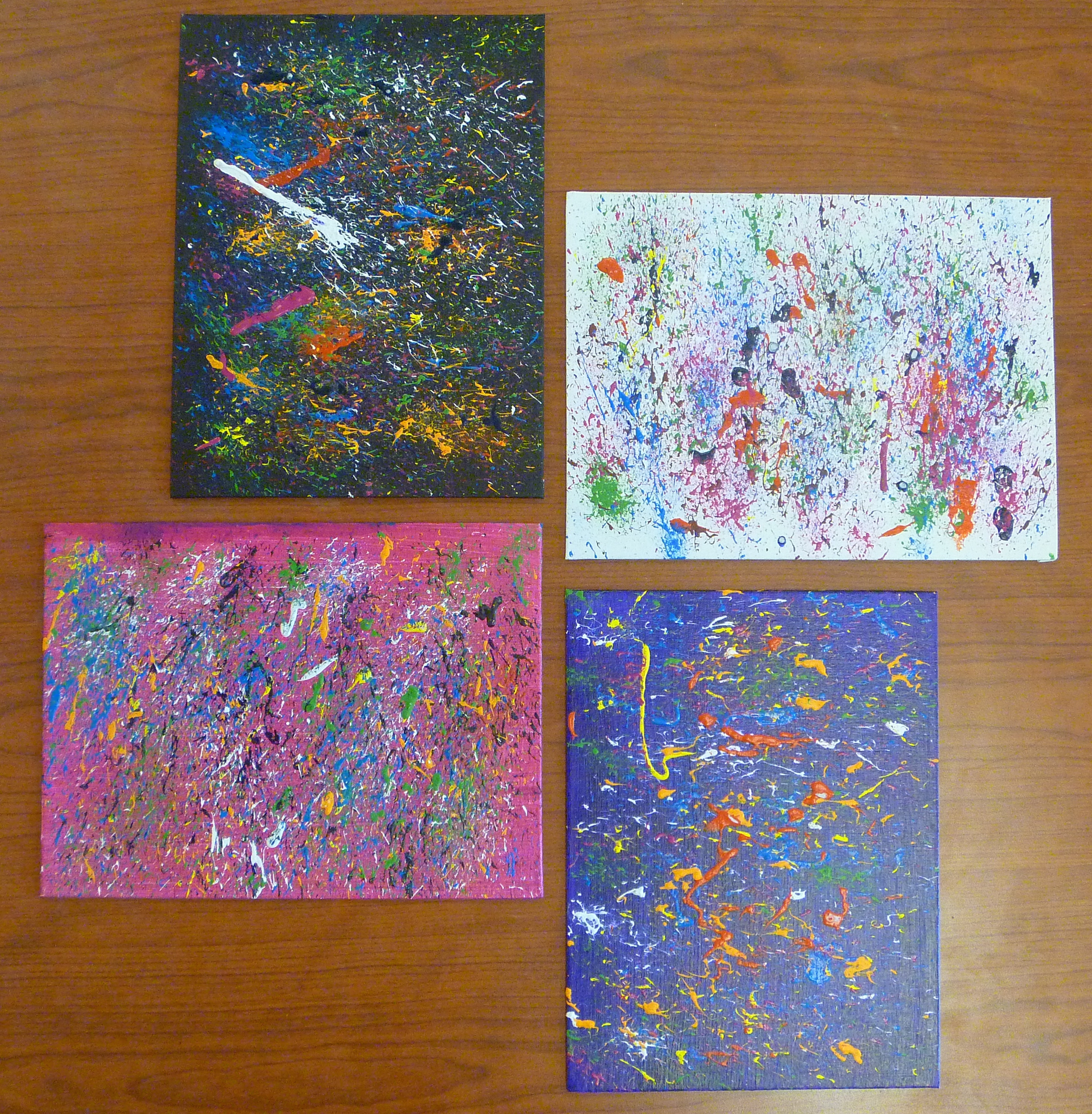
​Here are some of the fabulous practice works the students created.

This slideshow requires JavaScript.

I have a few tweaks to make, but I like this way of exploration.  I want to combine it with the other methods I use.  Not sure how I am going to do that yet, but it will come to me.


Realism, Contests, and Contemporary Art

Standard

This past Saturday, I drove the long 4 hour drive from my house to Galveston to attend TAEA’s (Texas Art Ed Assoc.) 2015 state conference to present about TAB in my classroom for the HS Division Meeting.  It was a long and tiring drive, but I made it on time and rocked my presentation.

After the meeting, I went to a couple of sessions.  I am sad to say I only attended 3 sessions because most of the sessions didn’t really interest me, but that doesn’t mean I didn’t get anything out of the conference.  In fact, I was left with some burning questions regarding what we, we as art teachers, art supporters, administration, and society, deem as “the best of the best” in student art.

If you have ever been to a state conference you know there is a large expo area with vendors peddling their wares to all who pass by.  At TAEA conferences, there is a section of the area where student art is displayed.  In this display are the gold seal winners of the Texas state VASE contest. (Visual Arts Scholastic Event).  As I wandered around the padded display panels and looked over the 2-D art, I began to notice something that started to bother me.  All the winners were “the same”.  They all were highly rendered, realistic looking, self-portraits that were cropped closely and usually had some sense of foreshortening.  There were a few prints and expressive pieces sprinkled in, along with some photographs, but at least 80% were these self-portrait drawings.

A few hours later, after a wonderful keynote from Roy Wooley, I attended one last session before starting the long drive home. This session was about creativity.  Within the first 5 minutes, the presenter, Samuel Thomas, had me hooked.  He brought up something I had been contemplating earlier that day…the highly rendered, realistic portraits that win these contests and their complete difference from what art is being made and shown in galleries today.  Todays artists are pushing the boundaries and thinking in the most abstract ways, bringing in unusual/non-traditional materials to create these thought provoking artworks.

This session left me with more questions. Why do we not see these types of drawings that are winning our contests in galleries?  Why do we value these kinds of artworks from our students and not push them to think differently?  Why is being able to specifically point out and talk about the elements and principles in VASE interviews so important? (This is something I learned in my first session of the day about preparing for the VASE interview.)  Why are teachers pressured to enter these contests that really focus on this type of artwork and not commended for having their students think and making provocative work?

As an artist, teacher, and art audience member, I was more impressed and more interested in the sculptures that tackled issues and created conversation, and the paintings and drawings created with expressive marks.  While  I appreciate the skill and patience that goes into these drawings, I think highly rendered realism is overrated, and a bit boring.  Just take a picture.

I am curious as to why this is.  Why is realism so celebrated?  Why are we not “pushing” are students in a different direction? Why the disparity between high school art and contemporary art?

I do want to close by saying that I am hopeful that a change can happen.  Remember that creativity session I went to?  The presenter did mention this artwork that was submitted in an AP.

Mateo Nava DESIGN AND ARCHITECTURE SENIOR HIGH SCHOOL Miami, FL Site-specific performance; soil, muslin, wooden pedestal, shovel, shirt, pants untitled Dimensions vary with performance and installation phase

Link to more images of Mateo’s piece.

Granted it was a 3-D piece, but still…..I am hopeful.

**Added Addendum**

It has come to my attention that my piece is attacking on VASE and the teachers whose students win this contest.  That was not my intention. I sighted VASE and their winning artworks because that is what I saw at the convention and what caused the questions I left the conference with.  For quite some time I have had issue with realism and society’s celebration of it.  I do apologize for offending anyone or their art program that has won awards from VASE.

Say Yes to Drawing Tests in Art!

Standard

A concern that I have heard about having a choice-based or TAB art studio is that students don’t ever work on skills–including observational drawing skills.  I would like to address this particular concern.  My students work on observational skills…every 2 weeks.  How do they do this you might ask?  Well, let me tell you…with a drawing test.

Several years ago I went the TAEA (TX Art Ed Assoc) State conference somewhere and I attended a session on creating workbooks.  In that session, the two teachers mentioned drawing tests. I was intrigued so I asked for more information.  They gave me the run down and I have been implementing them in my classes ever since.

I thought the drawing test was such a great way to have the students spend a few moments of uninterrupted time to concentrate on observational drawing.  And, now that I am in a TAB room, I find this time even more beneficial.

Here is the low-down:

MATERIALS:

  • many class sets of objects.  I went to the dollar store and bought a ton of crap over the year that would be good for drawing–spoons, forks, ramekins, ornaments, salt shakers, etc.  For me a class set is 24.  I also bought a bunch of cheap bins from the dollar store to hold each set.  It is an investment, but worth it.  If you can find sets of things…like the forks came in groups of 3, ornaments come in packs of 12. Each box is labeled so it is easy to find and pull out.
  • squares of lightweight drawing paper. I have a ton of 60# white drawing paper.  I cut the paper down to 5.5-inch squares.  I cut a bunch at a time…enough to get me through a few weeks of testing for 4 classes.  I keep it all in a bin.
  • white poster board or railroad board. This is used to mount the tests for the book at the end
  • silver rings. I use the binding rings.  This holds the books together and makes it easy for the students to flip through.
  • white labels. to be used to label the pages of the book
  • double-sided tape. to attach drawing tests to the railroad board
  • timer. the tests are timed

HOW TO:

  • Each student gets a piece of paper and the week’s object.
  • We start off with easy things like Legos and work towards more complicated things.
  • Each test is timed. Art 1 starts with 5 minutes and works up to about 10 minutes at the end of the year. Art 2 starts at about 7 minutes and work up until 13 minutes.
  • Every week I tell the students things I want them to concentrate on when they are drawing.  I usually start with 3 things and as we move along, the easier things get removed and harder things to observe and concentrate on get put in.
    • shape
    • line quality
    • use of 3-d
    • surface quality
    • no lines
    • shading/shadow
  • There is no talking during the test
  • They must draw the entire time.  This means they either need to draw again or try to improve what they have done.
  • I also don’t let them listen to music.
  • I type up a sheet and post it on the screen during the test.  The sheet has the date, the drawing time, and what I am looking for.  Also, the reminders about drawing the whole time and talking are at the bottom.  I save all these because they give me the information for the labels later on.

Before we start, I give reminders and tips to drawing from life and observing things like shadows and planes.  I talk about making connections to help with proportion.  I point out things they should notice…like the salt shaker top is not as wide as the glass part.  During the test, in a quiet voice, I give reminders about how to observe and things to notice.

When time is up, I have the kids sign their work.  The first test they write their names on the back for my reference. The second time we talk about signatures and how artists sign their work.–I show some famous examples like Picasso, Monet, Durer, and myself.  After this, they then can write their name on the back and/or sign the front.

From there I take up the tests, grade them, and put them away for safe keeping.  Sometimes the kids ask about them, but mostly they kind of forget about the tests themselves.  I don’t hide them and if they want to see them, I let them see them. What do I do with them?  This is where a good aide comes in.  Each test gets mounted on a 6X9 piece of railroad board.  Each board gets a label with the date, the test time, and what was the concentration areas.  At the end of the year, each board gets hole-punched twice and put on rings.  I make a cover page for each book and hand them back the last day of classes (well most of them anyway.)

The students like to look through and see how far they came.  They remember which items were hard, why things were hard, which they hated, which were easy, and which they didn’t try on.  Many cherish the book for years to come.  Several years ago, Ethen left his book behind.  I kept it because it was good, Ethen was one of my favorites (don’t tell nobody), and I could use it to remember what objects I used when, etc.  This year Ethen was a senior and he saw I still had the book.  He wanted it back because he didn’t have any of his drawings.  I was sad, but silently happy that his face lit up when he looked through it and remembered our awesome class.

Anyway, this past year I stumbled upon an article that talked about some of the things my students question me about–the main one is the silence/no music thing.  Here is an excerpt from the article.

1. What if I told you, you talk too much?

Talking and drawing don’t mix.
The main problems associated with drawing is when you talk you engage your logical, language dominated left side of the brain. This side of your brain is keen on knowing an objects name, labelling it, and organising it.
Often when learning to draw, you need to temporarily hold off judgment and try not to second guess what you think the object should look like, rather than what the object actually looks like.
When you are trying to learn to draw something realistically, you have to engage your right hand side of the brain, which is keener on images and spatial perception.
It’s very hard to do both at the same time.

Why?

Because it causes mind freeze.
Have you ever been in a creative zone of absorption, a state where time travels quickly and you are in what psychology professor Mihaly Csikszentmihalyi calls ‘flow’.

How Does It Feel to Be in Flow?

  1. Completely involved in what we are doing – focused, concentrated.
  2. A sense of ecstasy – of being outside everyday reality.
  3. Great inner clarity – knowing what needs to be done, and how well we are doing.
  4. Knowing that the activity is doable – that skills are adequate to the task.
  5. A sense of serenity – no worries about oneself, and a feeling of growing beyond the boundaries of the ego.
  6. Timelessness – thoroughly focused on the present, our sin to pass by in minutes.
  7. Intrinsic motivation – whatever produces flow becomes its own reward.

Flow is the mental state when you are fully immersed in an activity, a feeling of full involvement and energy.
You can get to this stage of involvement whilst drawing… until you get interrupted.
The combination of left and right battling against each other makes trying to draw tricky.
You can learn to talk and draw at the same time but it takes practice.
It all starts by understanding how your mind works, and how you can be subconsciously sabotaging your best efforts.

This excerpt is from an article by Will Kemp called “The 3 reasons why you can’t draw, (and what to do about it)”.  You can find the remainder of the article here.

I posted the excerpt on the students’ art blog.  Next year I plan on having them read the article as part of class, instead of just stumbling upon it.

Like I said, I think having these “tests” are important.  I think most kids think they can’t draw and this helps to show them otherwise.  Furthermore, it is good to have a time set aside for the students to work on these exercises.  Using the word “test” is mean, but I think it somehow gives the exercise a sense of importance in their minds.

Here are some examples from this past year.  It is a mix of art 1, art 2, and life skill students.

This slideshow requires JavaScript.
Day to Day in My TAB Classroom

Standard

DSC_0154

A post on my art teacher’s fb page asking about how a TAB classroom works at the high school level got me to searching my blog for a post on how I do it.  I found numerous posts on why I do it, the themes we have used, and organization of my room.  While those are very helpful, they don’t really talk about how my classroom is run–the day to day.

I have said in the past that my classroom is a living entity, and that is as true today as it was when I wrote about it; and it will be true tomorrow and for years to come.  I have to ebb and flow with the needs and wants of my students.  Otherwise, I am taking away something important from the students and not living up to the pedagogy I believe in.

The basics of running my classroom include: introduction of theme, brainstorming, inspiration, demos, time to plan and work, due date, reflection.

  • INTRODUCTION OF THEME:  This is just that…I tell the students the theme.  At the start of a unit, I turn to the kids and tell them the theme. simple. easy.  Themes we have used this year include:  man/machine, interior/exterior, power, pressure, home, environment, light, sound, surrealism, self-portraits.
  • BRAINSTORMING: A few of our themes have not needed brainstorming–like self-portraits.  But, for the most part, we brainstorm as a class.  We are a 1:1 school with MacBooks, so I have the students use a program called Padlet to help them develop ideas.  This helps in several ways…it allows for multiple points of views, it helps to give a voice to those who are shy, and I can link the brainstorm board for those that need to go back and review.
  • INSPIRATION: Currently I am helping my students get some inspiration.  Many of my students haven’t been exposed to much art, so thinking outside of the box is often difficult for them.  I like to help them see what could be possible within a certain theme.  I create pinboards with a myriad of examples for my students.  I hope in the future to change this by having my students find the inspiration and creating the pinboards.  I’m just not there yet.
  • DEMOS: Part of running the TAB classroom includes giving short demos on various materials, tools, techniques for the students.  When I introduce something new, I do a quick 5-8 minute demo and I record it.  I took a page from Apex High School and created my own media portal.  I post all the videos here so students can go back and reference if they were sick or if they need a refresher.
  • TIME TO PLAN AND WORK: The majority of time spent in my classroom is dedicated to this.  At the moment, I don’t require students to plan by sketching or the like because it is not something I always do.  Some students plan on their own, while others don’t.  I am seeing that the reason for this is that they don’t know how.  This is something I am working on and planning on adding in the future (as soon as I figure out how…).  Many of my students experiment as they go, working through ideas and finding solutions–just like many artists do.
  • DUE DATE: I’m going to be honest here, I like having due dates.  I think they are important.  They help to keep my students with wandering minds on-task.  They are important for future endeavors.  I think it is something they have to learn.  I use a soft due date and a hard due date.  There is a week between the two due dates.  Basically, the day after the soft due date I introduce the next theme and we brainstorm.  During that week, those that have finished with the current theme can move on and start planning/working on the new theme; those that need a few more days can finish up working while thinking about what they want to do on the new theme.  I have found the soft/hard due date works for my student population, and it helps keep me in compliance with a few district/campus policies.
  • REFLECTIONS: During the first semester, each student created a website using Weebly.com.  As a class, we talked about 8 different behaviors that artists have.  Every 2-3 weeks, the students chose 2 behaviors and wrote about how they were or weren’t showing that behavior.  It didn’t matter where they were in the process of an artwork.  It was helpful for them to see that the processes they were going through were what was changing them into artists.  When the second semester started, I introduced the artist statement, and the students reflected at the end of each unit, writing an artist statement about what they just created.  I realized that many were not ready to move on to this and were producing better reflections about themselves and their work talking about the behaviors.  I give them a choice at the end of the unit about how they want to reflect now.

MEDIA CHOICE:  I have set up my classroom so that almost all media is out in the classroom and easily accessible for the students.  We started off the year with b/w drawing media.  From there I added color media.  Next was printmaking, then painting and collage.  Starting in the second semester I opened sculpture and clay.  At this point in the year (10 weeks to go), students are allowed to choose whatever media they want.

I know that not every TAB classroom works like this, but this is what works for my student population and for me.  I hope as I continue with the TAB pedagogy, I am able to allow even more freedom to my students.  I keep a list of running notes of things I think will make it run better next year.  What demos did I miss this year that would have been good?  What if I spent more time on each behavior individually?  How can the students get more out of blogging?  Things like that.

There are never two days alike in my classroom.  In fact, even when I do an intro day, no two classes are ever the same.  It’s a good thing.  It keeps it interesting to me.  It keeps me on my toes.  It keeps me happy.

A New Theme Brings Back Some Life

Standard

Over the past week my students and I have waded through learning about how to draw and shade facial features.  All of this was leading up to the intro of our newest theme: the self portrait.

It’s a scary theme for many high schoolers. Many surprised themselves with how well they could draw lips, noses, and eyes.  But I could tell they were still dreading the theme.

I then showed them the pinterest inspiration board full of famous self portraits AND a myriad of non-traditional self portraits.  I could see the tension and apprehension melting away.  I could see the light in their eyes that had been missing these past 2 months.  I could feel the excitement in me return.

That same day, a student had talked to me about a controversial piece she wants to do. She wants to “talk” about the darkness she had inside and the scars that haven’t healed. Since I know she is already getting help, I gave her the go ahead. Today she made a cast of her hand and part of her arm. It has a well thought out diagonal opening on the arm where I imagine you will be able to see the dark and the scars.  I know to some that this may seem like a cry for help. I see it as a way to help her heal. I feel it could possibly help others too.

I didn’t intend for this post to take this turn, but as I was writing, I was thinking of her and a peer casting her arm today. I thought more information was needed. I admire her courage to take this theme and really make it her own and something that has meaning to her.

Let There Be Light?

Standard

Light:    

  1. the natural agent that stimulates sight and makes things visible.  
  2. understanding of a problem or mystery; enlightenment.
  3. (of a color) pale.
  4. of little weight; easy to lift.
  5. gentle or delicate.
  6. (of entertainment) requiring little mental effort; not profound or serious.
  7. (of persona) good; vs. evil (dark)

This was our theme.  Seems like there could be a myriad of possibilities.  I thought it would be “easier” that our previous theme of “Sound“.  Unfortunately, it was much harder than I thought it would be for my students.

I don’t know if it was the theme or if it is just that time of year.  (To be honest, I have hit that proverbial wall that often shows it face in February as we are just on the cusp of beginning the last 2 marking periods of the school year.  But, I digress.)  While a few knocked it out of the park and had some deep thinking and meaning to their artwork, many just went through the motions.

Not everything that came out of this unit was bad.  It helped me to realize some things about my students, myself, and the atmosphere in the room.  My students need a break from computers.  Enter our next theme of surrealism where they will rely on their minds for ideas.  I need a break.  I know we just returned to school, but I feel like I am about to start up this huge mountain of responsibilities and I won’t get to the top until mid-April.  And, finally, my room has become too comfortable.  It’s a double-edged sword really. It’s what I wanted.  I wanted my students to want to be here.  I wanted my students to want to make art.  I wanted my room to be a living thing.  And it is all of these and it is not all these things.  I don’t know how to explain it.  I like the chaos of art making and several of my classes deliver.  But what I don’t like is just general chaos–which other classes are becoming.

So, see, this unit has brought reflection and thought for me.  This is a good thing.

Here are a few more good things that were brought about by this unit.

P1050806 P1050811 P1050814 P1050837 P1050839 P1050844 P1050874 P1050879 P1050882 P1050913 P1050914 P1050923 P1050925 P1050927 P1050974 P1050978

The Living Painting Experiment

Standard

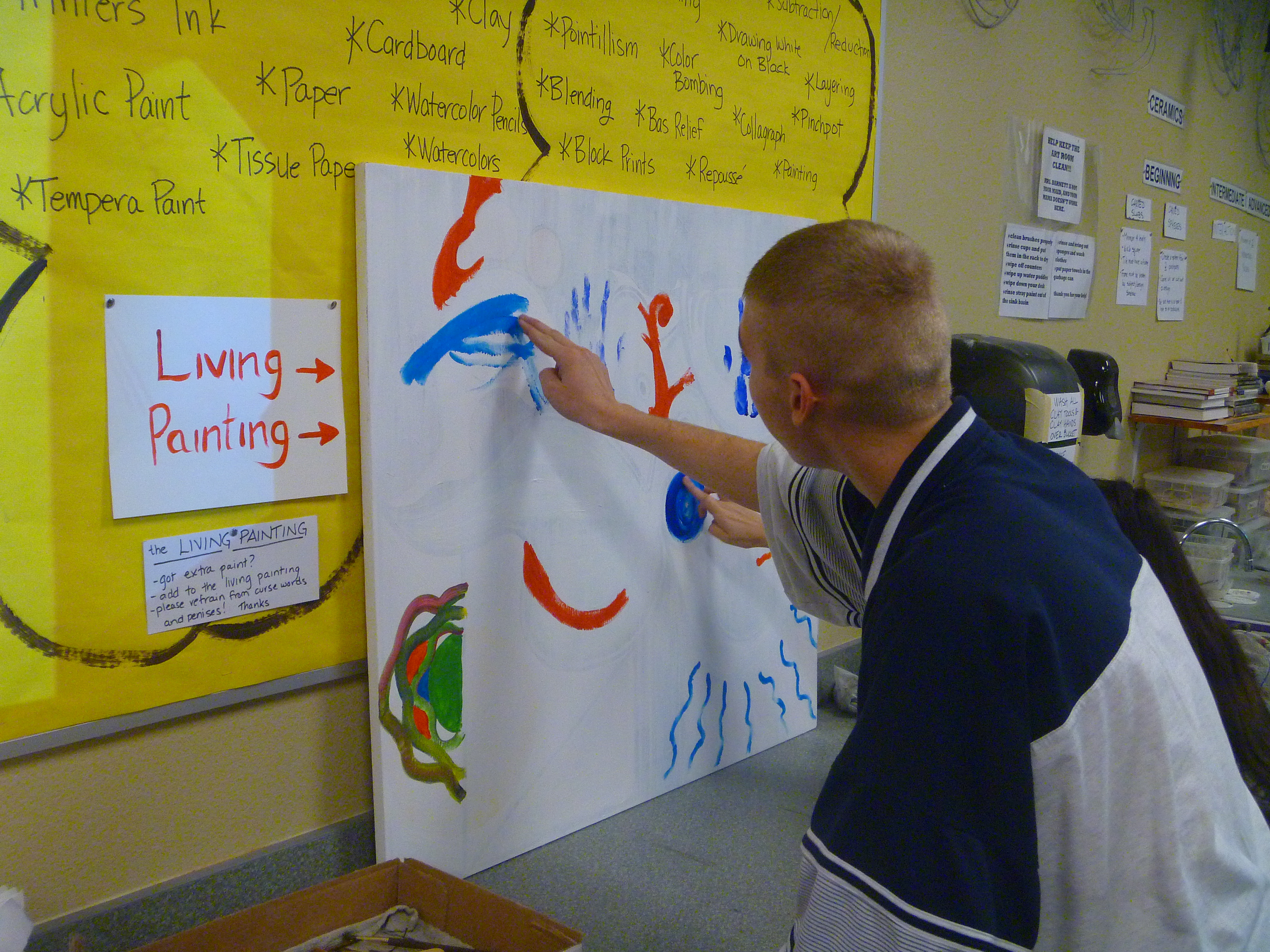
A friend of mine gifted me an canvas that she no longer wanted in her home.  I thought about using the canvas for myself, but I never got around to gessoing over the image to replace with my own.  Then I remembered something I read about on my art teachers group page about how a teacher had this canvas in her room that the kids could paint on when they had extra paint or had finished with their work.

I thought this was a fabulous idea.  So I brought the large (36″X40″) canvas to school and had my aide put one coat of gesso on the canvas.  You could still see the original painting through the gesso, but I thought that might help kids to get started.

I put a sign up that read ” LIVING PAINTING” with a smaller sign underneath.  It reads, “Got extra paint?  Add to the living painting.  Please refrain from curse words and penises.  Thanks.”  (Some of my students are obsessed with drawing, painting, and creating penises.  It’s what they do.)

I introduced them to the canvas today, and they jumped right in.

P1050495

I have included a slideshow of the canvas in the sidebar of my school art blog to show how it changes over time.  I am in love already.

A Great TASK to Help Start the New Year

Standard
A Great TASK to Help Start the New Year

Today was the start of a new semester at school.  I thought we needed to start off with a great activity–one that would shake off the slumber of winter break and ring in creativity and imagination for a new year.  And what better way to do so than have a day-long TASK party.

What is a TASK party you ask?

You can also find a previous post on TASK here.

I pulled out a bunch of supplies I had in my storage room:  yarn, egg cartons, craft items, fabric, 12″ dowels, wooden hearts and starts, buttons.  I plugged in all the hot glue guns we had.  I grabbed the large rolls of colored paper from the faculty lounge.  And, I started with a container full of tasks.

This party was to last all day.  I have 7 classes.  Once I started the party, I only broke for lunch, which consisted of writing more tasks.  This was the only place the students faltered…well, and when it came to blindly picking a task.  (Many wanted to pick and choose their task.  It was hard to stop them.)

It really was a fun day.  A few kids fought it at first, but ended up having a good time.  I think they need that time to play.  High school kids don’t often get that anymore.  And bonus, no one was on their computer today.  I wish I knew how many tasks were completed today…or at least attempted.   It would be fun to figure it out.  Perhaps next time.

By the end of the day, my feet were killing me and I was tired as all hell.  But, I had a counter full of artifacts.  I had a hopscotch board on my floor, and I had 2 body outlines–one in dry erase marker and one in tape.  (Just an FYI–certain dry erase markers don’t come off the floor so easily.)  I had a roll full of photos of the students making and laughing and creating and smiling.  I had a heart full of memories. And, I think it set the tone that creativity is welcome here–and encouraged.

This slideshow requires JavaScript.

How Do My Students Feel About Choice?

Standard

If you have read any of my posts, then you know exactly how I feel about Choice in my artroom.  And in case you are new…I love it!!!  Love it, love it, love it.

But all too often we talk about what we as teachers want and how something made us feel or if we made the right decision.  We don’t ask the students, the most important people in our teaching world, what they think.
So, I did just that.  I asked them on their midterm exam what the experience of having choice in their classroom was like.  Here are some responses.

“This effected me a lot because last year we were very limited on the materials we had to use, and we all had to do the same art work in  the same manner everyone was doing it. It was a good idea for you to change it to were we can all do different types of art work but with the same theme, for example we were able to carve, paint, draw, and a lot of types of work. i think that method should stay because you can see what each person likes, and what their good at.”   ~Aharon, art 2 student

“I was really appreciative of the opportunity to get to pick what I wanted to do and how I would do it.  Having little restrictions was really helpful in expanding my creativity and giving me more choices.”    ~Edward, art 2 student

“We had a variety of things to use and how to use them. I personally think that some of the projects shouldn’t have been so optional with such a variety of things. That the assignments shouldn’t have been so open to do what those of such wanted. Some should of been open to pick to choose their material used, but some also should of been told what to use and work with that and grow on that to know how to use it and get used to using it. When starting a project it took me awhile to pick what I wanted to do and what I wanted to use due to all the options we had. I am the type of person that I’m more comfortable to be told what to use and then go from there. So it was a challenge adjusting but I got it done. ”  ~Kalisha, art 1 student

“I liked the new way of teaching/learning you introduced because it gave me a lot of liberties. In my school (in Germany) we have more defaults and the pictures look similar. Here everybody can draw and interpret the theme his/her own way. That way everybody draws something different and unique.”  ~Dania, art 1 foreign exchange student

“I felt like it really effected me because if you wouldn’t have given us the choice to really be creative i wouldn’t really try and make something really boring just something easy. I feel like it honestly did help me because i am actually interested and feel like i could do something with my art one day in the future. I am honestly really happy i stayed in this class and you gave me freedom because without that i probably wouldn’t see how much i enjoy art and really see i can do a good job when i put actual effort into it.”  ~Casey, art 1 student

“I loved that we got to choose what our artwork was this year. It’s given me a lot more freedom and has actually made me care about my artwork because I’m doing what I want to do, instead of something that i have no connection to.”  ~Ryan, Art 2 student

“This was effective to me by, letting me use the things that i needed and allowing me to have the things i need to make my artwork be great, and make it to where i don’t just slap something on a piece of paper and turn it in. I can actually give it character.”  ~Zoe, art 1 student

“I remember last year in ceramics when we had to make a certain piece, but use the method our art teacher wanted us to use. This year, we have theme that our pieces must revolve around, and we may use which ever method of building we like. Personally, I love this new method our teacher has been using for this year. I feel this allows us to continue to use a method we enjoy and focus on improving our skills using that method. Instead of constantly changing which method we have to use and using a method some students might dislike more than others. For example, say we are assigned to make usable containers, one student could use the slab method while another might use coils. There could also be a student who wants to use his or her own method to build a container. They each can find a way they like to sculpt and continue to learn more and more about whatever method they choose. We also have the privilege to try and improve our skill in a method we are not yet comfortable with.”  ~Joseph, intermediate ceramics student

Far and wide, almost all of my students (with the exception of beginning ceramics because I have not moved that class to choice…yet–it is coming next semester) really like having the choice.  They like being able to experiment and try new things and start over with another medium when the first they chose isn’t working.  They like being able to interpret themes as they wish.

I appreciate Kalisha’s perspective as well.  I know for some it is really hard to not be told how to do something, especially when you have been told how to do it for most of your young life.  She is a fabulous artist who spends time thinking about how she will interpret things and trying new mediums.  She works hard and has created some fabulous work.  I think that one day she might change her mind about having such freedom because from my perspective, it is working for her.

For more reading my students’ responses, go here.  I would also like to thank the teachers of Apex High School (for the umpteenth time) for sharing what they have done in their TAB classrooms.  I “stole” their exam questions to use with my students.