Category Archives: Students

Skill vs Creativity

Standard

As a teacher that has embraced the Teaching for Artistic Behavior (TAB) philosophy for almost a decade and a half, I still find myself struggling sometimes with with debate around skill and its importance. I know it’s important for artists to have technical skills and for them to continue building those skills. Buuuutttt…. should that be the most important thing in the high school art room (or any art room for that matter?)

I was doom scrolling the other day, and I came across this reel in my IG feed and I finally felt a little bit of validation. The artist talked about an art teacher he had that pretty much said what I had felt in my art heart all these years.

Gabriel talked about an art teacher he had who said that “technical skill is extremely overrated. And she had visited a school that prioritized the technical ability versus teaching the students creativity. And while their paintings were very technically well done, they were super dead, boring, not inspiring whatsoever.” He goes on to say that he thinks we put technical ability on a pedestal way too much, and that there isn’t enough credit to the creativity. Skill is still important, but it is a means to show that creativity.

I couldn’t agree more. There are times when I go to conferences and see “award winning” art, or I scroll through Facebook looking at other high school programs and I feel a sense of insecurity. I begin to question if I am doing a disservice to my students by focusing on the process, on creativity, and on what they have to say over spending day in and day out just learning and practicing technical skills and realism. But then I pause and picture in my mind’s eye the work my students are producing. Some of my students are very skilled. Others still have ways to go on their journey. But their work is so expressive. It has life. You can tell they explored new things. You can see the energy in their marks. I think of their faces and conversations when they are in our classroom studios creating, and it fills me with joy. I watch them push themselves to be better than the day before.

It’s not that I don’t teach skill. It’s not that I don’t encourage practice to make better. I do those things. I just don’t preach that it’s the pinnacle of art making. I teach new skills for my students to have in their tool boxes. We practice technical skills every time we make in the art room. It’s just that I put the onus on my students to choose which technical skills they want to practice to get better at. There are so many mediums and techniques that I can’t teach them all, and I am not going to choose which ones are more important than others to focus on. I will let my students decide what is important to them. I let them guide me when it’s time to explore new mediums and techniques.

In the end, I am not saying that those classes that focus on technical skill are wrong. If that is what you want your focus to be, then that’s your prerogative. What I am saying is that I am proud of my students and the work they create. I am proud of my program. They are proud of their work and their growth! Personally, I would rather have my students make work that carries their feelings and emotions out to the world, than a bunch of pretty pictures that are technically well done.

Typical Days in the HS TAB Studio

Standard

As we get closer and closer to the start of the year, many people are asking what a typical day in the high school TAB studio/classroom is like. And well, it’s anything but typical. Just kidding. TAB classrooms are just like any other art classroom, just there is more independent thinking happening and less teacher-led projects. But, other than that, it’s pretty normal. We have routines just like any other classroom.

I thought I would create a small post outlining my day and my week as a high school TAB teacher. I see my students daily, all year long. This year we are back up to 50 minute classes. Woo hoo!! I teach Art 1, Art 3, and beginning through advanced Ceramics. Sometimes I teach AP or an Art 4, but those are on case by case bases. Unless it’s AP 3D, then that’s definitely me.

I like to have a routine that my students get used to, so they are comfortable and there’s not huge chaos every day. I have a white board, which when my room is not under construction, the students pass by as they come into class and they are encouraged to read the board so they know what they need to get out.

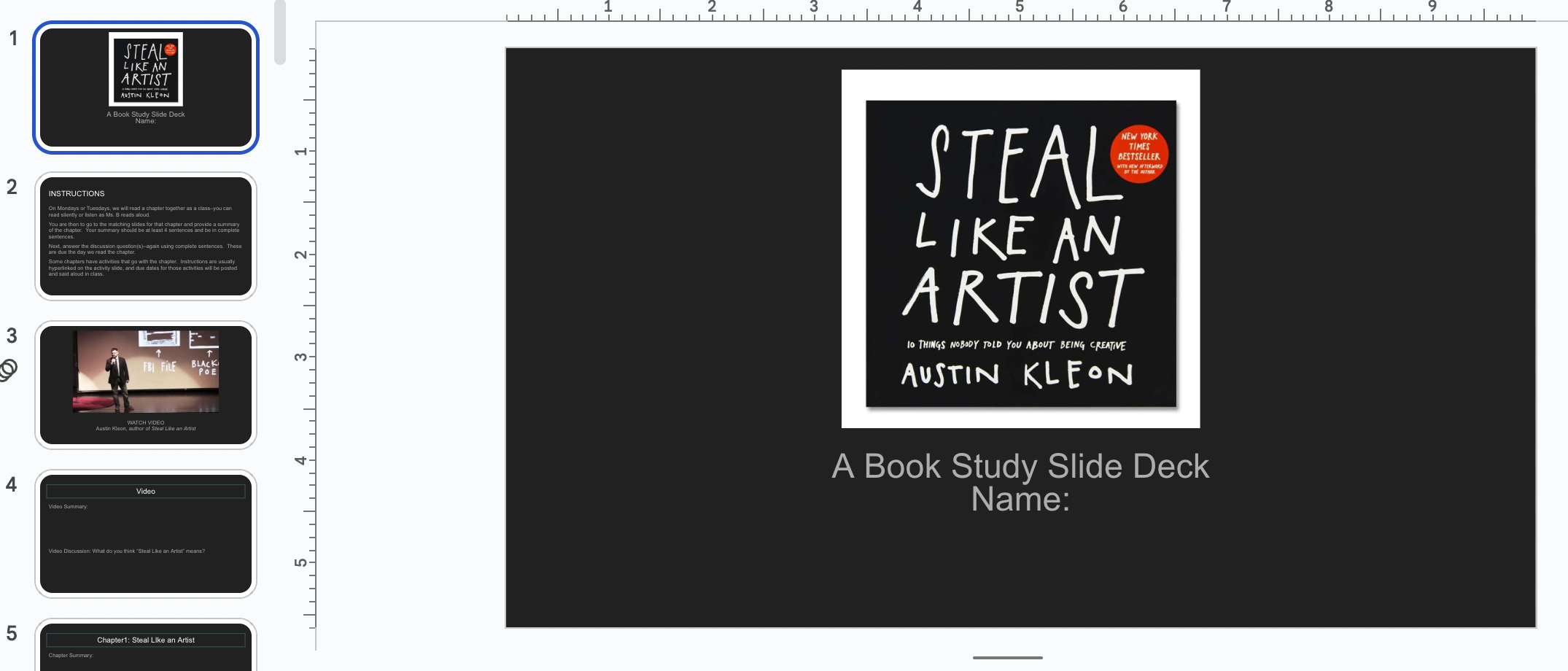
Mondays start off with either Artist Monday or Style/Movement Monday, for all my classes. We come in, watch a video and then the students answers questions, either in their sketchbooks (art 1) or on a slide deck (everyone else). That generally takes about 15 minutes of class total. After that, we go into one of 2 things, we get back to notes/practice of skills or studio time. Every other Wednesday, in art 1, we have a drawing test. Then, similarly to Mondays, the students pick up where they left off the day before. In my upper classes (art 3 and ceramics 2 & 3), I designate a day (usually every other Friday) for digital portfolio time.

Beyond those few fixed things, I typically don’t like to take much of the time away from arting. Kids will ask me what are we doing, and I say to look at the board. At some point, whether they need their sketchbooks or not, art 1 students will come in and grab it before sitting down. It has become a habit. Sometimes I address the class right at the beginning to do some house keeping, like reminding students of who I still need to go over ideas and development or when the last studio day for a unit is. Other times, I just let them get to work and don’t address the whole class until about 7 minutes left when it’s time to come to a convenient stopping point to begin clean-up.

When we do need to learn new skills (composition, perspective, facial features, etc.), we sit and take notes in our sketchbooks. After there is usually a small assignment in their sketchbooks to practice the new skills. New media explorations take about a week, while other smaller skills assignments take between 2-3 days (notes and practice time together.) When I do demos, where we (students and I) aren’t doing them simultaneously, I try to keep them under 10 minutes. That way, they still have at least a half hour of arting time.

There you have it. The biggest difference in my experience between when I was a more “traditional” teacher and a TAB teacher is that there is much more independent art making and exploring time. I circle the room more and talk to students more. There is not magic secret or formula. This is what feels right for my students and for me. It’s relaxed and safe and successful.

2 Philosophies, 1 Program

Standard

I wanted to take a moment to talk about my program. As many of you know, I am a TAB (Teaching for Artistic Behavior) teacher and have been for the majority of my 15-year career. What I am not sure people know is that my partner is not a TAB teacher. Yes, he sometimes gives choices to his students, our students, but for the most part, he is a traditional art teacher who assigns whole-class projects.

We have been working together for 15 years, and it has taken us 14 of those years to finally get our act together and create a program that not only allows cohesiveness for our students, but also allows for each us to teach to our own philosophy and to our strengths.

What does this look like? We were fortunate to have had a principal who trusted us as experts and allowed us to choose which class levels we wanted to teach. We both teach Art 1 classes due to the sheer number of class sections we have. (Texas requires one fine art credit for graduation, and the majority of students pick art as that FA credit.) We split the Art 1 sections as evenly as we can. The experiences for the students in our respective classes is different, but we are okay with that. The students get to know us as teachers and people, they get to learn about our program, they get to make some art, they have fun, and for about half, they get that credit they need so they can move to the pathway they are really interested in.

It’s when the students decide to continue in the art pathway that things really start to make sense for how we have structured the Duck Art Program. We have split the remaining sections of courses by levels between us. My partner teaches all sections of art 2, I teach all art 3, then the seniors return to him for art 4 and AP Studio. He teaches both AP 2D sections. I teach AP 3D, but I am also the ceramics teacher, so that is what makes sense for us.

Splitting the classes this way works to our strengths. He is really good at teaching techniques and materials, so the art 2 students benefit from all having this shared experience where they get to focus on skills and learning new materials. They come to back to me in art 3. We focus more on the ATP (Artistic Thinking Process), studio habits, and creating original art. My class helps them to really consider content and finding what media they like to work with, what types of subjects they like, and what they want to explore. AND they really start to find and develop their voice. So…..when they return to Art 4/AP, they have a well-rounded background and can create amazing art. It was hard in the past to have kids that were all over the map because we taught the same level in totally different styles. I understand that as a TAB teacher, I always meet students where they are, but this isn’t about meeting students at their artistic level, this is about the students have a common base knowledge that allows both teachers to better meet the students needs.

It took us forever to learn to play together, and play together well, but better late than never I say. I am excited for this coming year because we will be able to really see how well this will benefit our students and our program. It was time to stop being an island in a department of 2 and instead come together as 1. It is possible to work with those that don’t follow a TAB philosophy like you do. You just need to check your ego and remember what is really important and the focus of your art program–the students and helping them in their journeys to becoming artists.

Classroom Protocols in the Time of Covid

Standard

I know it’s been a while since I last wrote. It’s been, well, it’s been a semester–interesting, frustrating, at times apathetic, and at other times guilt-ridden. I am sure most of you know what I’m talking about. I thought I would start off the new year with trying to look at the positives, with hopes that I can help some people. We spend 2/3 of the first semester doing both in-person and asynchronous. Like other in-person art teachers, I had to figure out material procedures that worked within restrictions handed down from on high–no group work, no sharing, single-use if possible.

I run my TAB studio in a very self-serve type of environment. Unfortunately this year, that wasn’t feasible and I didn’t set up the studio as normal. ::sad face:: Fitting the expectations set out for me to work into an open studio was frustrating, but over the 3+ months I’ve had students in my room, I’ve been able to come up with strategies to make it work. I do have less than half the students I would have normally in my room, and my largest class was 12 (half my normal cap BUT it was a ceramics class, so that made things interesting.) Fewer students does make some things easier, I will admit, however, I did need to order a bunch of supplies that I wouldn’t normally order–more new brushes, lots of extra tools, extra sets of some media, single-use condiment containers, mesh bags. But in the grand scheme of things, it will help out in the future as there are some things I think I will continue using and doing after we return to a more “normal” school life.

Let’s do this…

Time Out area:

  • I got this idea from another Texas TAB teacher, Lori Wallace. Not sure if it was her idea or not, but it’s a super awesome idea.
  • It’s an area on my counter that I marked out as the time out area with some tape. (A student thought we needed a fun zone too, so there is that section next to it labeled as such.)
  • Students put all used tools and materials there, so at the end of the day I can sanitize spray them.

Clean Cups and Dirty Cups:

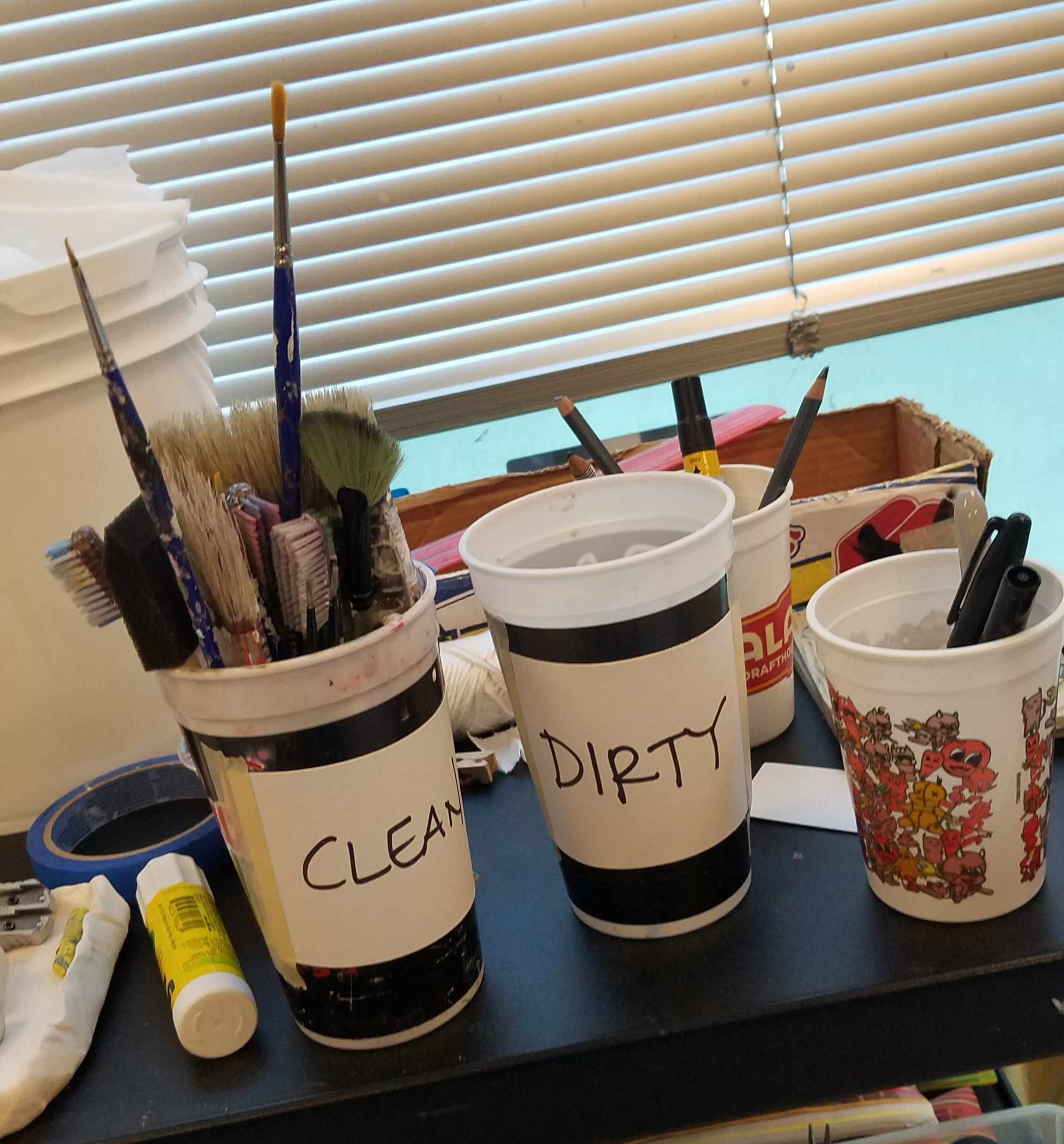
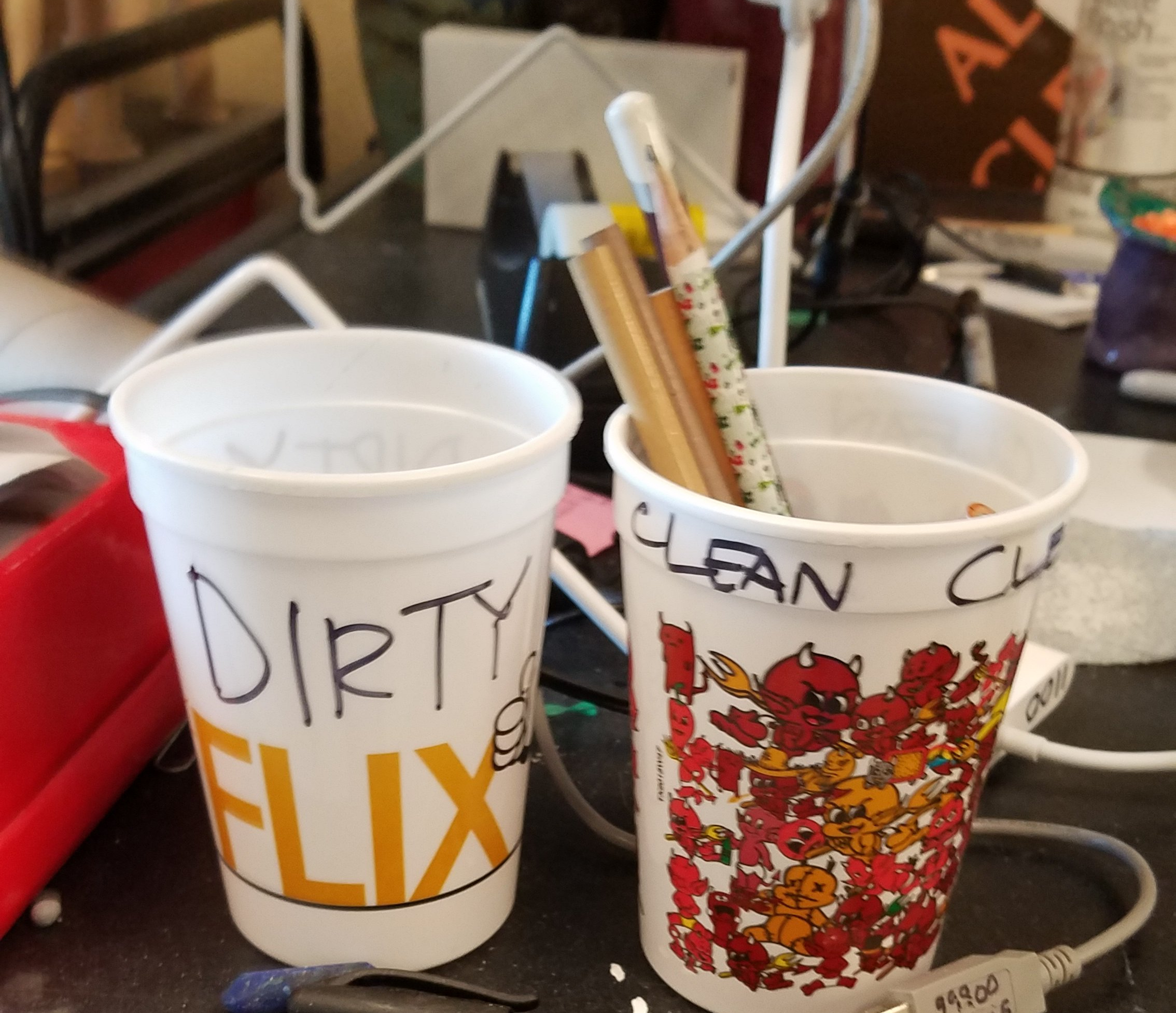
  • In a few different places, I have 2 sets of plastic cups–some labeled clean, and some labeled dirty.
  • Cleaned tools (pencils, sharpies, skinny paint brushes, etc) are in “clean” cups.
  • After student use, they put the tool in a dirty cup (this includes hand sharpener and erasers).
  • I wipe down the hand tools with the provided sanitizing wipes at the end of the day, and then put them back into the clean cup.

Mesh Bags:

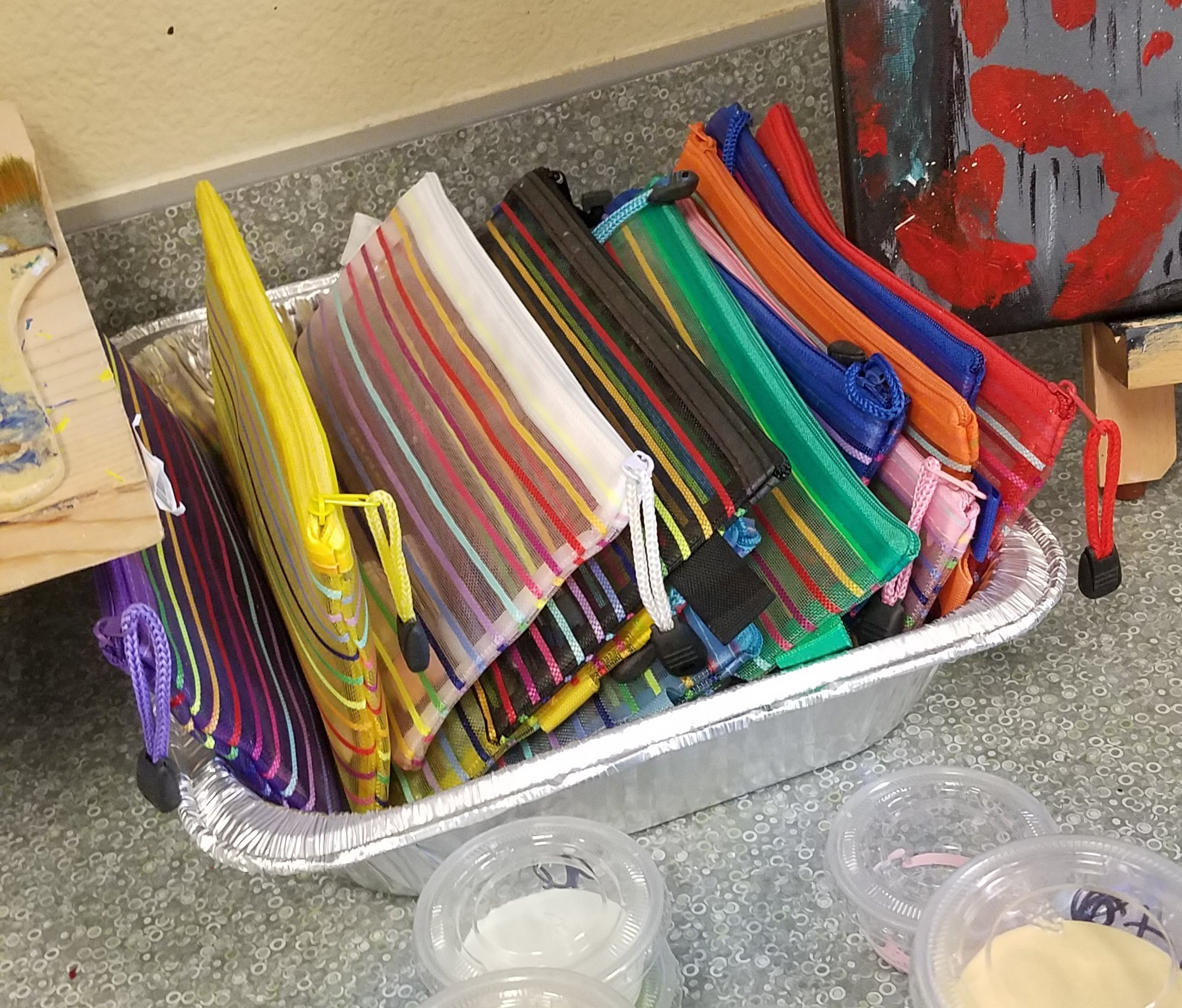
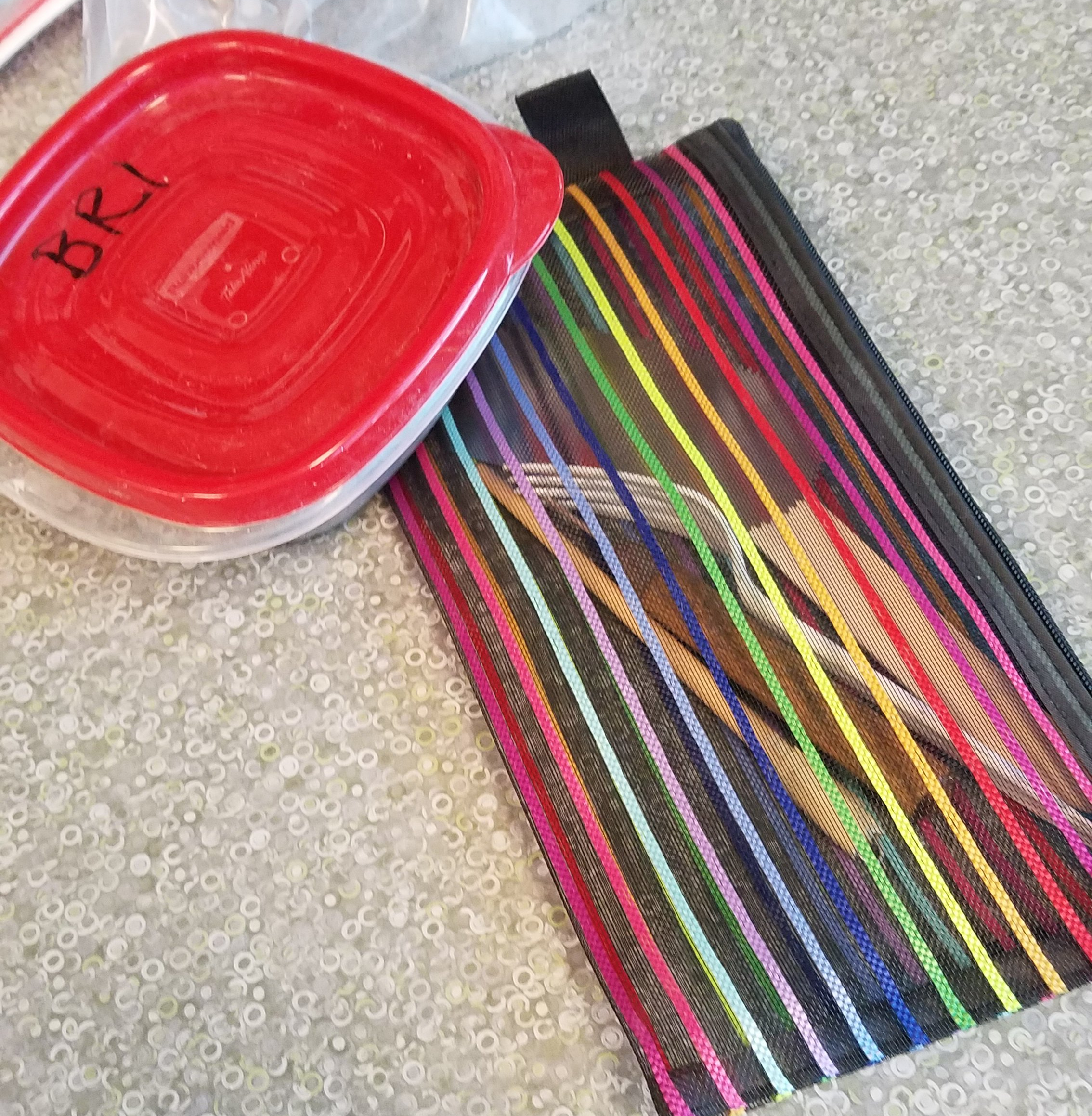
  • I bought these mesh bags with a local grant, about 80 or so of them. I use them for many things: sets of acrylic brushes, sets of watercolor brushes, ceramic students individual tools, sets of brush markers.
  • What makes them nice is that after the students use whatever is in them, they can put the bag in the time out area, and I can just spray the bag, turn it over, and spray the other side. The bag is mesh and plastic, so it gets the inside contents and allows for drying.
  • This will be something that continues next year…using the bags for sets of things.

Materials List/Paint Color List:

  • I made a list of all the different media I had to offer and a swatch of all the acrylic paint colors I have. I then laminated them and taped them down–one on each desk
  • Students can tell me what medium they would like and I can get it for them.
  • Students can tell me what paint colors they need, and I get those too.
  • This lessens the amount of hands touching things–I wear gloves to get the different media.
  • I don’t have to worry about sanitizing the paint bottles after each use because I am the only one touching the bottles.
  • I put a piece of copy paper on each paint tray (cafeteria type trays), squirt on the selected colors, and give the students their paint. They throw out the paper and put the tray in the time out area.

Individual Student Tool Sets:

  • This is mostly for my ceramic classes. This was costly, but there wasn’t really any other way. Tool kits were made; some sent home (and they come back when kids come back), and some stayed for in-person.
  • Each student has their own cubby where they keep their tool bag. I repurposed my cubby since I didn’t set up the studio as normal.
  • Each kit has a needle tool, a serrated metal scraper, a wide paint brush, a home-made sgrafitto tool (that each student made themselves), and a piece of canvas. I also bought a ton of wooden dowels (which I cut down to size to save money) and those longer, thicker paint stirrers. This allows for all to be able to use at the same time or for some to sit for a few days without being touched. These purchases will help out in the future with full classes.


Damp Boxes:

  • I have enough shoe box size to give each of my upper students their own box–both for in person and remote.
  • I walk around with large, under the bed size or sweater size ones, for my beginning students. I just go down the line, with gloves on, and give out each project. I do the reverse for clean-up.


Single Use Condiment Containers with Lids:

  • I originally bought these to send home underglaze to my ceramic students.
  • They come in handy for passing out regular ceramic glazes.
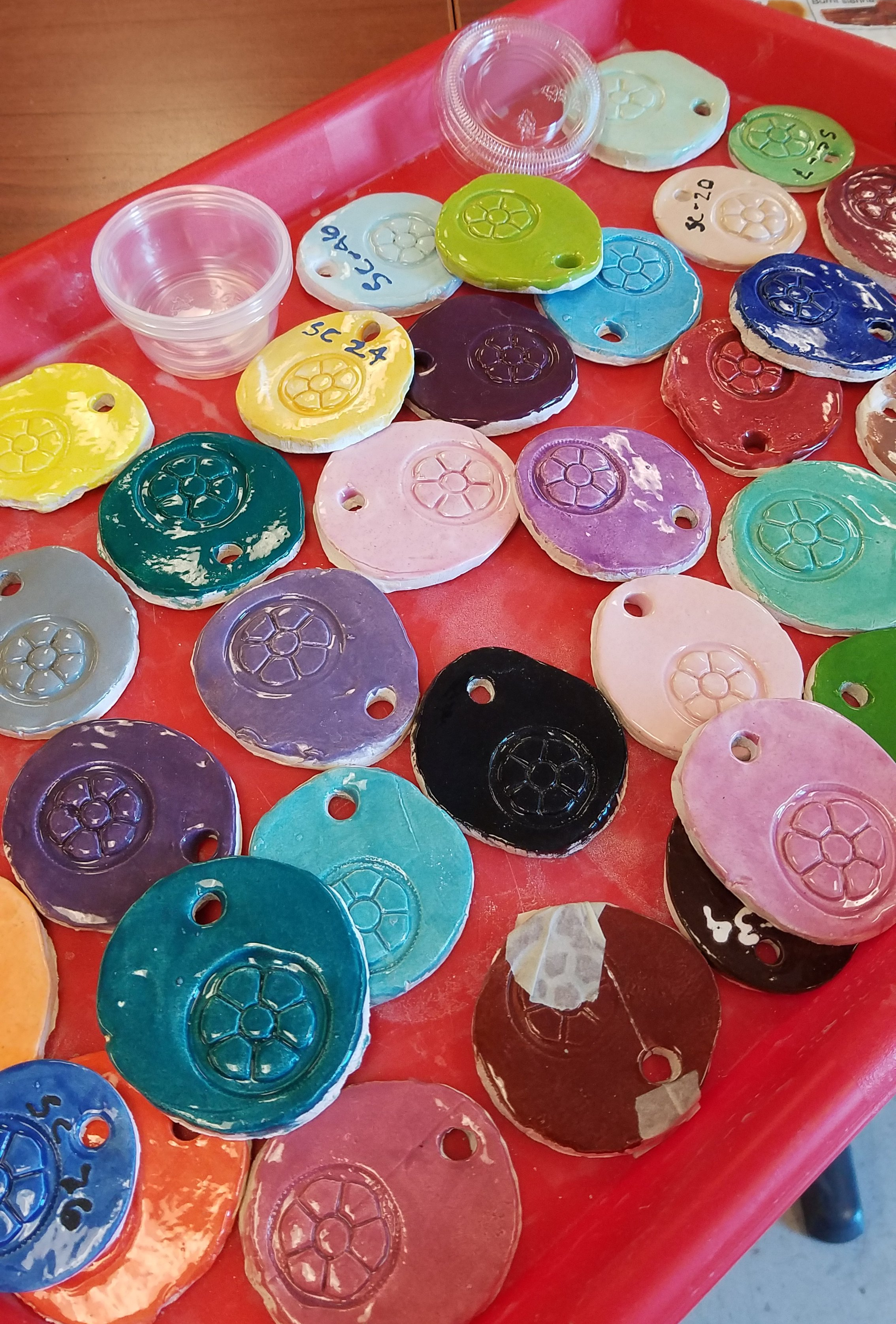
  • I took all my glaze tiles and put them on a tray. Kids can point to the color, and I then mark the cup with the glaze number in a sharpie, and then return the lidded glaze-filled cup to them. They also know what number glaze they had so they can ask for more.

A Zillion Washcloths:

  • Washcloths really are the best way to clean-up clay tables and paint spills. Those school paper towels suck.
  • I bought over 100 of them from Walmart.
  • Each one is “single” use. Student take one from the clean pile and go clean-up their table.
  • They then put the used washcloth in the bucket by the sink after they are done with it.
  • At the end of each week I was the washcloths for next week. I am lucky that I don’t have to take them home–I was given a key to the washers/dryer in the girls athletic area.
  • It’s a little more work, but it is actually cleaner than when we would share the rags–so many less cloudy tables because kids don’t understand to rinse and ring the towels first before wiping the table–because more than likely, the person before didn’t rinse it.

Gloves:

  • The district does supplies me with gloves and I go through 10 pairs a day maybe.
  • Gloves do help to pass out supplies and whatnot to the students…and you will need to pass out a lot. You’ll feel like a waiter, but it is what it is. Lol

I think that is all. I know this is long, but I hope it is helpful to those of you that struggled first semester with having an open studio or those going back to in-person for the first time. Like I mentioned, I sometimes feel like a waiter, and it is tiring many days. My kids like to remind me when I don’t hand out table wipes at the end of the day, and they laugh when I yell that I’m about to take my gloves off so it’s last call for supplies for a while. Undoubtedly, I get someone that needs something like a minute later. ::shrug::

Corona and Remote Teaching

Standard

I see it has been over 2 months since my last post. And, quite frankly, I’m not surprised. I had some ideas in the works for new posts on the exciting stuff and things happening in the Duck Art Room since January, but then Corona hit, and my spirits plummeted.

I tried with all I had in me to look the “new normal” in the eye and take it on. And by new normal, I mean remote teaching or distance learning or “homeschooling” 🙄🙄🙄. (Don’t get me started on how none of this is homeschooling. I know people that homeschool for a living, and this is not it folks. But I digress.) It was hard. I wanted to be the best teacher I could be, but in truth, I wanted to just paint and drink coffee and play with clay. And I’ve done all that. In fact, by the end of this, I will have a full kiln load of just stuff I made.

One week away from school turned to two weeks; then to three weeks. And now, I’m pretty sure we won’t be back this school year. And at this point, while I want to see all my kids more than anything, I don’t know how we could make the switch one more time with 7 weeks (in my district anyway) of school left — 3 of which we are definitely out for Shelter-In-Place orders.

My district has been remote teaching/distance learning for 3 weeks now. I feel it has all been one big trial and error session. My district finally came to a decision about grading and GPA and class rank–which for those of you who teach high school know that these things are currently important in the world of education and higher education. I won’t go into everything, but we are going to a pass/fail system for the second marking period of the 2019-20 school year. Grades will be assigned with “prominent emphasis on completion and effort”. So, that sounds good right. It sounds as about as equitable as they can get. We are trying very hard to make sure we can meet accommodations and reach students without internet and give grace to those struggling with home issues (siblings, work, etc.) that affect them being able to do school work. Could more be done? Probably. But I know we are trying.

What does this all have to do with Art and Teaching for Artistic Behavior and Duck Art? A lot actually. I said that my spirits had plummeted, and that included my spirit for facilitating meaningful art making situations for my students. Instead, I assigned what I felt was going to be the easiest thing for me to do. Currently, I have about 50-65% participation from my students–some do all of it, most pick and choose and turn in a thing here or a thing there. It made me sad to say the least. I was missing seeing my kids make and create and all those other things that go with being artists.

Earlier this week, I was looking at Facebook, like all who are at home do, and I finally clicked on my friend Melissa Purtee’s post about what she was doing remotely with her kids, and it sparked something in me. I was then reminded of a post another friend had put in the main TAB Facebook group about not forgetting our purpose as TAB teachers–those 3 main tenets of the philosophy. I knew I had to change what I was doing. I couldn’t sustain it anyway. So, I borrowed from Melissa, as she so graciously lets us do, and made a new website for my students–all of my students, no matter the level or the class type. It gives them choice. It lets them decided how to spend their time during the week–instead of a daily assignment, they know what they need to do for the week on Monday and can plan their schedule to meet their needs. It makes them think and decide and research and plan and all those behaviors we have been talking and learning about for months or years. I have full belief in my students and I am hoping that it is what is right for them, and for their situations. I hope they can see art making not as a thing they have to do, but they want to do–because the freedom is in their hands now.

I’ll leave you with this. I’m not sure how I feel about our “New Normal”. I just hope I am bringing a sense of comfort to my students thru art and choice as we navigate this together.

Screen Shot 2020-04-11 at 10.08.03 AM

Click image for website

Restoration of a Practice

Standard

As we enter the third week of the new semester, I thought I would update on my “restoration” of the school year. (Confused? See this post for some clarity.) I know it has been a short time, but I am starting to really feel like I am getting a hold of the school year. Maybe I should say it’s been a long time. I mean, it is January, and we’ve been in school for about 4 months already.

img_20200123_183235_2816965594421370195777.jpg       img_20200122_110002_4556652781830567087963.jpgI came into this semester in a different frame of mind. I realized in December that I needed to change what was happening in my art studio, what was happening with my students. I felt they weren’t getting the best out of our TAB studio. And, I knew it wasn’t really them, but it was me. I was doing what felt right last school year…what worked for last year’s students. I was doing what I thought I should be doing. I wasn’t really seeing what my kids were missing.
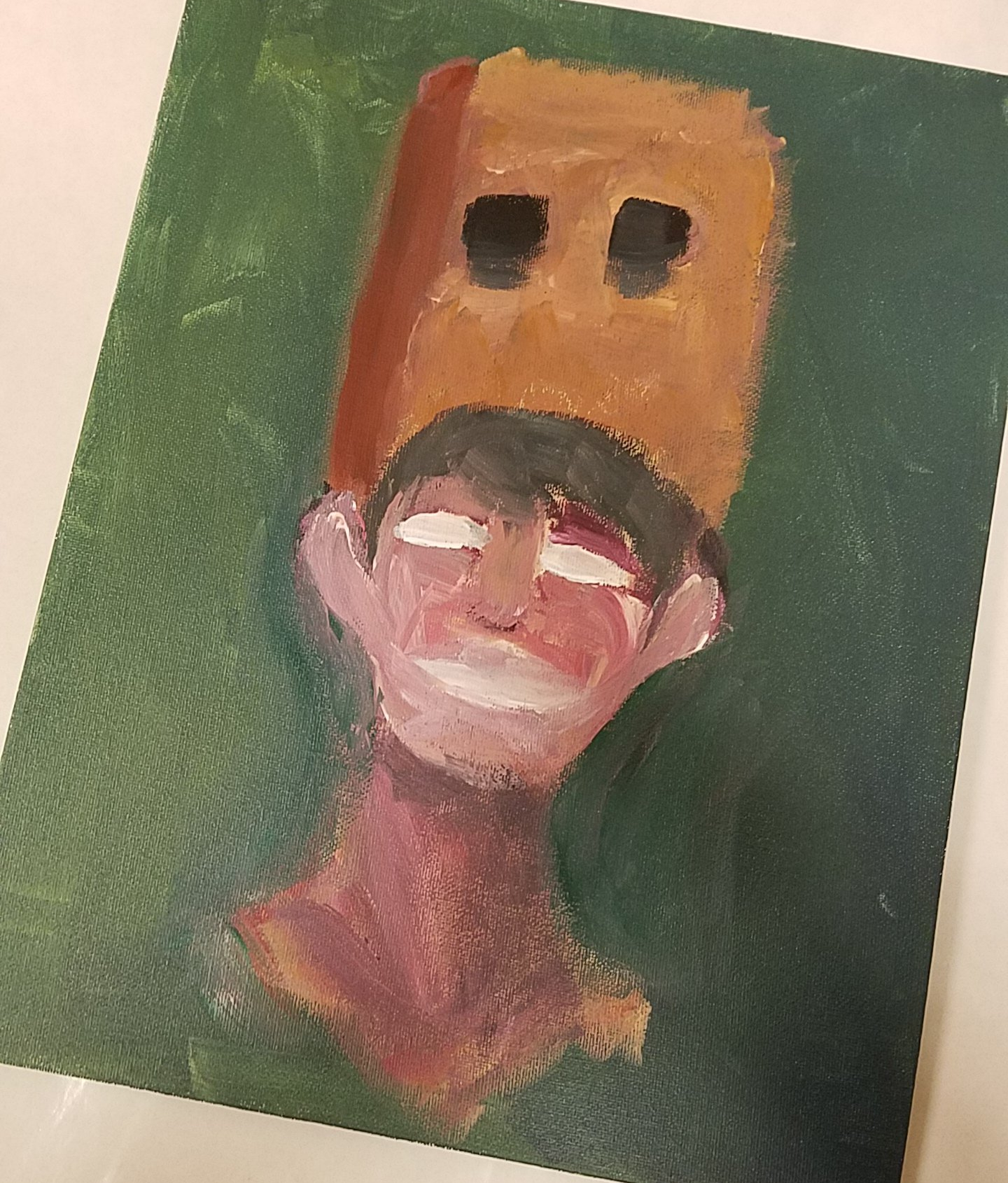
So, over winter break I sat down with notebooks and made lots of notes. I figured out what my students were needing, and got to planning.

20200124_0857018934901901214536620.jpg

We started off with an exploration of the human face. It was very teacher-led, but it was a good way to start off the new semester. It got them engaged because teens love drawing eyes and lips. It helped to build their skills, and it was a nice ease back into art after 2+ weeks of sitting around.

But, it was what I decided to do after that I think is really making the difference. In art 1, we had been working through “The 9”, packets designed by Ian Sands that offer a lot of choice, but on a more basic, general subject matter (landscape, nature, architecture, etc.) These have been helpful, but I felt my art 1 students

20200124_0856444252853371711185527.jpg

needed more. At one point in my TAB journey, we worked with themes. I felt it was time to incorporate themes again. What I ultimately decided was that students would have a choice of a new packet (this time portraits due to the exploration we did), any previous packet we have visited this year, and a theme. And, so far, so good. Students are much more engaged with the larger choice, and because everyone isn’t doing the same packet, there is much more delving into the ATP (Artistic Thinking Process). Also, the required student-teacher meeting between development and creation has really helped them as well.

I20200116_1003544689872620955959336.jpg am finally fully engaged this school year, and all it took was some deep reflection and a few tweaks to restore my passion for TAB and teaching.

“Lucky” Number 13?

Standard

This year marks my 13th year as a high school art teacher.  I have spent all 13 years in the same district, at the same school.  I have had 3 principals, 3 superintendents, countless colleagues, and over 1000 students.  Lots of things have changed over the years–some sad, some bad, but mostly good.  I have been lucky to have found a teaching philosophy, TAB, that really resonated with me and kept me from giving up on teaching all together.

Through the years I have seen amazing growth and creativity.  I have watched students eyes get wide as they discovered clay or when they were told they could choose whatever material they wanted.  I couldn’t have asked for a better journey.

As anyone who has gone on a journey knows, it’s not all puppies and rainbows.  And, this year has really demonstrated that for me.  I am having one of the hardest years I have had since my first year teaching.  I’ve had one of the hardest groups of students to come through my program.  I’ve written more referrals in 3 months than I did in 10 years of teaching; and if you know me at all, I’m pretty lax when it comes to discipline.  I just don’t write referrals.  Cell phones drive me up the walls, and kids doing homework in my class instead of arting gives me agita.

But, what really gives me pause this year, is the level of thought being put into the work.  And it’s mostly in my Art 1 classes.  Unfortunately, it isn’t a very deep level of thought.  It’s like they feel thinking is the hardest thing they have ever been asked to do. (Perhaps it is, who knows?) Now, I have always met students where they are in their artistic journey, but this is so different that what I am used to. We’ve normally had to work more on skill and less on concept.  This year it is a lot of column A and a lot a column B.  It has made me question how I am facilitating my TAB studio.  I feel like what I am doing isn’t enough to help them grow during their time in my class.

I have been taking notes and reflecting on years past to see what I can introduce to help them snap out of this lazy thing they call high school.  I know it is in there somewhere.  I know I can find a way to challenge them.  I think it’s a combination of the packets, themes, and explorations.  I’m not 100%, and I have more planning to do.

Seeing the Art of Children

Standard

Every child is an artist. The problem is how to remain an artist once we grow up.

~Pablo Picasso

This is the ultimate challenge to artists, isn’t it–to hold onto that wild abandon and curiosity when making art.  As we grow up, for some reason that changes.  How we make and view art as adults does a complete 180, and I believe this issue needs to be addressed.  In this day and age as we talk about creativity and how this new generation lacks creativity, we must ask ourselves how did we get here?  Then, we need to figure out how we can change that.

Somewhere along the line, we are taught that the skill to make things realistic is equal to beautiful/good art.  That coloring in the lines is a goal.  That creation comes with a set of directions that needs to be followed.  Things like expression through messiness and exploration through process go to the wayside.  Does this stem from an unconscious connection to the development of fine motor skills (FMS)?  Perhaps somewhere we think that as we develop our FMS, our art should follow suit–that it needs to look sharp and be realistic.  But, I think that is taking away what art could and should be.

The old adage that says “Beauty is in the eye of the beholder” comes to mind.   Art could be defined by this, and many people do define art this way.  But, should it be defined by this?  I think this minimizes what art is.  I think children get it right.  For children, art is about the process.  It’s not defined by skill.  It’s not about correctness.  It’s about telling a story.  It’s about making what is in their head a reality.

And, we as adults need to understand that.  We have been told for so long what to do and how to do it that we have lost track of our inner child.  And, as art teachers, we have an opportunity to help create the next generation of adults who can see art and make art as they did as children.

20180508_155426

Art 1 student in-progress work

You have to be in a state of play to design.

~Paula Scher

That is where Teaching for Artistic Behavior can come into play.  (See what I did there?)  Starting at the elementary level, we can not only teach kids how to behave like artists, but we can teach ourselves and our colleagues to see their, the children’s, work for what they intend it to be.  We can stop telling our students what to create and how to create it, and let them tell us what they want to create and how they want to create it.  Each student has her own story and voice to tell it.  We can stop pushing our adult agenda and aesthetics on students and listen to them.

This doesn’t mean we don’t help our students improve their skill.  This doesn’t mean we don’t teach them about composition or color theory or shading or foreshortening or art history.  Those things are important parts of art, and we should incorporate them into our lessons, but should they be the most important or central part about art?  We need to help guide our students on their journey and see their journey for what it is…and we need to look at it at their level.  We need to meet them where they are.  We need to stop telling them what art should look like, but instead ask them what they envision it could look like.

Perhaps a bullet list will help… And remember, these lists are not mutually exclusive and they are not complete and can change with time


What art doesn’t have to be:

  • photorealistic
  • 24 of the “same” image (ie student created “Van Gogh sunflowers”)
  • polished
  • colored in the lines
  • a finished product

What art could be:

  • made of repurposed materials
  • messy
  • unfinished
  • a “failure”
  • a journey
  • outside the lines
  • unrealistic
  • in need of an explanation

What should be your takeaway from this blog post?  That children’s art is NOT adult art.  AND, we as adults need to recognize that and stop judging it like it is.  Does that sound harsh?  Maybe.  But, what if we did just that and helped to make a generation of artists instead of a generation of followers.


The Re-Do: A Final Exam

Standard

It appears as if I am not the only one to have students revisit an artwork made earlier in the year to re-work as a final exam for high school art.  (Melissa Purtee wrote about it here, and I did take the idea from Ian SandsJanine Campbell did it years ago.)

Anyway, for my art 1 and my art 2: p/d classes, the exam was to take a piece of artwork they had made sometime in their class that they created or started to create and re-do it in one of 3 ways–make it better, make it different, or rearrange it.  We looked at a slide show, I answered questions, and then kids had at it.  When they were finished, I had the students fill out a written reflection about the new artwork, why they chose that piece to redo, how they re-did it, and which was stronger/why.  There were a couple of other questions about the work they did this year as well.   The students had to turn in the original (or a photo of the original) with the new work so I could compare.

I thought it was a great way to finish the year.  Students were able to go back over everything they had created.  Some pieces they hadn’t seen since I put them back in their portfolios earlier in the year, some forgetting even having made the piece.  The reasons students gave for choosing specific pieces varied–from it was my favorite piece to I wanted to take it out of my sketchbook to I knew I could do better.   I am so proud of the work they put into the new pieces.  It really was a good way to show what they had learned over the year–art making skills, decision making skills, and reflection skills.  It’s a final exam I will continue to use in my classes.

I wish I had taken more photos, but I was so caught up in what they were doing and the end of the year, that I forgot.