Tag Archives: reflections

Skill vs Creativity

Standard

As a teacher that has embraced the Teaching for Artistic Behavior (TAB) philosophy for almost a decade and a half, I still find myself struggling sometimes with with debate around skill and its importance. I know it’s important for artists to have technical skills and for them to continue building those skills. Buuuutttt…. should that be the most important thing in the high school art room (or any art room for that matter?)

I was doom scrolling the other day, and I came across this reel in my IG feed and I finally felt a little bit of validation. The artist talked about an art teacher he had that pretty much said what I had felt in my art heart all these years.

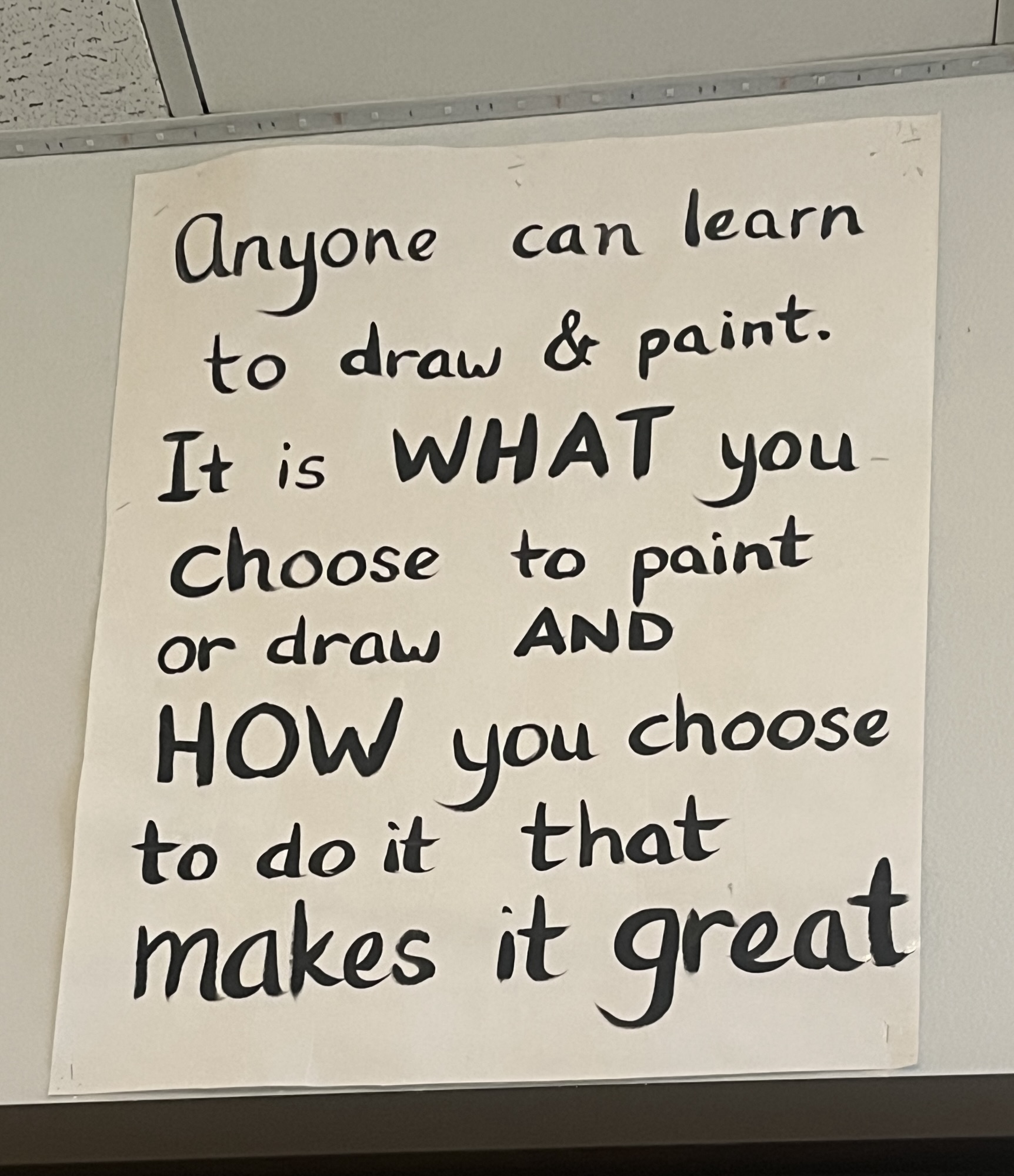
Gabriel talked about an art teacher he had who said that “technical skill is extremely overrated. And she had visited a school that prioritized the technical ability versus teaching the students creativity. And while their paintings were very technically well done, they were super dead, boring, not inspiring whatsoever.” He goes on to say that he thinks we put technical ability on a pedestal way too much, and that there isn’t enough credit to the creativity. Skill is still important, but it is a means to show that creativity.

I couldn’t agree more. There are times when I go to conferences and see “award winning” art, or I scroll through Facebook looking at other high school programs and I feel a sense of insecurity. I begin to question if I am doing a disservice to my students by focusing on the process, on creativity, and on what they have to say over spending day in and day out just learning and practicing technical skills and realism. But then I pause and picture in my mind’s eye the work my students are producing. Some of my students are very skilled. Others still have ways to go on their journey. But their work is so expressive. It has life. You can tell they explored new things. You can see the energy in their marks. I think of their faces and conversations when they are in our classroom studios creating, and it fills me with joy. I watch them push themselves to be better than the day before.

It’s not that I don’t teach skill. It’s not that I don’t encourage practice to make better. I do those things. I just don’t preach that it’s the pinnacle of art making. I teach new skills for my students to have in their tool boxes. We practice technical skills every time we make in the art room. It’s just that I put the onus on my students to choose which technical skills they want to practice to get better at. There are so many mediums and techniques that I can’t teach them all, and I am not going to choose which ones are more important than others to focus on. I will let my students decide what is important to them. I let them guide me when it’s time to explore new mediums and techniques.

In the end, I am not saying that those classes that focus on technical skill are wrong. If that is what you want your focus to be, then that’s your prerogative. What I am saying is that I am proud of my students and the work they create. I am proud of my program. They are proud of their work and their growth! Personally, I would rather have my students make work that carries their feelings and emotions out to the world, than a bunch of pretty pictures that are technically well done.

Let’s Go? Advice from almost 2 decades of teachering.

Standard

I’m about to start year 19, and man have I had an interesting career. I’ve taught high school for 18 years, AND I’ve done it all in the same place. I can retire in 11 years, but plan on doing at least 12 so I can retire on an even number. But, that’s just an arbitrary date. I’ll see the state of education when I get there. I may be done, I may not be. Who know’s. ::shrug:: But this post isn’t about when I’ll retire. This post is about a few things from my journey that helped to get here…to today…a week and a half before I walk into day one of in-service for year 19.

When I look back on everything, there are a few key things I’ve learned that keep me going, keep it relevant, and have made me into the force I am today. Yes–I said it, I am a force. I haven’t always been so confident in my abilities, but today I am. I am a good, nay, an amazing teacher. I am really good at what I do. Do I have some areas I can work on? Of course–who doesn’t? What makes me so different is that I know there are things I lack and I reflect on that and I learn and continue to grow in this ever changing, but not really changing, world of art education.

I want to share some of what has motivated me, and helped me to believe in my abilities over the years. It always hasn’t been sunshine and puppies (although I don’t really like puppies–come at me bro–so maybe that phrase for me should be sunshine and art supplies. Just sayin’.) I’ve had my fair share of crap days and considering moving districts and not wanting to go to work, but in the end, I show up because deep down, I love teaching and I looooove teaching art to teenagers.

So here we go!

It takes 3 years to build a program. I was told this by Ian Sands at the beginning of my TAB journey. And, he was right. I now say it to everyone who is new to a role or implementing TAB for the first time or even starting at a new school. You may think you have it in the bag and that it’s going to be easy peasy, and that attitude is great. But, as you go along the first year, you will hit bumps and things won’t work. You’ll be learning how your population reacts to you, your goals for both you and them, and your systems that you are trying to implement. You will fail, and THAT IS OKAY. Learn from those failures and revise the next year, or even as you go along that year. Teaching is like making an artwork–we have an idea, we research, we develop plans, we try to implement those plans, we revise, we fail, we reflect, we try again, then we start the whole cycle again. By that third year, you really do understand the relationship between you and your population, and you can see the growth that you’ve made and your program has made. It’s easier in year 4 and beyond. That’s not to say that you stop reflecting and revising, but at that point it’s different. So, don’t give up. Give yourself grace. I needed this “3 -year build” advice when I jumped into TAB. Then I needed to remind myself again when I switched up my sculpture program to a purely ceramics program. Rome wasn’t built in a day. Just sayin’.

Administrators come and go, but good teachers stay. One of my favorite co-workers, and a great friend of mine, said this to me about year 4 when I was struggling with my principal and the differences of opinions we had. And she was right. That principal left, finally, and left space for one of the best principals I have worked under. He wasn’t perfect, but he was perfect for me. He took time to understand me and my program. He knew what I needed both professionally and personally. He supported me. Unfortunately, he had to move onto another district, and my current admin isn’t him, but I know that some things are temporary. When you find your place and find what feels right, even when admin and you just don’t mesh, you stay. I love my program (which I helped to build from very little), and I love my population. I love that I’ve taught all the siblings in a family or am going to. I don’t always agree with my district or the town I teach in, but I know that being a constant in the district is important to what those families love about being ducks.

Remember your why. I know all you reading this just totally cringed at that phrase. I hate it too. I’m not talking about when admin asks you to try and placate you because they aren’t giving you a raise or there is some other stuff thing they are doing. This is super TAB specific. I said this to my secondary cohort this summer at the 2025 TAB Institute. I saw the eye rolls. But then I went on to explain. What are you trying to achieve by implementing a TAB philosophy? What do you want from your students? This isn’t about the methodology and how you will do this, but why you CHOOSE to believe the philosophy? This is my why: Yes I am hoping to make artists, that is my dream goal that everyone of my students will be an artist. And yes, that drives all the decisions about how I implement TAB–from the choice continuum, to themes, to the supply buffet. But let’s be realistic. That is not my population–they are not all going to go to art school and become artists. And while yes, I am trying to make artists, my why is really is about helping my students become creative and become independent thinkers. I am helping them to be able to make choices, informed choices. I am helping them to have an open mind and to see that things do not live in a vacuum and things are cross-curricular. That is my goal. Art making is my vehicle to get there. TAB allows me to do that more than any other art education philosophy I’ve explored. And it allows me to do it in my own way, using my strengths. So, when I am having those days full of doubt and questions, I think of my students and the ones that I have impacted well after they’ve graduated and the ones that are currently making a mess in my office, and it all makes sense again.

I’ll leave you with this. As you go into this new school year, whether it’s your first, your fifth, your nineteenth, or beyond, have confidence in yourself and your ability as a teacher. You’ve got this. I am already facing challenges this year, both personally and professionally. I can go in with an eff this attitude, or I can focus on what is important to me, inside my classroom with my students. I will take what they throw at me and try to see their point of view, but in the end, while I will be compliant with their requests (for the most part–iykyk), I will just do me. I know my program is strong. I know I am strong. I know my students will thrive because of what I am setting up for them. I know I’m not perfect and that I have things to work on, but I don’t have to be perfect, because clearly no one is and the conditions we teach in today clearly aren’t either. I just need to shut my classroom door, have fun, be present for my students, remember my why, and be imperfectly me. Everything else is just noise and in the end doesn’t matter. Have a wonderful year.

Goal Setting

Standard

School’s been in session for just a month now, so of course that means it’s time for me to decide on my yearly goal for my T-Tess. That’s the evaluation system my district in Texas uses. While I’m not sure that the system in general has helped me as a teacher, I did decide to actually take my goal seriously this year.

In the past, I wrote goals that seemed easy to achieve and collect data on so that I could easily check that box off and spend most of my time focusing on the fun part of my job. When we had to work on our goal during our PD earlier this month, I started off with the same attitude and just copied a goal from about 5-6 years ago. But as the month went on and I thought about it, something in my brain switched and I began to take the goal seriously and really figure out ways to help me learn from my goal.

This year’s goal falls under the professionalism domain, as I am going to work on reflecting on my practice. I normally reflect on my practice throughout the year. I make notes. I think about what worked, what didn’t work, and changes I can make. But after 17 years, I think that’s not enough.

I know they say if it’s not broke, don’t fix it. Somehow, that doesn’t seem to apply this year. This year has come with some changes that I didn’t anticipate, and I am struggling with finding my place in our system this year. I know I have been a strong and effective teacher for years, but something feels different this year. I feel I’ve been focusing so much on being a great TAB teacher and being true to the philosophy that I believe in so much, that I’m missing something else. I am hoping to figure what that is.

I have been working on gathering some strategies to really help me reflect on the different facets of being a TAB teacher. I hope to write more reflective posts this year, not just ones that give advice on technique or incorporating TAB. I really want to look closely at how I deliver information, at how I am communicating to students and colleagues, at how I scaffolding the important concepts as I lead my students towards understanding the artistic thinking process and ultimately independent thinking. I plan on watching other teachers teach, from a variety of disciplines. I am essentially an island, in more ways than the obvious. I think seeing how others approach their classrooms can shine many lights on what I do and choose not to do. I have contacted several teachers that I respect and asked if I could come and observe them. I received much enthusiasm and am excited to start. I will go to my first observation next week. I am pretty excited about it.

How do you choose your yearly goals? Is it part of your evaluation process? Do you take it seriously or do you do it to check the boxes? I have just written goals in the past that easily allowed me to look good. But, the longer I teach, I don’t want to get stagnant or stale and just do what has always worked. I am looking forward to learning more about teaching and myself through this process.

Seeing the Art of Children

Standard

Every child is an artist. The problem is how to remain an artist once we grow up.

~Pablo Picasso

This is the ultimate challenge to artists, isn’t it–to hold onto that wild abandon and curiosity when making art.  As we grow up, for some reason that changes.  How we make and view art as adults does a complete 180, and I believe this issue needs to be addressed.  In this day and age as we talk about creativity and how this new generation lacks creativity, we must ask ourselves how did we get here?  Then, we need to figure out how we can change that.

Somewhere along the line, we are taught that the skill to make things realistic is equal to beautiful/good art.  That coloring in the lines is a goal.  That creation comes with a set of directions that needs to be followed.  Things like expression through messiness and exploration through process go to the wayside.  Does this stem from an unconscious connection to the development of fine motor skills (FMS)?  Perhaps somewhere we think that as we develop our FMS, our art should follow suit–that it needs to look sharp and be realistic.  But, I think that is taking away what art could and should be.

The old adage that says “Beauty is in the eye of the beholder” comes to mind.   Art could be defined by this, and many people do define art this way.  But, should it be defined by this?  I think this minimizes what art is.  I think children get it right.  For children, art is about the process.  It’s not defined by skill.  It’s not about correctness.  It’s about telling a story.  It’s about making what is in their head a reality.

And, we as adults need to understand that.  We have been told for so long what to do and how to do it that we have lost track of our inner child.  And, as art teachers, we have an opportunity to help create the next generation of adults who can see art and make art as they did as children.

20180508_155426

Art 1 student in-progress work

You have to be in a state of play to design.

~Paula Scher

That is where Teaching for Artistic Behavior can come into play.  (See what I did there?)  Starting at the elementary level, we can not only teach kids how to behave like artists, but we can teach ourselves and our colleagues to see their, the children’s, work for what they intend it to be.  We can stop telling our students what to create and how to create it, and let them tell us what they want to create and how they want to create it.  Each student has her own story and voice to tell it.  We can stop pushing our adult agenda and aesthetics on students and listen to them.

This doesn’t mean we don’t help our students improve their skill.  This doesn’t mean we don’t teach them about composition or color theory or shading or foreshortening or art history.  Those things are important parts of art, and we should incorporate them into our lessons, but should they be the most important or central part about art?  We need to help guide our students on their journey and see their journey for what it is…and we need to look at it at their level.  We need to meet them where they are.  We need to stop telling them what art should look like, but instead ask them what they envision it could look like.

Perhaps a bullet list will help… And remember, these lists are not mutually exclusive and they are not complete and can change with time


What art doesn’t have to be:

  • photorealistic
  • 24 of the “same” image (ie student created “Van Gogh sunflowers”)
  • polished
  • colored in the lines
  • a finished product

What art could be:

  • made of repurposed materials
  • messy
  • unfinished
  • a “failure”
  • a journey
  • outside the lines
  • unrealistic
  • in need of an explanation

What should be your takeaway from this blog post?  That children’s art is NOT adult art.  AND, we as adults need to recognize that and stop judging it like it is.  Does that sound harsh?  Maybe.  But, what if we did just that and helped to make a generation of artists instead of a generation of followers.


The Re-Do: A Final Exam

Standard

It appears as if I am not the only one to have students revisit an artwork made earlier in the year to re-work as a final exam for high school art.  (Melissa Purtee wrote about it here, and I did take the idea from Ian SandsJanine Campbell did it years ago.)

Anyway, for my art 1 and my art 2: p/d classes, the exam was to take a piece of artwork they had made sometime in their class that they created or started to create and re-do it in one of 3 ways–make it better, make it different, or rearrange it.  We looked at a slide show, I answered questions, and then kids had at it.  When they were finished, I had the students fill out a written reflection about the new artwork, why they chose that piece to redo, how they re-did it, and which was stronger/why.  There were a couple of other questions about the work they did this year as well.   The students had to turn in the original (or a photo of the original) with the new work so I could compare.

I thought it was a great way to finish the year.  Students were able to go back over everything they had created.  Some pieces they hadn’t seen since I put them back in their portfolios earlier in the year, some forgetting even having made the piece.  The reasons students gave for choosing specific pieces varied–from it was my favorite piece to I wanted to take it out of my sketchbook to I knew I could do better.   I am so proud of the work they put into the new pieces.  It really was a good way to show what they had learned over the year–art making skills, decision making skills, and reflection skills.  It’s a final exam I will continue to use in my classes.

I wish I had taken more photos, but I was so caught up in what they were doing and the end of the year, that I forgot.

Working with “The 10”: Ceramics Packet Reflection

Standard

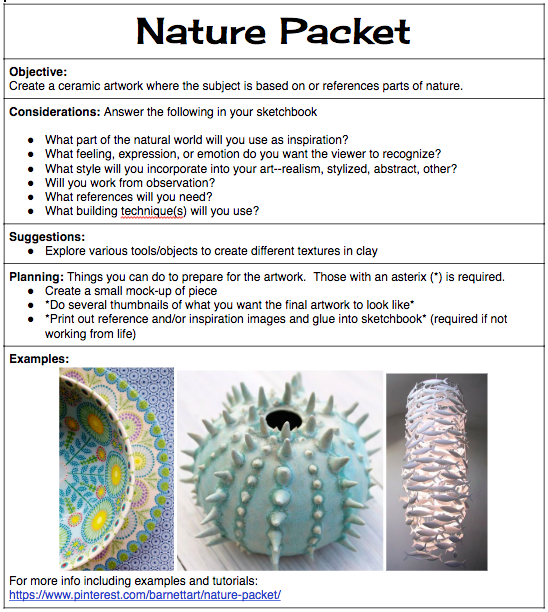
My friend, Ian Sands, developed a system called “the 9“.  They are packets based around the basics of subjects of art that artists create.  It’s not about content, but more about category that art would fall into.  The packets include: the object, architecture, nature, landscape, figure, portrait, imagination, non-representational, and conceptual.  He introduced them to me some time last school year, and I thought they were wonderful.  I’ve been successfully using them with my art 1 students this year.  They are a great introduction to art categories, while allowing my TAB students to make lots of meaningful choices.

I tested them out last year with one of my classes, and thought that they would be a great tool for working with my ceramics students as they move along their artistic journey.  Sometime last spring, I began planning how to use Ian’s model for my ceramics program.  I began researching and decided that for the most part, ceramics artists’ works fall into most of the same categories.  But, I discovered that there are 10 categories, instead of 9.  They include: nature, animal, architecture, “figure”-ative, functionality, imagination, non-representation, portraiture, the object, and conceptual/installation.

Following Ian’s template, I created consideration questions for each packet, changed up the suggestions and geared the planning around requirements I have for my students.  I am very happy with the development of my packets.

Now, here’s where I am dissatisfied with “The 10”.  I rolled them out in a way that I find isn’t working the way I hoped.  I thought it would make my students more independent, so I introduced it with my intermediate and advanced students.  (They meet at the same time.)  I think this was my mistake.  I should have used it with my beginners after we completed the “have-to” portion of our class.  Seeing how my art 1 students are growing using “The 9”, helped me to see this.  Currently with my beginners, we do ceramic artistic behavior units right after finishing our “have to” section.  We just began our first unit, Ceramic Artists are Inspired by Nature, but I think that after this unit, we will pass out sketchbooks and move onto the next packet.  Nature is one of the packets after all.  We will continue through the rest of the year going through packets, picking up next fall with where we left off.  Then we will dive into deeper meaning with Ceramic Artistic Behavior units.

I will continue with my upper ceramic students in the way we are working. With the exception of one student, they are all seniors, and I’m not too worried about it.  They are working and learning and growing.

They say it takes 3 years to really build up a program.  Like I previously stated, this is the 5th year of the program.  I’ve been playing around with it, trying new things each year to replace things that weren’t working.  I feel I finally have a great grasp on the program and the progression it should take to truly have my students behaving and thinking like artists.  The timing of “The 10” was the final piece of the puzzle that finally fell into place.


Screen Shot 2018-11-01 at 9.05.55 AM

Example of “The 10: Nature Packet”


2018 Texas TAB Lab

Standard

One would think that by now I would be sitting in the sun, sipping margaritas and enjoying my summer.  One would think that if one didn’t know me.  I have 2 kids and the Texas sun is way to hot to sit under all day.  Now sipping margaritas…that’s another story for another day.

Screen Shot 2018-06-18 at 2.06.10 PM

My third week off for summer was spent doing some very important and exciting professional development–the Texas TAB Lab (#TxTABLab).  Lori Wallace and Julie Bates20180613_0938451693010827.jpg honored me months ago by asking me to help out with this year’s mini-conference, by heading up the secondary portion of the conference.  This year was our second event.  At our first meet-up, there were about 30 of us tops in this small conference room in a hotel in Waco, TX.  Ginger Tapia set the whole thing up and it was wonderful.  It was there that an event was born.  This year, TAB Lab was definitely the place to be, as we more than doubled the attendance with 67 teachers.  And, I am happy to say that the secondary peeps went from about 7 or 8 to almost 20.  It’s a good time to be a Tx TAB teacher.

20180613_0952401374525972.jpg

Let’s get to it.  Our main meeting hall was the Frank Fickett Center  (FFSTC).  The hotel suggested it because the conference room was not going to hold us all.  It was a wonderful space to be in for 2 days.  The conference kicked off with one of our keynote speakers, Katherine Douglas.  She was unable to make it to Austin, so she spoke via interwebs.  Among the many fabulous things Kathy spoke of, she told us in regards to child art that “adult eyes need to learn appreciation for it”.  She also shared her 7 goals for her TAB studio and her students.

  1. Have an idea20180613_100200859648563.jpg
  2. Get materials and tools to explore idea
  3. Explore/Make idea, with false starts, change directions, mistakes
  4. Know when it’s finished
  5. Put away materials/tools properly
  6. Reflect/Share ideas
  7. Think about what’s next

Thank you Kathy so much for joining us.

That afternoon we went to visit some classrooms.  The elementary teachers broke into 2 groups–visiting both Julie’s and Lori’s classrooms in Pflugerville.  The secondary teachers made the long drive to Taylor to visit my classroom.  I am so happy they made the journey.  In spite of the 80+° room temp, it was an amazing experience.  I talked briefly about my journey, then we toured my room and how it was set up.  We talked about daily activities and classroom flow.  There was much conversation…conversation that lasted well past when I thought we would leave.


We went to dinner at Rudy’s BBQ and went back to the FFSCT for some more art chat and some Paper Smaché with the one and only Clyde Gaw.  Paper smaché is like paper maché, but Clyd-i-fied.


Our second day opened up with our second keynote speaker, Clyde Gaw.  I bet you thought he was just here for Smaché.   He was also here for the cardboard. In 20180613_092720-1358794459.jpghis presentation, he told us of his journey–his life journey–from the train tracks by where he grew up to his current job as a high school TAB teacher in Indiana.  It was interesting to me to hear how and when he met people I know (or know of), like Clark Fralick, Diane Jacquith, Kathy, NanHathaway, and John Crowe.  My biggest take away from Clyde that morning was the rhizome.  He likened things to it and called us rhizomatic. (def 1 def 2).  If you were’t at TAB Lab, but you are meeting up with Clyde at some other TAB event this summer, I’m sure he’ll talk about it.


The rest of the day included a working lunch, small group sessions, mini-presentations from attendees and 2 guest speakers, Priscilla Lamb and Manuel Gamez.  Priscella presented on Autism and Special Ed.  Manuel is the Fine Arts Director for PfISD.  It was interesting to hear the perspective of a non-teacher, someone in admin.  He very much supports the arts and really likes TAB.  Bonus for Lori and Julie. We ended the day with some gelli printing with Lori and some faux screen printing led by yours truly.  Unfortunately, after testing the screen the night before, I didn’t wash it fully and the prints weren’t as clean as I would have liked.  But, my fellow teachers were cool with it and didn’t complain.


After dinner, many of us met back at the hotel conference room and had some cookies, milk, chat, and arting.  It was a fun way to end the day.


20180615_1215441732492350.jpg

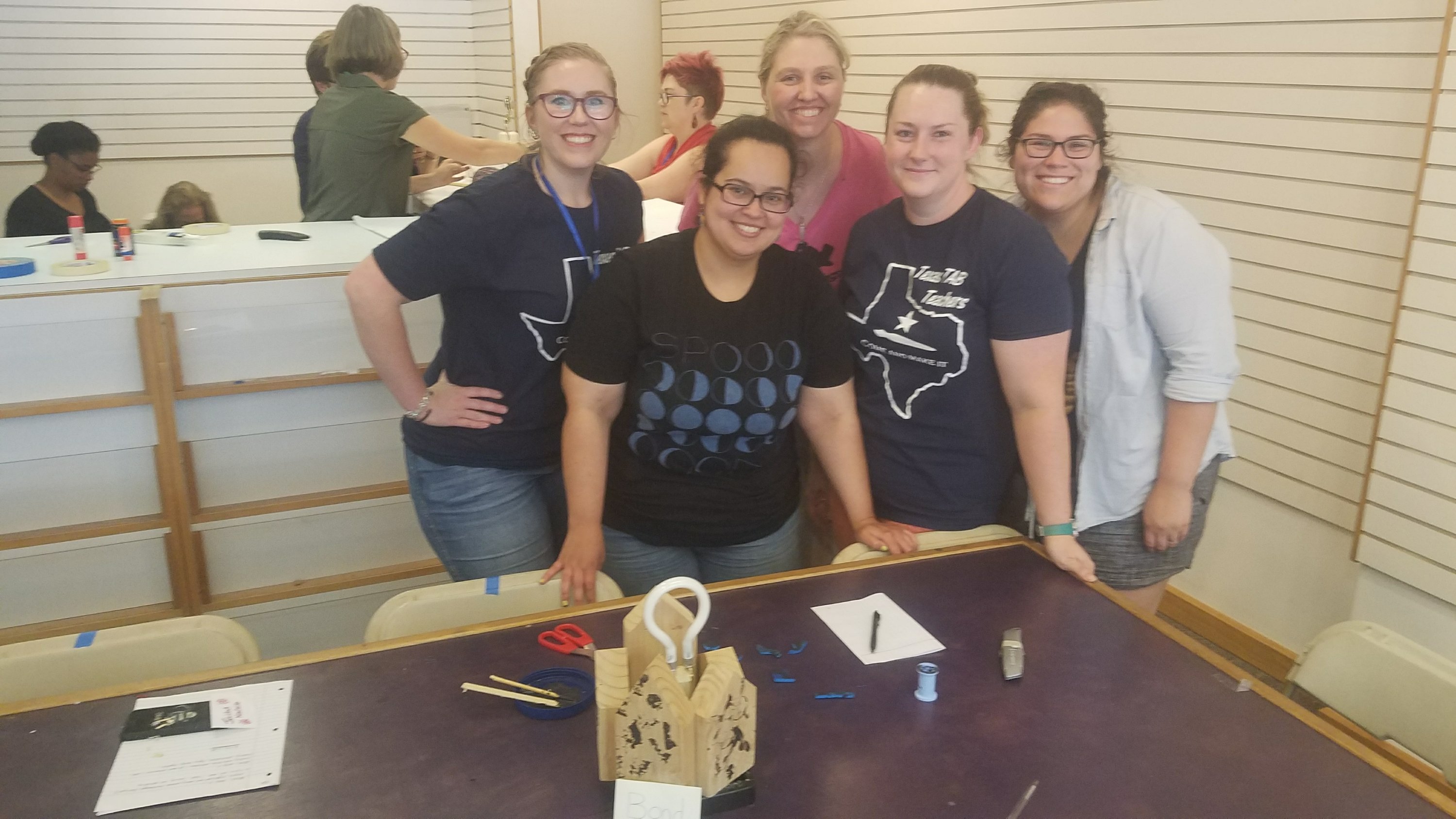
Friday was our last day and Lori had set up a great activity at Austin Creative Reuse.  ACR is a store that is supplied by donations.  It is a TAB teacher’s dream.  Well, and it’s the dream of artists and crafters and people that are into reuse.  We met in the classroom at ACR and split into 2 groups.  Those with the late birthdays went to the store first.  I have already been to ACR, so I knew what was up.  The others were new and were in amazement.  After shopping time, we went back and we participated in what was essentially like “Chopped”, but with art materials. We worked in groups of 4/5.  We were given a theme of “represent”.  And we went from there.  I was fortunate to get with a group where we all just flowed and worked well together.  Our sculpture was called “Bond”.


All in all it was a fabulous conference.  I am so glad that I was able to go and that I was enable to pass on my knowledge to others.  I know that I didn’t provide much of what I learned at Tx TAB Lab, but if you are curious as to what was shared, visit out Padlet.  It has links to almost everything.  I look forward to next year when I hope we go even bigger…it is Texas after all…Go Big or Go Home!  Until then, I have Facebook to be able to talk to my new TAB friends.


The 2017-18 School Year in Review

Standard

Another school year has come to a close.  That makes 11 for me.  The 2017-18 school year was a good year for me.  I had a couple of bumps in the road–that one student who felt she no longer needed to be here (luckily she is still here ♥) and the whole grading issue with me not being in compliance.  Overall, it was a fun and happy year.  So, without further ado, let’s take a look back and see what went down.

⇒ I entered 3 students this year into Scholastic Art and Writing.  We didn’t get any awards or even mentions, but I am proud that I was able to enter the work of these 3 young women.  I think we were robbed, but life goes on, right.

⇒ I was honored when Diane Jacquith and Kathy Douglas asked me to have a small part in the 2nd edition of their book, Engaging Learners Through Artmaking.  I speak of how I include current artists in my curriculum through an activity called Artist Monday.  Students watch a short video and then answer some questions about the artist and what they create.  Artists are always current, and many create art in ways that go beyond the traditional ways my students know about art making.

⇒I took my upper ceramic students on a field trip…on a Saturday!  It was so much fun.  We went to the Texas Clay Festival in Gruene, TX.  My students got to see a woman who was burnishing a pot and talking about terra sigillata.  They saw a variety of artists and got to see what people would be willing to pay for ceramics.  And, they got to watch a raku firing.  I am so glad that we went.  The fact that they were willing to give up a Saturday to go on a field trip was tremendous.  I hope to make this a yearly activity.

Seattle 2018.  This year’s NAEA conference was in Seattle.  I was lucky to be able to present not once, but twice at this year’s conference.  And bonus for me, both were with my very good friend and amazing TAB teacher, Elizabeth Honeysett.  We presented on Single Media and the TAB Classroom.  Liz talked about her jewelry classes and I talked about my ceramics classes.  We also did a ticketed event–The Secondary Choice Demo Room.  This was extra fun for me because I got to see adults make art.   Seattle was a blast.

FB_IMG_1522036718517.jpg

Restorative Discipline was brought into my school in the 2016-17 school year.  Each year they train a small amount of teachers.  I was lucky to be asked to be part of the 2017-18 cohort (cohort 2).  I really like restorative discipline because it focuses on relationships and community building.  It stresses being proactive instead of being reactive.  It was a great fit for me because I am all about relationships and community in my classroom.  We had many trainings throughout the year, which kept me always reflecting on my teaching.  I reflect anyways, but the reflections from the RD perspective made me think about things I sometimes gloss over.

⇒ RD brought the academic circle into my teaching practice.  In RD, there are many types of circle activities you can do with your students and the academic circle is one I really liked.  I utilized it in my ceramics classes.  There had been a disconnect between what my students researched on a artistic behavior and the art making that went along with it.  The academic circle filled the gap.  It allowed me to check what my students learned on their own. It allowed my students to share and connect with each other.  It allowed for questions.  It allowed for students to see ceramic art their peers were drawn to.  And, it helped to clarify the big idea for the students before they moved to the creation of their work.

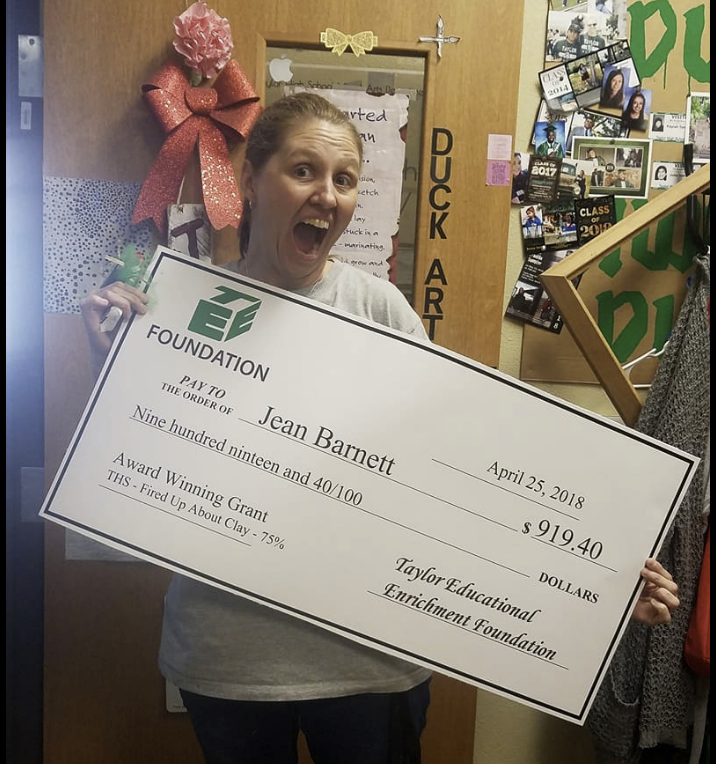
⇒ I applied for a grant and was award it!  In our community, there is a Screen Shot 2018-05-27 at 11.42.27 AMfoundation called the Taylor Educational Enrichment Foundation (TEE) that offers thousands of dollars in grants annually.  I finally got the courage to write a grant proposal for a raku kiln kit.  When the day finallyarrived when we would find out who would be awarded, I’ll admit, I was nervous.  I heard the band and the cheerleaders coming down the hall.  I kept hoping they were coming to me and not going to walk on by.  My principal ducked his head into my office and told me to come out into the hallway.  I was so excited.  I was dancing around my classroom.  I have since ordered and received the kit and I can’t wait to set it up and teach my students how to raku this fall.

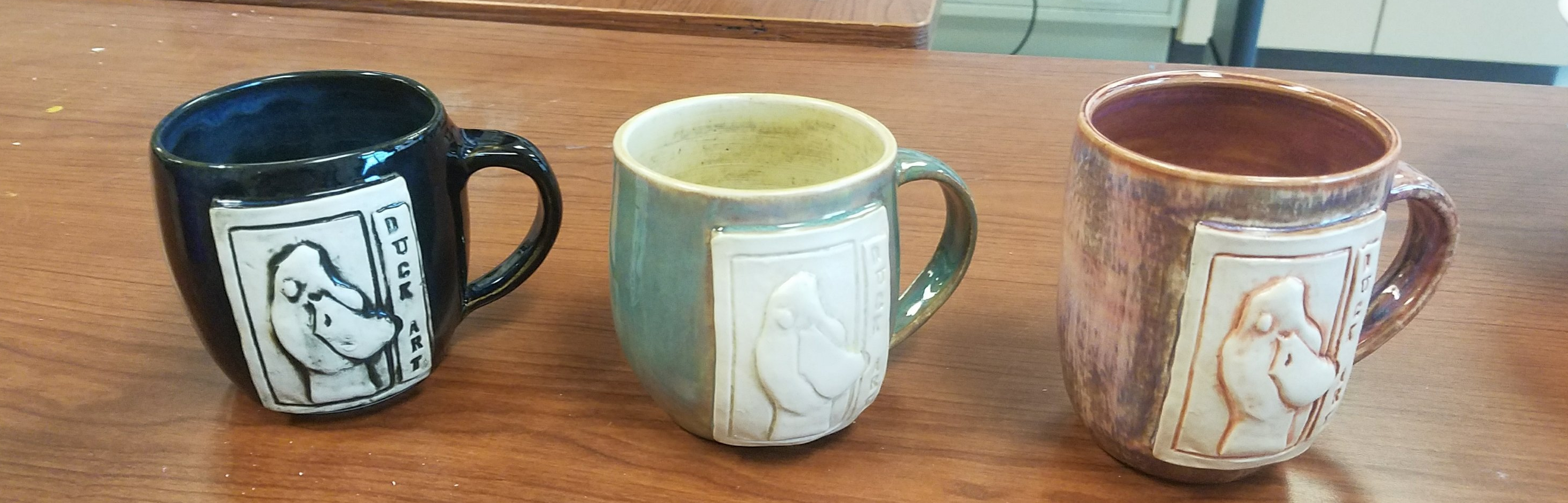
⇒For a few years, I make and gift some special seniors a piece of “Duck Art” pottery.  It started when some seniors bugged the crap out of me for cereal bowls.  So, as an end of year gift, I made bowls and gave them each one.  On the inside of the bowl, there was a duck.  The next year the seniors weren’t into cereal so much as they were coffee.  So, the image was transferred to a mug.  Each year, the duck image changed, but the sentiment was the same.  I made X# of mugs–all similar in shape, color, and image–and handed them out to the lucky ones I had forged relationships with.  This year, I wanted something different.  I really don’t like being a production potter.  I don’t like making the same thing over and over.  I decided to make each mug different and glaze each mug different.  The only thing that was my thru-line was the Duck Art medallion I made.  I made a sprig, which was a good lesson for the students, and went from there.  At the end, the students got to pick which mug they wanted according to their tastes and what fit well in their hands.  This has become the new and final senior Duck Art Mug.


20180521_1245161636134650.jpg

The Duck Art Mug!!

20180430_0817051451780997.jpg

The lefties

Those are really the bigs things that happened this year.  Like I said, it was a good year.  I made some stronger relationships with both students and colleagues.  I am sad that my ceramics seniors are gone.  They were a great group of kids.  But, I am excited for those returning next year.  I learned a lot about my teaching and how I want to move forward.  I really understand the end goal I have for my students–both those that will be with me for a year and those that will continue on.  I have worked hard (and continue to) on how to help my students meet those goals.  I have much in store for next year…I hope to implement “the 9”, courtesy of Ian Sands, with my art 1 class.  I have taken the 9 and created my own version–“the 10”–which is geared for my upper ceramics kiddos.  And, our principal decided to split the AP Studio art program between my co-worker and myself…so that will be interesting.  I am happy with my 11th year, and I look forward to another fun-filled TAB-tastic year in the Duck Art Studio.  But, until then, I will relax and enjoy my summer.

NAEA 2018: Seattle

Standard

I have always wanted to go to Seattle, so when I saw that the National Art Ed conference was going to be held there, I was going no matter if my session proposals were accepted or not.  Luckily for me, I was selected to co-present twice for the Seattle conference.  That meant that I could get reimbursed by my district for the cost of admission to the conference.  (Every little bit given back is helpful.)

img_20180322_101602_7321725555340.jpg

I woke up at 3:30 am to start my journey to the West Coast.  It was a long day, but the beauty of the city made it worth it…not to mention that I was meeting up with 2 of my favorite fellow TAB teachers, Liz and Hillary.  We were able to get out of the city proper and experience Kirkland.  It was so beautiful, and if we could afford it, I would so pick up my family and move there.

But I digress.  Let’s talk about the conference.  I spent this conference a little bit differently than I had in the past.  I barely went to sessions, and instead channeled my friend and fellow Texas art teacher, Arlene Shelton. I wandered around the city for a large portion of the time.  I spent a morning walking in the rain (and snow) down to the MoPop museum.  I took my time and photographed parts of the city that often gets overlooked.  I spent one morning with Joy Schultz walking around Pike Place Market, getting lost in the colors of fresh fruit and flowers, and marveling over the artisans booths.  Hillary and I went on an adventure to dinner one evening and along the way found Jimmy Hendrix, Dick Blick, and rainbowed crosswalks.  I paused for over a half hour Saturday morning to stand in solidarity as my fellow Americans walked in the “March for our Lives” protest.  And, I drank more coffee than I would like to admit.


20180402_140935568186445.jpg

I did go to a few sessions, and I did present twice (these 2 sessions will each have their own posts.)  But, to be honest, it was tough to find things that interested me.  I went to every ceramics session I could find, but there wasn’t much that was new to me. In fact, one session got me so fired up…  Let’s just say, as art teachers, we need to stop perpetuating techniques that are dangerous.  No matter how cute it is.

Out of the 6 or 7 sessions I attended over the 3 days, several did stand out.  I went to one that was about STEAM…well…it was really anti-STEM/STEAM.  One of the speakers was Cindy Foley.  She is amazing to listen to and I could have just sat and listened for hours.  She is so passionate.  (And, did you know that STEM really means “Strategies That Engage Minds”?  Yeah, neither did I until Cindy told me so.)  Another session that was wonderful was by Pam Ehrenreich.  She talked about how she TABs in her high school class.  Ask her about her “Random Objects of Treasure” collection, you won’t be disappointed.  Clara Lieu gave a session on art critique.  I found it super helpful as having student critique each other is one of my weak areas in my classes.  Every year I do improve though, so there’s that.  And, finally I went to a session by Candi Poll-Price on assessment.  It was fantastic.  I was sad I had to miss the end, but my session was next, so I had to take off early.  (Also, I needed some more coffee.)

20180321_1839052022233196.jpgI hadn’t planned on spending the conference going to so few sessions.  I had hoped there would be a ton for me to learn.  Unfortunately, when I looked through the program, not much stood out to me.  There were TAB sessions, but many were for elementary or they were sessions to get you excited about TAB.  I already am excited about TAB.  I don’t need to be convinced how amazing it is–for both my students and for me.  I know this is going to sound a bit egotistical, and that is not my intention.  I felt there wasn’t much for teachers, TAB teachers specifically, at my level in the ways of development.  Things I want to discuss and think about are above the beginning levels.  Don’t get me wrong, those types of beginning level sessions are of extreme importance.  And, I love presenting and giving.  I just need to be getting something too.

I am glad I went because I had numerous important conversations with my tribe at the TAB dinner and at other eating events.  Funny how food and drink do that.  Those conversations are what I really got the most from this year.

20180323_1032351374836076.jpg

20180323_205055349308201.jpg

I will not be attending NAEA19 in Boston next year.  I am opting for another Boston event–the TAB Institute in the summer of 2019.  I am looking forward to the amazing things I will get from it and from the teachers who will be attending with me. Until then, thanks Seahawk fans for accepting this Packer fan into your town for a few days.