Category Archives: Classroom

Skill vs Creativity

Standard

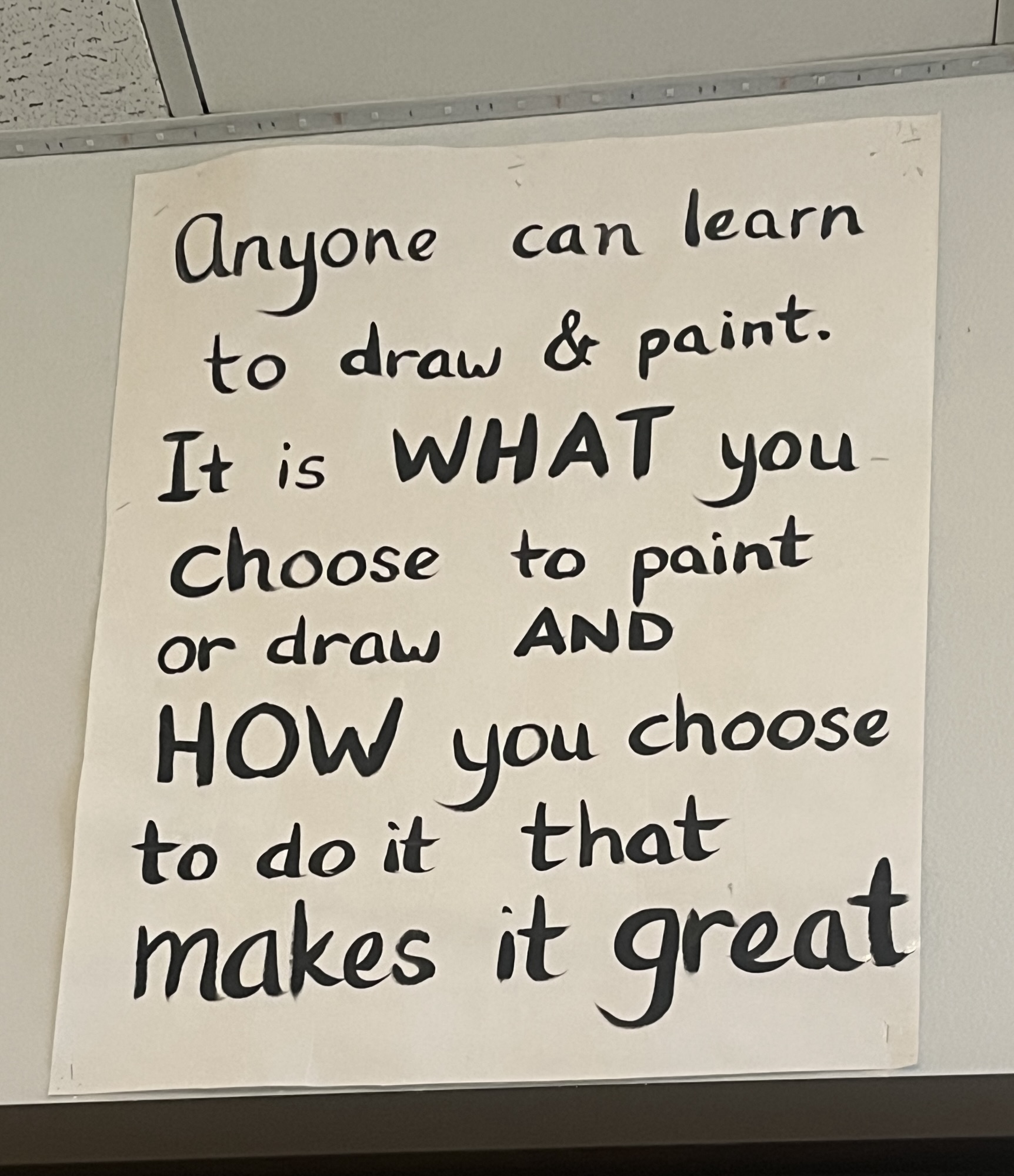
As a teacher that has embraced the Teaching for Artistic Behavior (TAB) philosophy for almost a decade and a half, I still find myself struggling sometimes with with debate around skill and its importance. I know it’s important for artists to have technical skills and for them to continue building those skills. Buuuutttt…. should that be the most important thing in the high school art room (or any art room for that matter?)

I was doom scrolling the other day, and I came across this reel in my IG feed and I finally felt a little bit of validation. The artist talked about an art teacher he had that pretty much said what I had felt in my art heart all these years.

Gabriel talked about an art teacher he had who said that “technical skill is extremely overrated. And she had visited a school that prioritized the technical ability versus teaching the students creativity. And while their paintings were very technically well done, they were super dead, boring, not inspiring whatsoever.” He goes on to say that he thinks we put technical ability on a pedestal way too much, and that there isn’t enough credit to the creativity. Skill is still important, but it is a means to show that creativity.

I couldn’t agree more. There are times when I go to conferences and see “award winning” art, or I scroll through Facebook looking at other high school programs and I feel a sense of insecurity. I begin to question if I am doing a disservice to my students by focusing on the process, on creativity, and on what they have to say over spending day in and day out just learning and practicing technical skills and realism. But then I pause and picture in my mind’s eye the work my students are producing. Some of my students are very skilled. Others still have ways to go on their journey. But their work is so expressive. It has life. You can tell they explored new things. You can see the energy in their marks. I think of their faces and conversations when they are in our classroom studios creating, and it fills me with joy. I watch them push themselves to be better than the day before.

It’s not that I don’t teach skill. It’s not that I don’t encourage practice to make better. I do those things. I just don’t preach that it’s the pinnacle of art making. I teach new skills for my students to have in their tool boxes. We practice technical skills every time we make in the art room. It’s just that I put the onus on my students to choose which technical skills they want to practice to get better at. There are so many mediums and techniques that I can’t teach them all, and I am not going to choose which ones are more important than others to focus on. I will let my students decide what is important to them. I let them guide me when it’s time to explore new mediums and techniques.

In the end, I am not saying that those classes that focus on technical skill are wrong. If that is what you want your focus to be, then that’s your prerogative. What I am saying is that I am proud of my students and the work they create. I am proud of my program. They are proud of their work and their growth! Personally, I would rather have my students make work that carries their feelings and emotions out to the world, than a bunch of pretty pictures that are technically well done.

Let’s Go? Advice from almost 2 decades of teachering.

Standard

I’m about to start year 19, and man have I had an interesting career. I’ve taught high school for 18 years, AND I’ve done it all in the same place. I can retire in 11 years, but plan on doing at least 12 so I can retire on an even number. But, that’s just an arbitrary date. I’ll see the state of education when I get there. I may be done, I may not be. Who know’s. ::shrug:: But this post isn’t about when I’ll retire. This post is about a few things from my journey that helped to get here…to today…a week and a half before I walk into day one of in-service for year 19.

When I look back on everything, there are a few key things I’ve learned that keep me going, keep it relevant, and have made me into the force I am today. Yes–I said it, I am a force. I haven’t always been so confident in my abilities, but today I am. I am a good, nay, an amazing teacher. I am really good at what I do. Do I have some areas I can work on? Of course–who doesn’t? What makes me so different is that I know there are things I lack and I reflect on that and I learn and continue to grow in this ever changing, but not really changing, world of art education.

I want to share some of what has motivated me, and helped me to believe in my abilities over the years. It always hasn’t been sunshine and puppies (although I don’t really like puppies–come at me bro–so maybe that phrase for me should be sunshine and art supplies. Just sayin’.) I’ve had my fair share of crap days and considering moving districts and not wanting to go to work, but in the end, I show up because deep down, I love teaching and I looooove teaching art to teenagers.

So here we go!

It takes 3 years to build a program. I was told this by Ian Sands at the beginning of my TAB journey. And, he was right. I now say it to everyone who is new to a role or implementing TAB for the first time or even starting at a new school. You may think you have it in the bag and that it’s going to be easy peasy, and that attitude is great. But, as you go along the first year, you will hit bumps and things won’t work. You’ll be learning how your population reacts to you, your goals for both you and them, and your systems that you are trying to implement. You will fail, and THAT IS OKAY. Learn from those failures and revise the next year, or even as you go along that year. Teaching is like making an artwork–we have an idea, we research, we develop plans, we try to implement those plans, we revise, we fail, we reflect, we try again, then we start the whole cycle again. By that third year, you really do understand the relationship between you and your population, and you can see the growth that you’ve made and your program has made. It’s easier in year 4 and beyond. That’s not to say that you stop reflecting and revising, but at that point it’s different. So, don’t give up. Give yourself grace. I needed this “3 -year build” advice when I jumped into TAB. Then I needed to remind myself again when I switched up my sculpture program to a purely ceramics program. Rome wasn’t built in a day. Just sayin’.

Administrators come and go, but good teachers stay. One of my favorite co-workers, and a great friend of mine, said this to me about year 4 when I was struggling with my principal and the differences of opinions we had. And she was right. That principal left, finally, and left space for one of the best principals I have worked under. He wasn’t perfect, but he was perfect for me. He took time to understand me and my program. He knew what I needed both professionally and personally. He supported me. Unfortunately, he had to move onto another district, and my current admin isn’t him, but I know that some things are temporary. When you find your place and find what feels right, even when admin and you just don’t mesh, you stay. I love my program (which I helped to build from very little), and I love my population. I love that I’ve taught all the siblings in a family or am going to. I don’t always agree with my district or the town I teach in, but I know that being a constant in the district is important to what those families love about being ducks.

Remember your why. I know all you reading this just totally cringed at that phrase. I hate it too. I’m not talking about when admin asks you to try and placate you because they aren’t giving you a raise or there is some other stuff thing they are doing. This is super TAB specific. I said this to my secondary cohort this summer at the 2025 TAB Institute. I saw the eye rolls. But then I went on to explain. What are you trying to achieve by implementing a TAB philosophy? What do you want from your students? This isn’t about the methodology and how you will do this, but why you CHOOSE to believe the philosophy? This is my why: Yes I am hoping to make artists, that is my dream goal that everyone of my students will be an artist. And yes, that drives all the decisions about how I implement TAB–from the choice continuum, to themes, to the supply buffet. But let’s be realistic. That is not my population–they are not all going to go to art school and become artists. And while yes, I am trying to make artists, my why is really is about helping my students become creative and become independent thinkers. I am helping them to be able to make choices, informed choices. I am helping them to have an open mind and to see that things do not live in a vacuum and things are cross-curricular. That is my goal. Art making is my vehicle to get there. TAB allows me to do that more than any other art education philosophy I’ve explored. And it allows me to do it in my own way, using my strengths. So, when I am having those days full of doubt and questions, I think of my students and the ones that I have impacted well after they’ve graduated and the ones that are currently making a mess in my office, and it all makes sense again.

I’ll leave you with this. As you go into this new school year, whether it’s your first, your fifth, your nineteenth, or beyond, have confidence in yourself and your ability as a teacher. You’ve got this. I am already facing challenges this year, both personally and professionally. I can go in with an eff this attitude, or I can focus on what is important to me, inside my classroom with my students. I will take what they throw at me and try to see their point of view, but in the end, while I will be compliant with their requests (for the most part–iykyk), I will just do me. I know my program is strong. I know I am strong. I know my students will thrive because of what I am setting up for them. I know I’m not perfect and that I have things to work on, but I don’t have to be perfect, because clearly no one is and the conditions we teach in today clearly aren’t either. I just need to shut my classroom door, have fun, be present for my students, remember my why, and be imperfectly me. Everything else is just noise and in the end doesn’t matter. Have a wonderful year.

Classroom Protocols in the Time of Covid

Standard

I know it’s been a while since I last wrote. It’s been, well, it’s been a semester–interesting, frustrating, at times apathetic, and at other times guilt-ridden. I am sure most of you know what I’m talking about. I thought I would start off the new year with trying to look at the positives, with hopes that I can help some people. We spend 2/3 of the first semester doing both in-person and asynchronous. Like other in-person art teachers, I had to figure out material procedures that worked within restrictions handed down from on high–no group work, no sharing, single-use if possible.

I run my TAB studio in a very self-serve type of environment. Unfortunately this year, that wasn’t feasible and I didn’t set up the studio as normal. ::sad face:: Fitting the expectations set out for me to work into an open studio was frustrating, but over the 3+ months I’ve had students in my room, I’ve been able to come up with strategies to make it work. I do have less than half the students I would have normally in my room, and my largest class was 12 (half my normal cap BUT it was a ceramics class, so that made things interesting.) Fewer students does make some things easier, I will admit, however, I did need to order a bunch of supplies that I wouldn’t normally order–more new brushes, lots of extra tools, extra sets of some media, single-use condiment containers, mesh bags. But in the grand scheme of things, it will help out in the future as there are some things I think I will continue using and doing after we return to a more “normal” school life.

Let’s do this…

Time Out area:

  • I got this idea from another Texas TAB teacher, Lori Wallace. Not sure if it was her idea or not, but it’s a super awesome idea.
  • It’s an area on my counter that I marked out as the time out area with some tape. (A student thought we needed a fun zone too, so there is that section next to it labeled as such.)
  • Students put all used tools and materials there, so at the end of the day I can sanitize spray them.

Clean Cups and Dirty Cups:

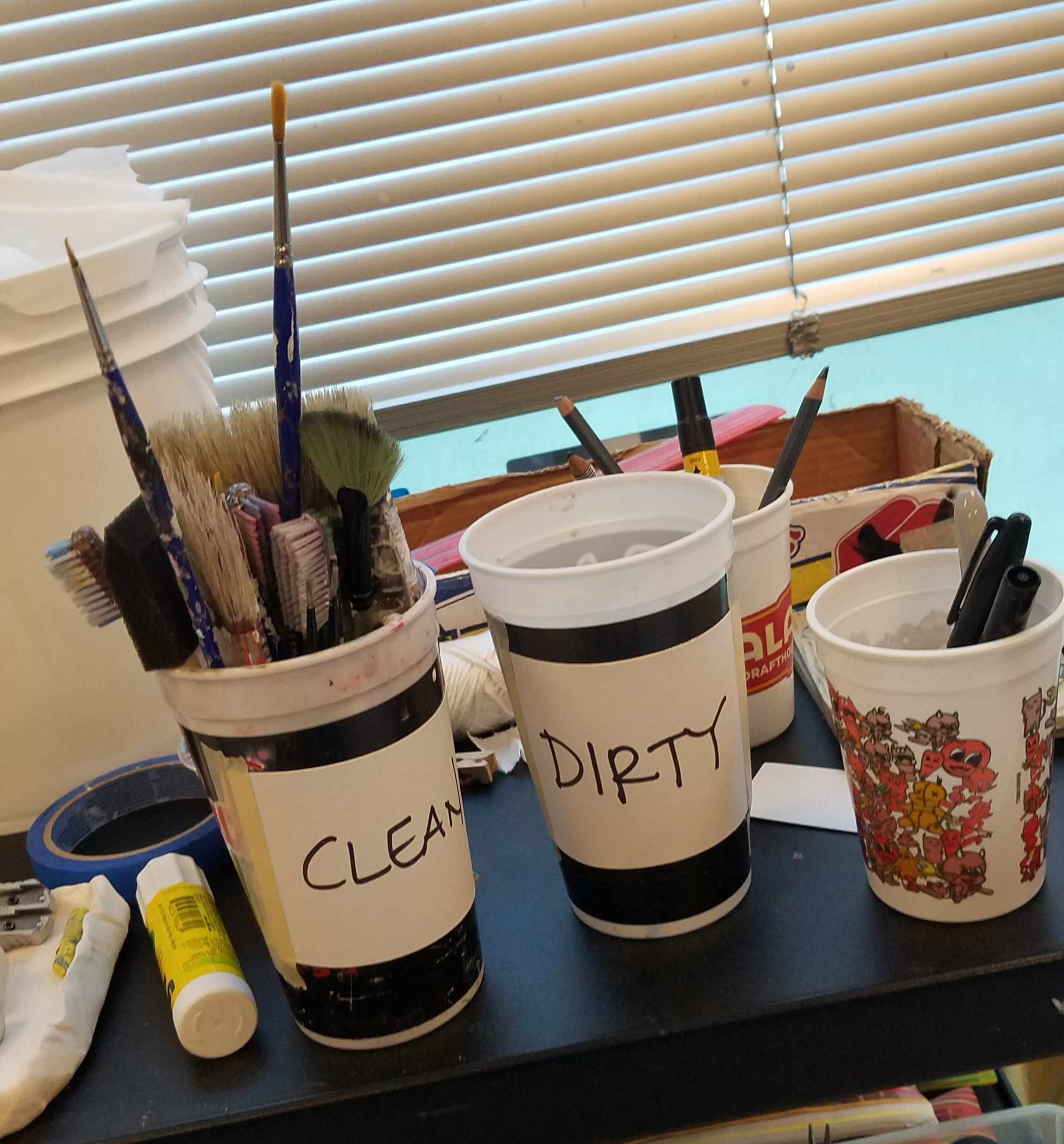
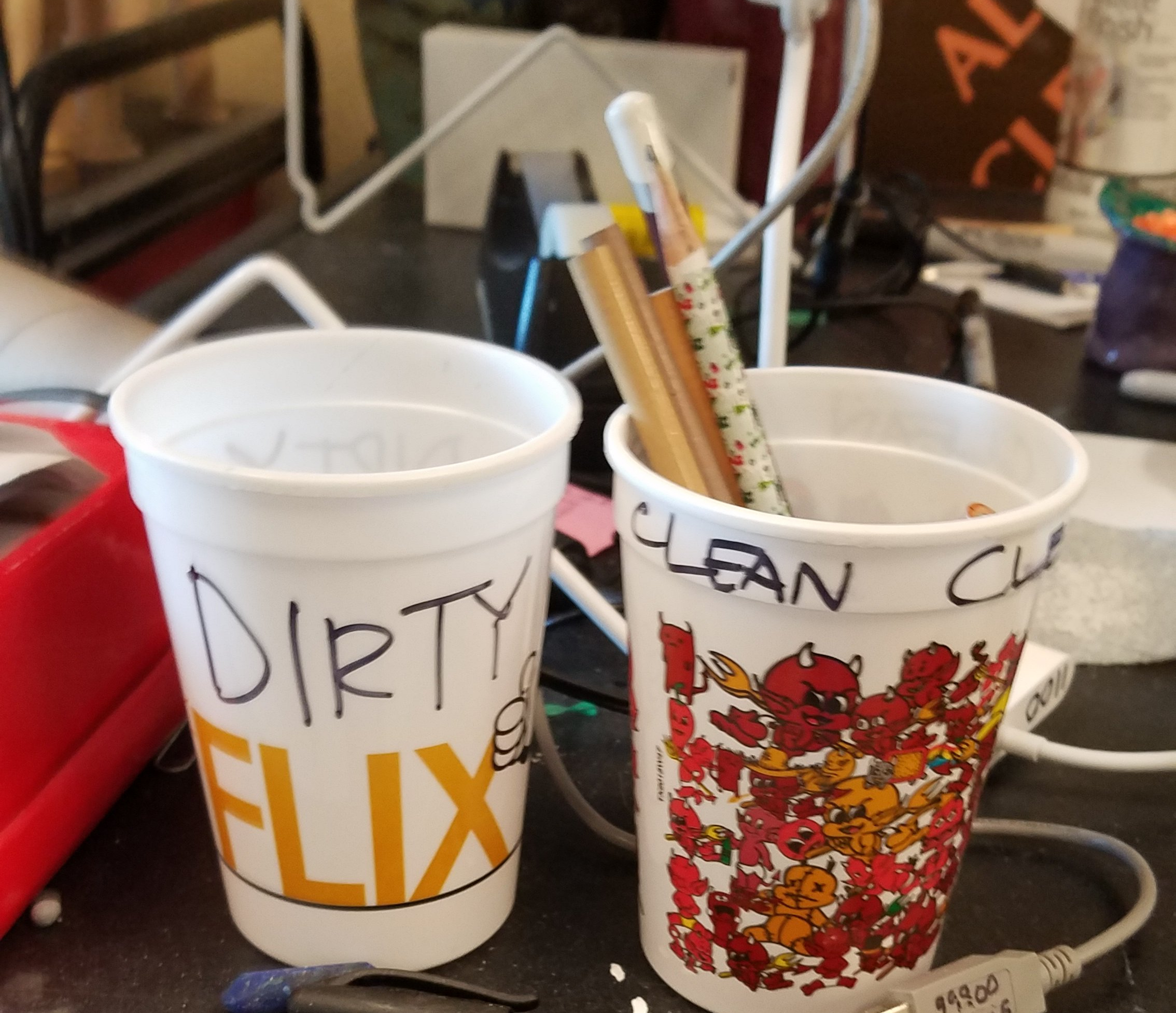
  • In a few different places, I have 2 sets of plastic cups–some labeled clean, and some labeled dirty.
  • Cleaned tools (pencils, sharpies, skinny paint brushes, etc) are in “clean” cups.
  • After student use, they put the tool in a dirty cup (this includes hand sharpener and erasers).
  • I wipe down the hand tools with the provided sanitizing wipes at the end of the day, and then put them back into the clean cup.

Mesh Bags:

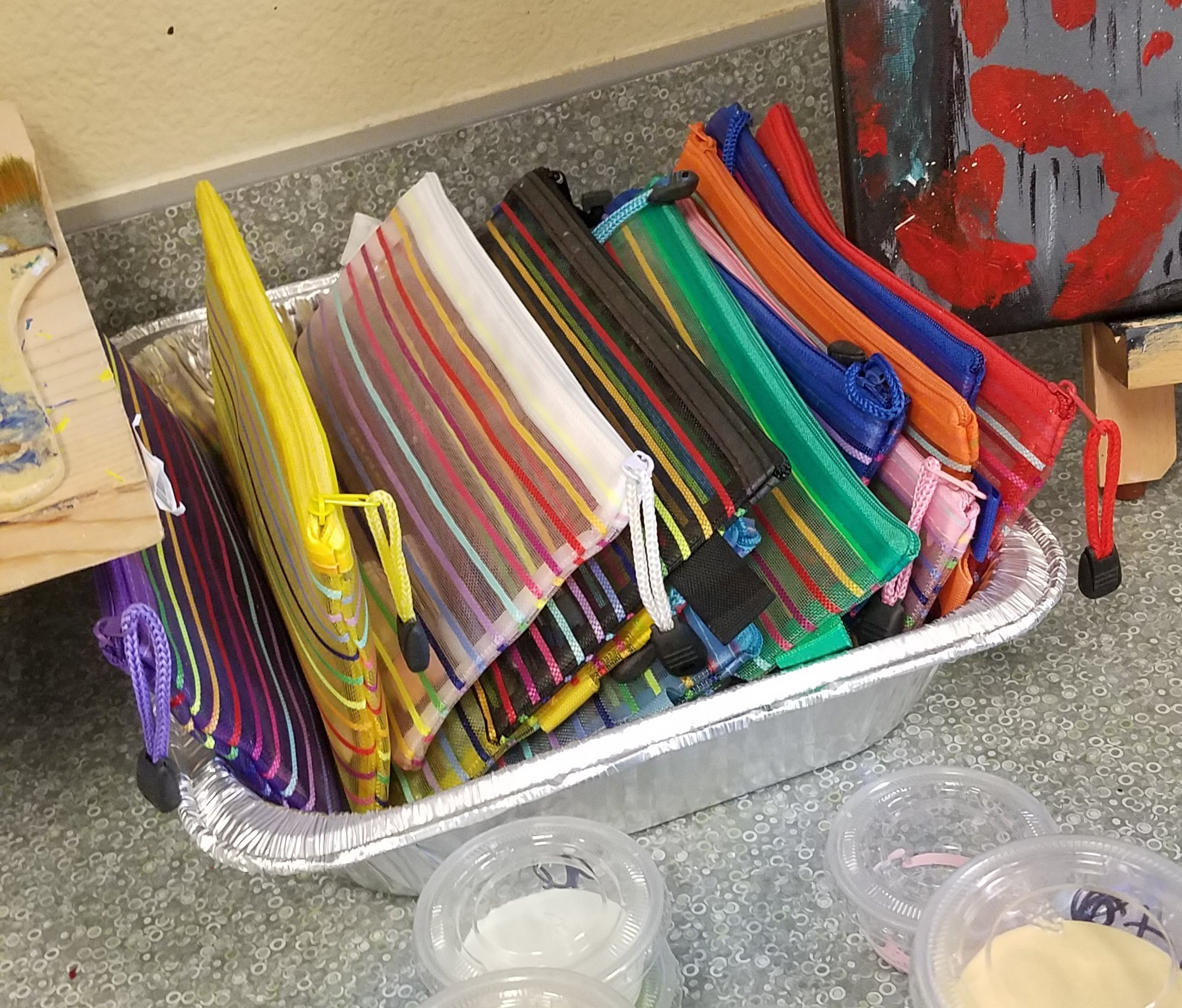
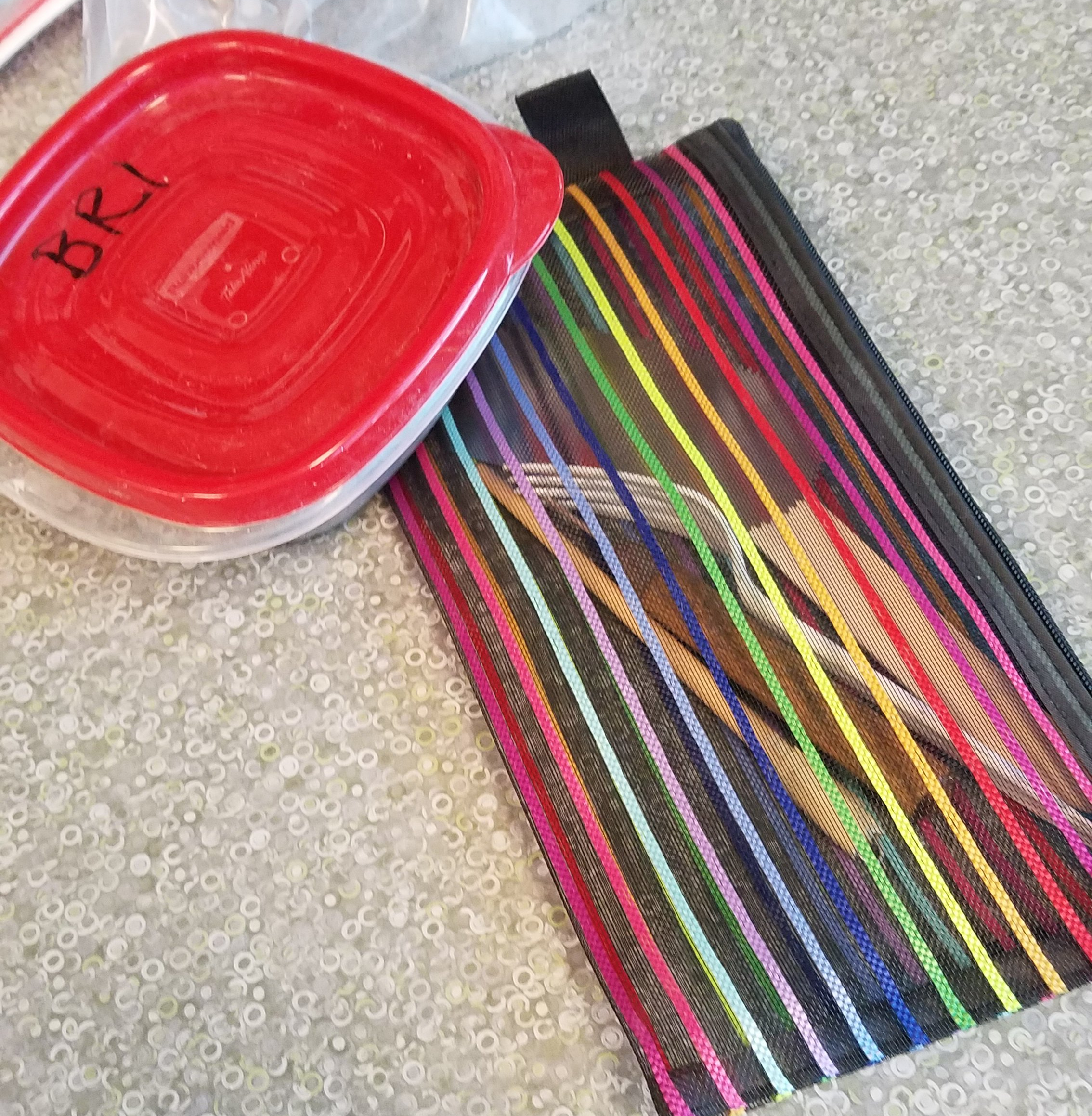
  • I bought these mesh bags with a local grant, about 80 or so of them. I use them for many things: sets of acrylic brushes, sets of watercolor brushes, ceramic students individual tools, sets of brush markers.
  • What makes them nice is that after the students use whatever is in them, they can put the bag in the time out area, and I can just spray the bag, turn it over, and spray the other side. The bag is mesh and plastic, so it gets the inside contents and allows for drying.
  • This will be something that continues next year…using the bags for sets of things.

Materials List/Paint Color List:

  • I made a list of all the different media I had to offer and a swatch of all the acrylic paint colors I have. I then laminated them and taped them down–one on each desk
  • Students can tell me what medium they would like and I can get it for them.
  • Students can tell me what paint colors they need, and I get those too.
  • This lessens the amount of hands touching things–I wear gloves to get the different media.
  • I don’t have to worry about sanitizing the paint bottles after each use because I am the only one touching the bottles.
  • I put a piece of copy paper on each paint tray (cafeteria type trays), squirt on the selected colors, and give the students their paint. They throw out the paper and put the tray in the time out area.

Individual Student Tool Sets:

  • This is mostly for my ceramic classes. This was costly, but there wasn’t really any other way. Tool kits were made; some sent home (and they come back when kids come back), and some stayed for in-person.
  • Each student has their own cubby where they keep their tool bag. I repurposed my cubby since I didn’t set up the studio as normal.
  • Each kit has a needle tool, a serrated metal scraper, a wide paint brush, a home-made sgrafitto tool (that each student made themselves), and a piece of canvas. I also bought a ton of wooden dowels (which I cut down to size to save money) and those longer, thicker paint stirrers. This allows for all to be able to use at the same time or for some to sit for a few days without being touched. These purchases will help out in the future with full classes.


Damp Boxes:

  • I have enough shoe box size to give each of my upper students their own box–both for in person and remote.
  • I walk around with large, under the bed size or sweater size ones, for my beginning students. I just go down the line, with gloves on, and give out each project. I do the reverse for clean-up.


Single Use Condiment Containers with Lids:

  • I originally bought these to send home underglaze to my ceramic students.
  • They come in handy for passing out regular ceramic glazes.
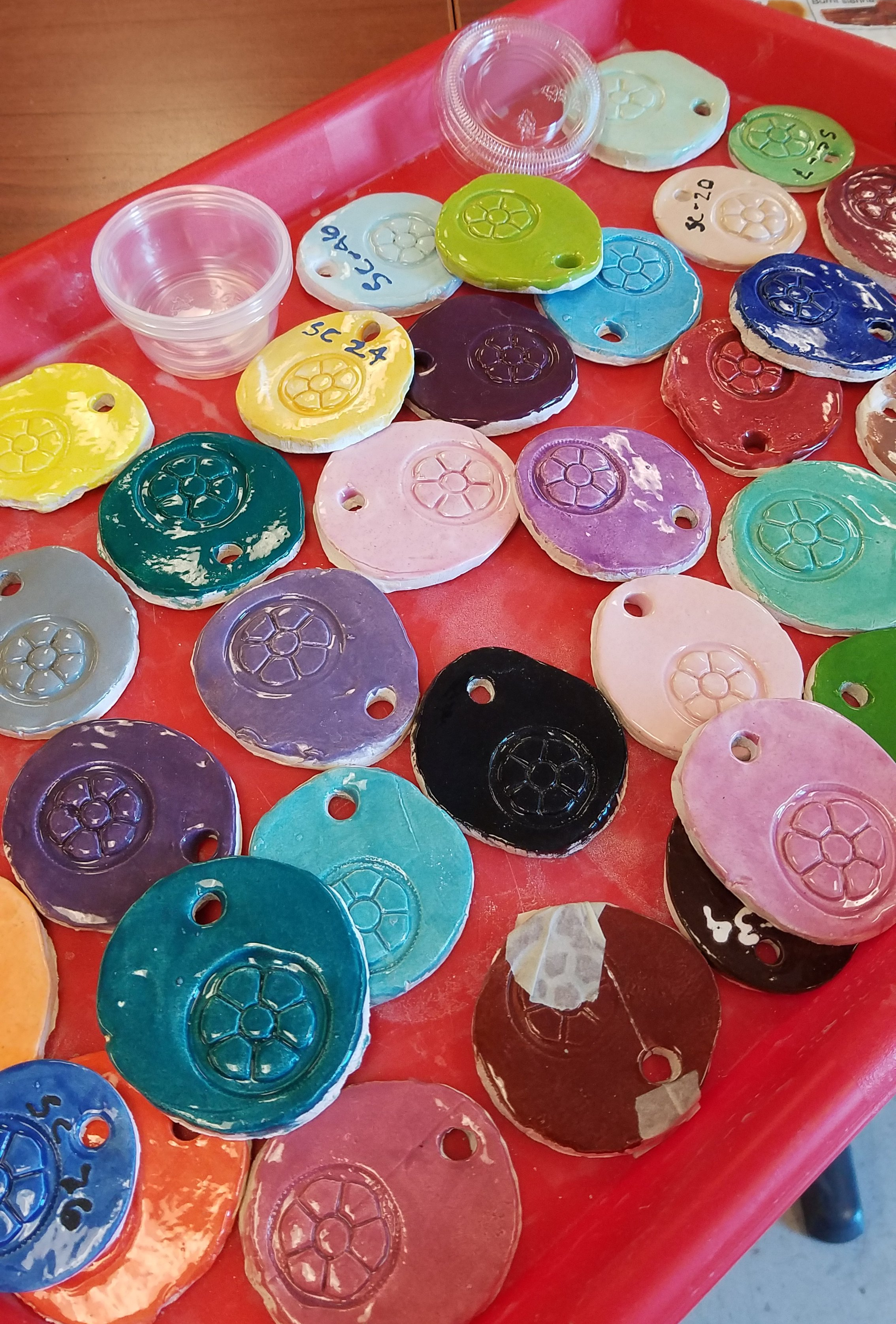
  • I took all my glaze tiles and put them on a tray. Kids can point to the color, and I then mark the cup with the glaze number in a sharpie, and then return the lidded glaze-filled cup to them. They also know what number glaze they had so they can ask for more.

A Zillion Washcloths:

  • Washcloths really are the best way to clean-up clay tables and paint spills. Those school paper towels suck.
  • I bought over 100 of them from Walmart.
  • Each one is “single” use. Student take one from the clean pile and go clean-up their table.
  • They then put the used washcloth in the bucket by the sink after they are done with it.
  • At the end of each week I was the washcloths for next week. I am lucky that I don’t have to take them home–I was given a key to the washers/dryer in the girls athletic area.
  • It’s a little more work, but it is actually cleaner than when we would share the rags–so many less cloudy tables because kids don’t understand to rinse and ring the towels first before wiping the table–because more than likely, the person before didn’t rinse it.

Gloves:

  • The district does supplies me with gloves and I go through 10 pairs a day maybe.
  • Gloves do help to pass out supplies and whatnot to the students…and you will need to pass out a lot. You’ll feel like a waiter, but it is what it is. Lol

I think that is all. I know this is long, but I hope it is helpful to those of you that struggled first semester with having an open studio or those going back to in-person for the first time. Like I mentioned, I sometimes feel like a waiter, and it is tiring many days. My kids like to remind me when I don’t hand out table wipes at the end of the day, and they laugh when I yell that I’m about to take my gloves off so it’s last call for supplies for a while. Undoubtedly, I get someone that needs something like a minute later. ::shrug::

“Lucky” Number 13?

Standard

This year marks my 13th year as a high school art teacher.  I have spent all 13 years in the same district, at the same school.  I have had 3 principals, 3 superintendents, countless colleagues, and over 1000 students.  Lots of things have changed over the years–some sad, some bad, but mostly good.  I have been lucky to have found a teaching philosophy, TAB, that really resonated with me and kept me from giving up on teaching all together.

Through the years I have seen amazing growth and creativity.  I have watched students eyes get wide as they discovered clay or when they were told they could choose whatever material they wanted.  I couldn’t have asked for a better journey.

As anyone who has gone on a journey knows, it’s not all puppies and rainbows.  And, this year has really demonstrated that for me.  I am having one of the hardest years I have had since my first year teaching.  I’ve had one of the hardest groups of students to come through my program.  I’ve written more referrals in 3 months than I did in 10 years of teaching; and if you know me at all, I’m pretty lax when it comes to discipline.  I just don’t write referrals.  Cell phones drive me up the walls, and kids doing homework in my class instead of arting gives me agita.

But, what really gives me pause this year, is the level of thought being put into the work.  And it’s mostly in my Art 1 classes.  Unfortunately, it isn’t a very deep level of thought.  It’s like they feel thinking is the hardest thing they have ever been asked to do. (Perhaps it is, who knows?) Now, I have always met students where they are in their artistic journey, but this is so different that what I am used to. We’ve normally had to work more on skill and less on concept.  This year it is a lot of column A and a lot a column B.  It has made me question how I am facilitating my TAB studio.  I feel like what I am doing isn’t enough to help them grow during their time in my class.

I have been taking notes and reflecting on years past to see what I can introduce to help them snap out of this lazy thing they call high school.  I know it is in there somewhere.  I know I can find a way to challenge them.  I think it’s a combination of the packets, themes, and explorations.  I’m not 100%, and I have more planning to do.

Year 12: A Review

Standard

I have completed my 12th year in eduction, and coincidentally, my 12th year as a

HS Art Teacher at the same school. It’s been an interesting year, to say the least. Many changes began and will continue in our district over the foreseeable future. Some good, some meh, and some make me say blerg.

Anyway, for the most part, things went really well in my TAB studio this year. This was my 6th year as a TAB teacher–I think. Maybe 5th. Who knows, and it isn’t really important how long I’ve taught under the philosophy…just that I believe whole-heartedly in it.

So, without further ado, here is my countdown (as usual) of my favorite moments of the 2018-19 school year.
7. CHANGING RELATIONSHIPS WITH ART: Not one, but two students (that I know of) changed their relationship with art. Both were freshmen this year and both took their required fine art credit this year to get it over with. About a month or so into the year, I over heard one girl telling her friends that she hated art, but because of they way I ran the classroom, she no longer felt that way. She liked the freedom and the faith I put in her. She liked making what she wanted to make. A while later, perhaps after the midterm ( the Tantamounter–old link, but you get the jist), another boy who was only there for the credit and I had over heard several times say he hated art, saw that he wasn’t limited to 2D work, and he came alive. Anytime he could figure out what to build to satisfy the packet umbrella, he would. He couldn’t wait to get started, and would go into the supply room and just dig and create. I am glad to say both signed up to stay with me in ceramics next year.


6. RAKU: Last year I was awarded a grant to purchase a raku kiln for my program. We finally were able to use it this year. It was so much fun. It was a great experience in building the community of my intermediate/advanced ceramics students, and it was such a learning experience for me…I learned a lot about propane. POST

5. ANOTHER GRANT AWARD: This year I applied for another grant, and after much delay, I was finally awarded at $5100 grant to purchase a pugmill for my ceramics program. We have so much dried up clay, and I just can’t wedge it fast enough. (And, due to our schedule and time limits and space, it is not that easy to have the students do it.) My order has been placed; now I am just waiting for it to arrive.


4. T.O.Y. NOMINATION: I was nominated for our Teacher of the Year award. While I didn’t win, I was happy that at least 2 people (you have to be nominated several times to make the final list) thought enough about my teaching and my presence at school to nominate me.
3. PACKETS: This year was the first year I based both my art 1 and beginning ceramics around “The 9“. The packets were developed by Ian Sands, and he let me use them in my classes. I used “The 9” in my art 1 classes and I developed “The 10” for my ceramic classes. I am really happy with how they worked in the classes.

With my art 1 students, we learned some basics about the topic, then the students went through the ATP (Artistic Thinking Process) when interpreting and creating their work. I found they gave the students a place to start with a broad overarching type of artwork, but helped to guide them in how and what they would make. I have some things to tweak for next year in the consideration questions and my input/talking with the students at that stage. But, overall, using them was a major success. I also thing that it will be a smooth transition to art 2 when we dive more into content of their art.

My beginning ceramic students have their own packets. We started with “The 10” before the end of the first semester, and got through 4 or 5. It was a good place to stop and a good place to pick up in intermediate next year. I think it has been helpful in developing style and interests in ceramic art. I think it is harder for many high school students to communicate in 3D than in 2D, so having the different genres of ceramic arts to guide them is important in the journey. I also think it helps to teach the ins and outs of working with clay. We shared and compiled information in different ways as I tried to figure it all out. But, I made lots of notes on how to proceed with The 10 next year in my large group of incoming beginner ceramicists. I am excited for the next group to come in to the studio.
2. SKETCHBOOKS: Every year I change how we are going to do sketchbooks. For the past two years I bought sketchbooks and then had the students buy them from me. This year, I wanted something more. I wanted their sketchbooks to mean something, since I was going to have the kids use them for everything (except drawing tests and artist Mondays). So, instead of purchasing books–either me or them–I decided to have them make coptic stitch sketchbooks. It was a great decision. We did them the first week of school–you know that time when schedules are finalized and kids are coming and going. It was a lot of prep work, but worth it in the end. Most kids took ownership of their books. It was a mostly relaxing way to start off the year, talk about what was needed to be talked about, and to chat with the kids. Most kids took their sketchbooks home at the end of the year.


1. AP STUDIO ART: This year, for whatever reason, my principal had me teach a section of AP Studio Art. We have only had 2D portfolios in the past, and my partner has taught the class(es) since I had started. I was both excited and scared. I found out before the 2017-18 year ended, so I convinced a ceramic student to do the 3D portfolio. She agreed and they created the class for her. My 2D students ended up not doing the portfolio. I knew they wouldn’t. AP was the only 2D class they could sign up for senior year. But, my ceramics girl…she kept going. She worked so hard, and created some of the most developed ceramic pieces that have gone through my program. She completed and submitted her portfolio with a week to spare. I don’t care what scores she gets because the process of doing the portfolio itself changed her and taught her so much. That’s what is really important. I couldn’t be more proud of her.

That about wraps it up. Not everything was good or easy, I did have a student pass away from congestive heart failure. That was hard. And, I had some rocky friendships with colleagues develop this year. But, I can’t dwell on that. I was lucky to have an amazing group of students this year–kids that made me want to be there for them and be a better teacher for them. Overall, it was a good year in the #DuckArt Studio. I wonder what lucky #13 will bring in August.

TAB, Modified TAB, and Other TABby things

Standard

TAB is a huge buzzword these days. I see it thrown around in many Facebook groups. But what is TAB exactly? TAB is an acronym for Teaching for Artistic Behavior. It is a philosophy that has three core values. It asks “What do Artists do?” It believes the child is the artist. And, it believes the art room is her/his studio. It is these three ideas that drive a TAB teacher’s curriculum…how they run their studio.

That brings me to my next topic, Modified TAB. This isn’t really a thing. A teacher either believes in the philosophy or doesn’t. They don’t really pick and choose which of the values they want to believe. What confuses people is the misunderstanding that being a TAB teacher means you are balls to the wall full choice, all day long. Like I said…this is a misconception of the philosophy. When running a TAB studio, no matter the level, there is a spectrum of choice. The amount of choice a teacher will allow has several variables.

  • Campus/district expectations
    • Some teachers are expected to do x, y, and z. And most of us do like to be in compliance.
  • How “on board” a principal is with the change in the art program.
  • Bootcamp vs studio time
    • bootcamps are short amounts of time where the full class will explore a specific topic such as acrylic paints and color theory or copyright. Bootcamps should last a few days to a week tops. Studio time is where the students create their artwork.
  • Needs of the child
    • Each child is different in their learning styles and how comfortable they are with freedom. TAB is differentiation at its best.
  • Have to’s
    • There are certain things that teachers believe every student needs to know. This could be doing an attachment test to be able to use the sculpture center or biweekly drawing tests that have kids focus on the eye/brain/hand connection.
  • Teacher comfortability with giving up control.

Basically, a TAB teacher utilitizes varying degrees of choice throughout the year, for various reasons. But, they don’t utilize varying degrees of the philosophy.

Teaching in a “TAB-like” way isn’t a thing, but using varying levels of choice is. You can offer choice without being TAB, but you can’t be TAB without offering choice. You are a TAB teacher or you are not. There is not a formula as to how to run a TAB studio. There are as many ways to run the studio as there are TAB teachers. That’s the beauty of it. Believe the philosophy and do what works for you, your population, and your admin…as long as you have student Artistic autonomy as a goal for your students.

For more information about Teaching for Artistic Behavior, visit teachingforartisticbehavior.org

20171027_1535122129426906.jpg

A High School TAB studio with multiple mediums being worked on at the same time.

2018 Texas TAB Lab

Standard

One would think that by now I would be sitting in the sun, sipping margaritas and enjoying my summer.  One would think that if one didn’t know me.  I have 2 kids and the Texas sun is way to hot to sit under all day.  Now sipping margaritas…that’s another story for another day.

Screen Shot 2018-06-18 at 2.06.10 PM

My third week off for summer was spent doing some very important and exciting professional development–the Texas TAB Lab (#TxTABLab).  Lori Wallace and Julie Bates20180613_0938451693010827.jpg honored me months ago by asking me to help out with this year’s mini-conference, by heading up the secondary portion of the conference.  This year was our second event.  At our first meet-up, there were about 30 of us tops in this small conference room in a hotel in Waco, TX.  Ginger Tapia set the whole thing up and it was wonderful.  It was there that an event was born.  This year, TAB Lab was definitely the place to be, as we more than doubled the attendance with 67 teachers.  And, I am happy to say that the secondary peeps went from about 7 or 8 to almost 20.  It’s a good time to be a Tx TAB teacher.

20180613_0952401374525972.jpg

Let’s get to it.  Our main meeting hall was the Frank Fickett Center  (FFSTC).  The hotel suggested it because the conference room was not going to hold us all.  It was a wonderful space to be in for 2 days.  The conference kicked off with one of our keynote speakers, Katherine Douglas.  She was unable to make it to Austin, so she spoke via interwebs.  Among the many fabulous things Kathy spoke of, she told us in regards to child art that “adult eyes need to learn appreciation for it”.  She also shared her 7 goals for her TAB studio and her students.

  1. Have an idea20180613_100200859648563.jpg
  2. Get materials and tools to explore idea
  3. Explore/Make idea, with false starts, change directions, mistakes
  4. Know when it’s finished
  5. Put away materials/tools properly
  6. Reflect/Share ideas
  7. Think about what’s next

Thank you Kathy so much for joining us.

That afternoon we went to visit some classrooms.  The elementary teachers broke into 2 groups–visiting both Julie’s and Lori’s classrooms in Pflugerville.  The secondary teachers made the long drive to Taylor to visit my classroom.  I am so happy they made the journey.  In spite of the 80+° room temp, it was an amazing experience.  I talked briefly about my journey, then we toured my room and how it was set up.  We talked about daily activities and classroom flow.  There was much conversation…conversation that lasted well past when I thought we would leave.


We went to dinner at Rudy’s BBQ and went back to the FFSCT for some more art chat and some Paper Smaché with the one and only Clyde Gaw.  Paper smaché is like paper maché, but Clyd-i-fied.


Our second day opened up with our second keynote speaker, Clyde Gaw.  I bet you thought he was just here for Smaché.   He was also here for the cardboard. In 20180613_092720-1358794459.jpghis presentation, he told us of his journey–his life journey–from the train tracks by where he grew up to his current job as a high school TAB teacher in Indiana.  It was interesting to me to hear how and when he met people I know (or know of), like Clark Fralick, Diane Jacquith, Kathy, NanHathaway, and John Crowe.  My biggest take away from Clyde that morning was the rhizome.  He likened things to it and called us rhizomatic. (def 1 def 2).  If you were’t at TAB Lab, but you are meeting up with Clyde at some other TAB event this summer, I’m sure he’ll talk about it.


The rest of the day included a working lunch, small group sessions, mini-presentations from attendees and 2 guest speakers, Priscilla Lamb and Manuel Gamez.  Priscella presented on Autism and Special Ed.  Manuel is the Fine Arts Director for PfISD.  It was interesting to hear the perspective of a non-teacher, someone in admin.  He very much supports the arts and really likes TAB.  Bonus for Lori and Julie. We ended the day with some gelli printing with Lori and some faux screen printing led by yours truly.  Unfortunately, after testing the screen the night before, I didn’t wash it fully and the prints weren’t as clean as I would have liked.  But, my fellow teachers were cool with it and didn’t complain.


After dinner, many of us met back at the hotel conference room and had some cookies, milk, chat, and arting.  It was a fun way to end the day.


20180615_1215441732492350.jpg

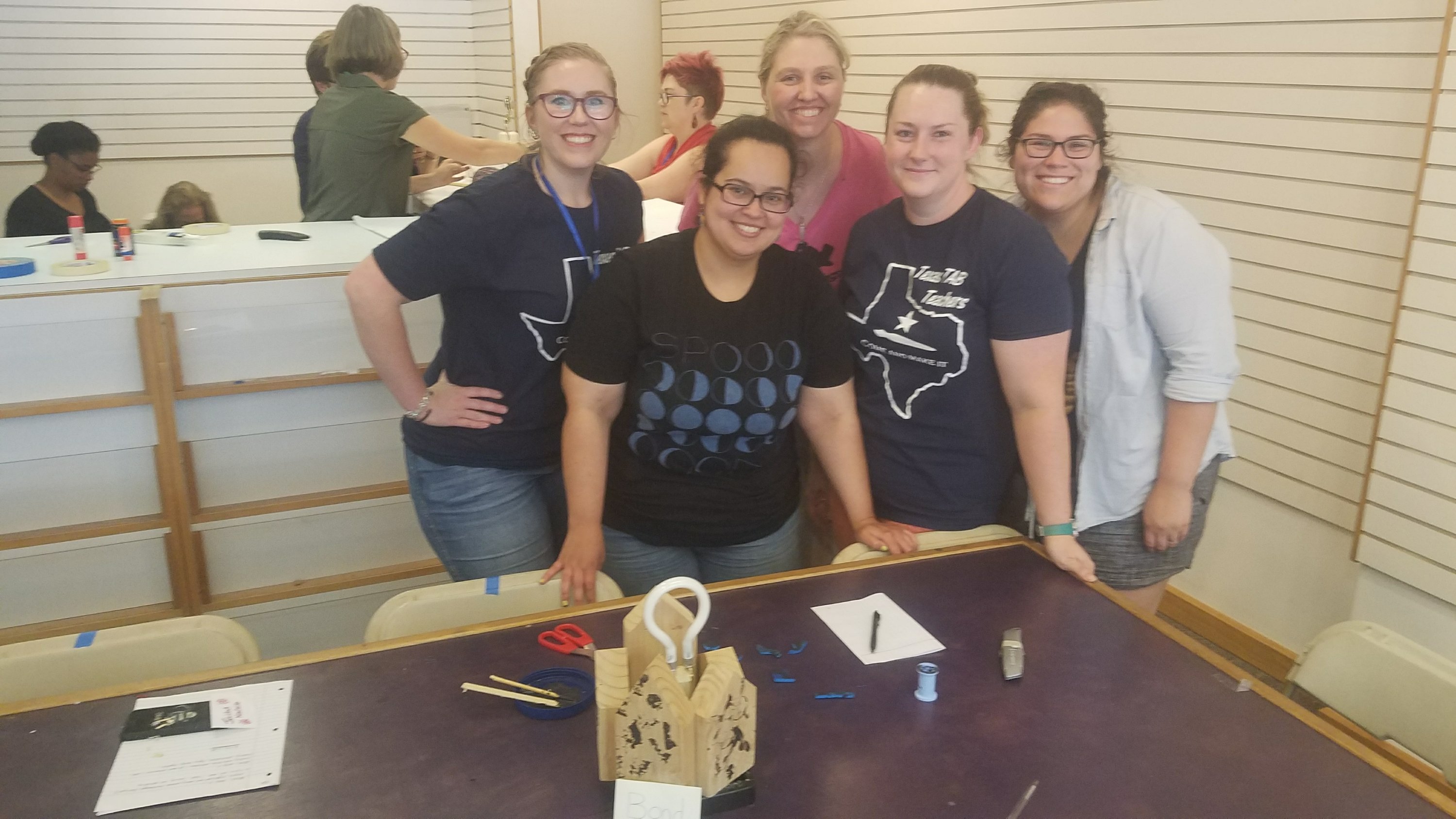
Friday was our last day and Lori had set up a great activity at Austin Creative Reuse.  ACR is a store that is supplied by donations.  It is a TAB teacher’s dream.  Well, and it’s the dream of artists and crafters and people that are into reuse.  We met in the classroom at ACR and split into 2 groups.  Those with the late birthdays went to the store first.  I have already been to ACR, so I knew what was up.  The others were new and were in amazement.  After shopping time, we went back and we participated in what was essentially like “Chopped”, but with art materials. We worked in groups of 4/5.  We were given a theme of “represent”.  And we went from there.  I was fortunate to get with a group where we all just flowed and worked well together.  Our sculpture was called “Bond”.


All in all it was a fabulous conference.  I am so glad that I was able to go and that I was enable to pass on my knowledge to others.  I know that I didn’t provide much of what I learned at Tx TAB Lab, but if you are curious as to what was shared, visit out Padlet.  It has links to almost everything.  I look forward to next year when I hope we go even bigger…it is Texas after all…Go Big or Go Home!  Until then, I have Facebook to be able to talk to my new TAB friends.


The 2017-18 School Year in Review

Standard

Another school year has come to a close.  That makes 11 for me.  The 2017-18 school year was a good year for me.  I had a couple of bumps in the road–that one student who felt she no longer needed to be here (luckily she is still here ♥) and the whole grading issue with me not being in compliance.  Overall, it was a fun and happy year.  So, without further ado, let’s take a look back and see what went down.

⇒ I entered 3 students this year into Scholastic Art and Writing.  We didn’t get any awards or even mentions, but I am proud that I was able to enter the work of these 3 young women.  I think we were robbed, but life goes on, right.

⇒ I was honored when Diane Jacquith and Kathy Douglas asked me to have a small part in the 2nd edition of their book, Engaging Learners Through Artmaking.  I speak of how I include current artists in my curriculum through an activity called Artist Monday.  Students watch a short video and then answer some questions about the artist and what they create.  Artists are always current, and many create art in ways that go beyond the traditional ways my students know about art making.

⇒I took my upper ceramic students on a field trip…on a Saturday!  It was so much fun.  We went to the Texas Clay Festival in Gruene, TX.  My students got to see a woman who was burnishing a pot and talking about terra sigillata.  They saw a variety of artists and got to see what people would be willing to pay for ceramics.  And, they got to watch a raku firing.  I am so glad that we went.  The fact that they were willing to give up a Saturday to go on a field trip was tremendous.  I hope to make this a yearly activity.

Seattle 2018.  This year’s NAEA conference was in Seattle.  I was lucky to be able to present not once, but twice at this year’s conference.  And bonus for me, both were with my very good friend and amazing TAB teacher, Elizabeth Honeysett.  We presented on Single Media and the TAB Classroom.  Liz talked about her jewelry classes and I talked about my ceramics classes.  We also did a ticketed event–The Secondary Choice Demo Room.  This was extra fun for me because I got to see adults make art.   Seattle was a blast.

FB_IMG_1522036718517.jpg

Restorative Discipline was brought into my school in the 2016-17 school year.  Each year they train a small amount of teachers.  I was lucky to be asked to be part of the 2017-18 cohort (cohort 2).  I really like restorative discipline because it focuses on relationships and community building.  It stresses being proactive instead of being reactive.  It was a great fit for me because I am all about relationships and community in my classroom.  We had many trainings throughout the year, which kept me always reflecting on my teaching.  I reflect anyways, but the reflections from the RD perspective made me think about things I sometimes gloss over.

⇒ RD brought the academic circle into my teaching practice.  In RD, there are many types of circle activities you can do with your students and the academic circle is one I really liked.  I utilized it in my ceramics classes.  There had been a disconnect between what my students researched on a artistic behavior and the art making that went along with it.  The academic circle filled the gap.  It allowed me to check what my students learned on their own. It allowed my students to share and connect with each other.  It allowed for questions.  It allowed for students to see ceramic art their peers were drawn to.  And, it helped to clarify the big idea for the students before they moved to the creation of their work.

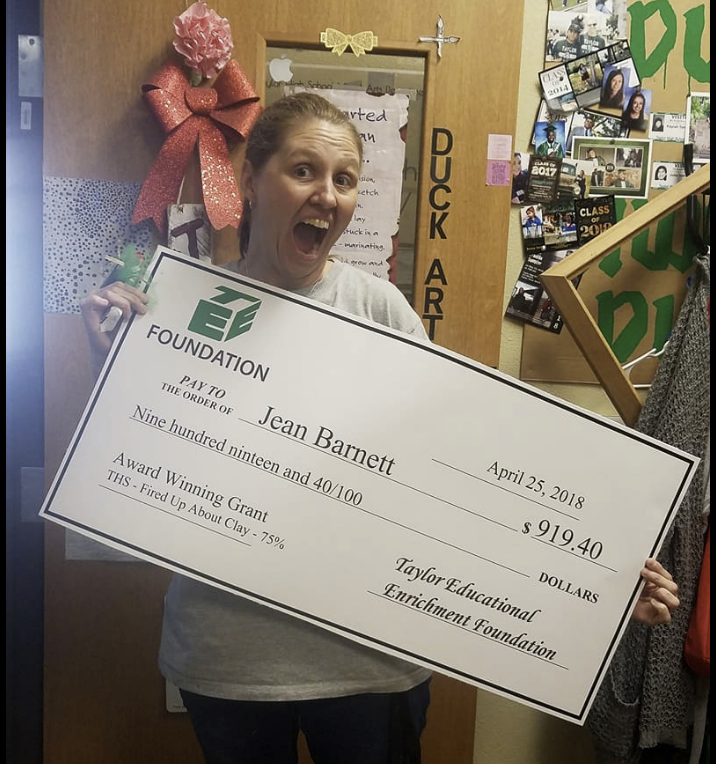
⇒ I applied for a grant and was award it!  In our community, there is a Screen Shot 2018-05-27 at 11.42.27 AMfoundation called the Taylor Educational Enrichment Foundation (TEE) that offers thousands of dollars in grants annually.  I finally got the courage to write a grant proposal for a raku kiln kit.  When the day finallyarrived when we would find out who would be awarded, I’ll admit, I was nervous.  I heard the band and the cheerleaders coming down the hall.  I kept hoping they were coming to me and not going to walk on by.  My principal ducked his head into my office and told me to come out into the hallway.  I was so excited.  I was dancing around my classroom.  I have since ordered and received the kit and I can’t wait to set it up and teach my students how to raku this fall.

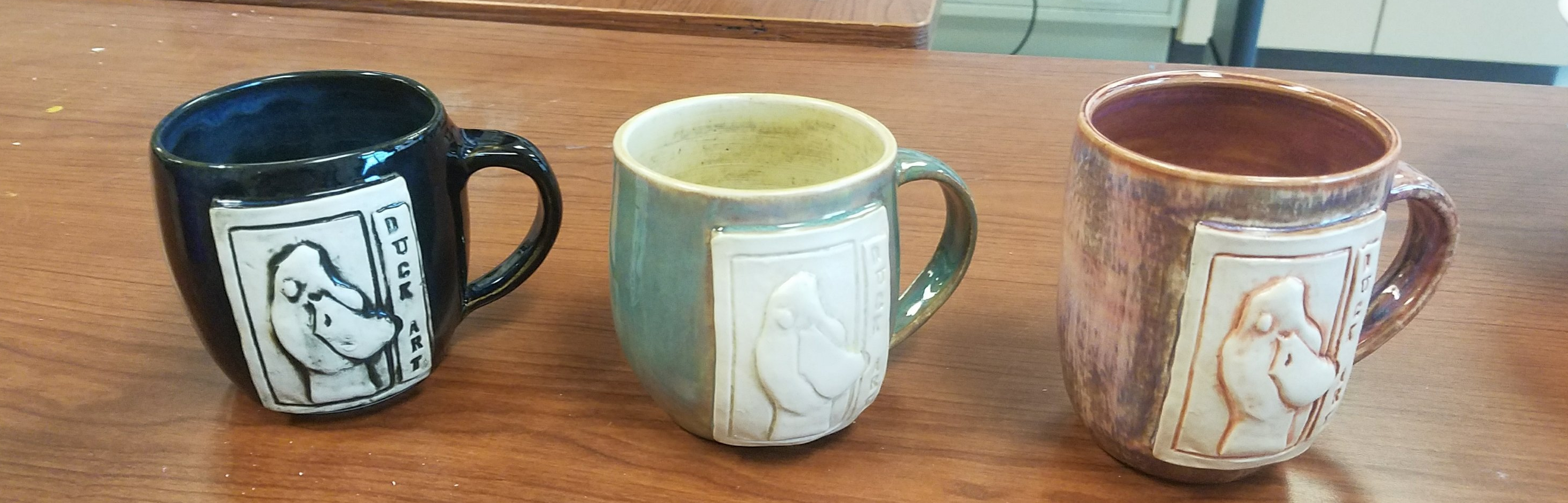
⇒For a few years, I make and gift some special seniors a piece of “Duck Art” pottery.  It started when some seniors bugged the crap out of me for cereal bowls.  So, as an end of year gift, I made bowls and gave them each one.  On the inside of the bowl, there was a duck.  The next year the seniors weren’t into cereal so much as they were coffee.  So, the image was transferred to a mug.  Each year, the duck image changed, but the sentiment was the same.  I made X# of mugs–all similar in shape, color, and image–and handed them out to the lucky ones I had forged relationships with.  This year, I wanted something different.  I really don’t like being a production potter.  I don’t like making the same thing over and over.  I decided to make each mug different and glaze each mug different.  The only thing that was my thru-line was the Duck Art medallion I made.  I made a sprig, which was a good lesson for the students, and went from there.  At the end, the students got to pick which mug they wanted according to their tastes and what fit well in their hands.  This has become the new and final senior Duck Art Mug.


20180521_1245161636134650.jpg

The Duck Art Mug!!

20180430_0817051451780997.jpg

The lefties

Those are really the bigs things that happened this year.  Like I said, it was a good year.  I made some stronger relationships with both students and colleagues.  I am sad that my ceramics seniors are gone.  They were a great group of kids.  But, I am excited for those returning next year.  I learned a lot about my teaching and how I want to move forward.  I really understand the end goal I have for my students–both those that will be with me for a year and those that will continue on.  I have worked hard (and continue to) on how to help my students meet those goals.  I have much in store for next year…I hope to implement “the 9”, courtesy of Ian Sands, with my art 1 class.  I have taken the 9 and created my own version–“the 10”–which is geared for my upper ceramics kiddos.  And, our principal decided to split the AP Studio art program between my co-worker and myself…so that will be interesting.  I am happy with my 11th year, and I look forward to another fun-filled TAB-tastic year in the Duck Art Studio.  But, until then, I will relax and enjoy my summer.

A New Approach to the Bootcamp

Standard

Well, it’s a new bootcamp approach for me and my students. Normally when we do bootcamps, there are many demos by me. And, since I don’t want to spend the whole class period doing demos, it ends up being one per day and then work time. So, each approach is learned separately. Granted, this has been okay for our drawing bootcamps and painting bootcamps. Last year I followed this approach for printmaking as well. It was kind of a disaster. Most kids didn’t really learn much, they whipped through each technique, and they wasted a lot of materials. So, this year, I decided we needed to do something different.

My school is 1:1 MacBooks, and it is an expectation that we include a technology component. I thought this would be a great way to meet that expectation and change up the bootcamp. This year, I would expect the onus of learning the techniques on the students. We talked about how this bootcamp would be different and that they were the ones to watch the demo videos for the technique they needed to learn. I would only be doing one demo–inking and pulling prints.

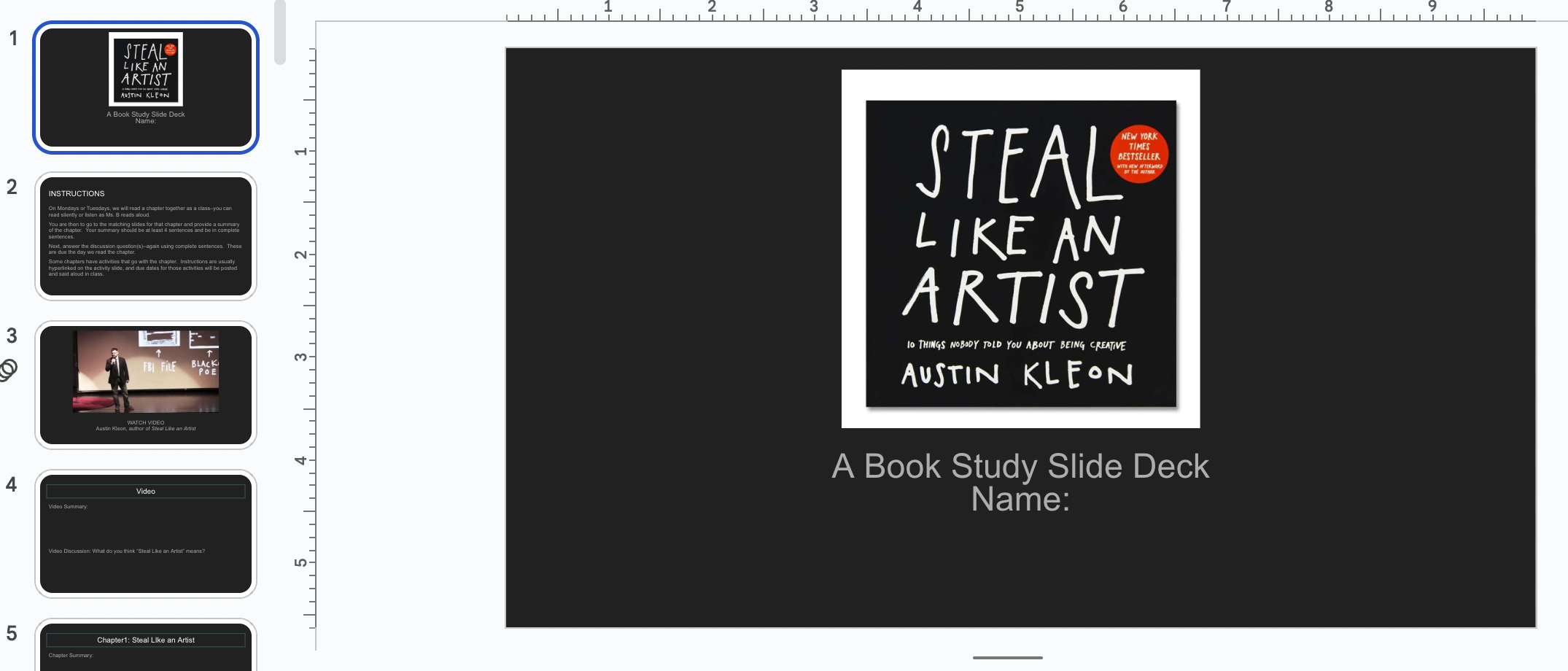
I create a Google Slides with my expectations for the bootcamp and shared it with my students in Google Classroom. At the start of the bootcamp, we went over it. I expected that each student would learn a minimum of one printmaking technique. They students could decide to either work alone or in groups of up to 4 people. Each group had to make 3 copies of an artwork that utilized different printmaking techniques. AND, they couldn’t repeat techniques in their piece. So, for example, a group of 4 had to create an artwork that had 4 different printmaking techniques. If you worked alone, you had to learn 2 techniques.

While I have 2 things I need to revise for next year, and I will get to those in a minute, I think overall this was a success. The majority of the kids watched multiple video demos before making decisions on what they wanted to learn. They communicated with others on the artwork creation and learned from each other when they had questions about techniques. Of course I had those that needed more attention than others, and I had some that needed modified requirements, but that is normal in a TAB classroom where differentiation is a common occurrence.

The biggest thing I have to revise is HOW I deliver the information and expectations to the students. The multiple copies aspect of printmaking was a difficult concept for many. I also want to look at the time line for next year. The students had 8 studio days (48 minute periods) to create and do a google slides for a presentation. I think I need to make it a full 2 weeks (10 days), not including a day for presentations.

I am proud of my students. They worked hard and learned way more than they realize. I plan on trying to incorporate this type of bootcamp into our future bootcamps. I am glad that I put the learning was put on their shoulders because it allowed me more time to observe and interact with my students.