Category Archives: Art Programs

Skill vs Creativity

Standard

As a teacher that has embraced the Teaching for Artistic Behavior (TAB) philosophy for almost a decade and a half, I still find myself struggling sometimes with with debate around skill and its importance. I know it’s important for artists to have technical skills and for them to continue building those skills. Buuuutttt…. should that be the most important thing in the high school art room (or any art room for that matter?)

I was doom scrolling the other day, and I came across this reel in my IG feed and I finally felt a little bit of validation. The artist talked about an art teacher he had that pretty much said what I had felt in my art heart all these years.

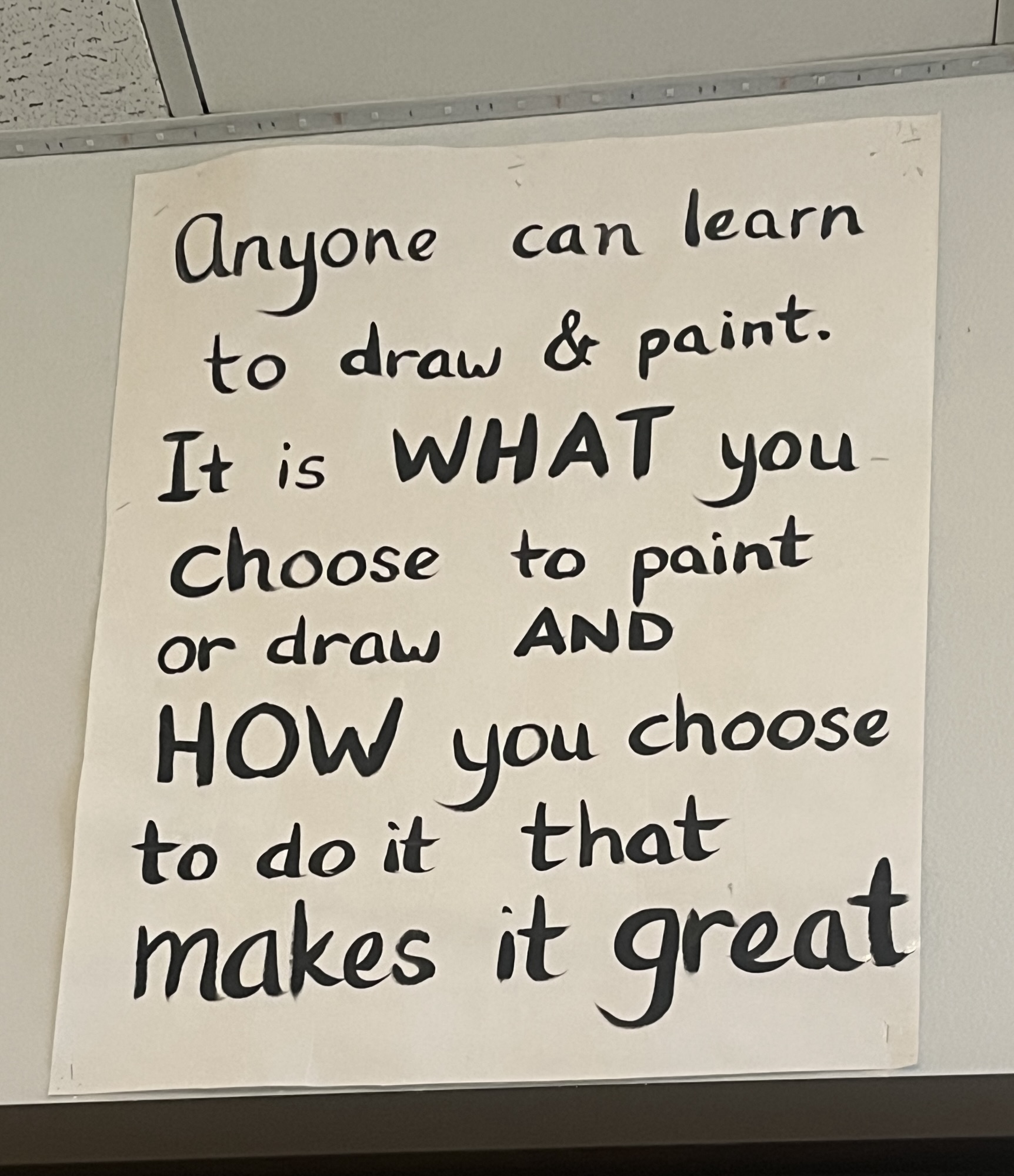
Gabriel talked about an art teacher he had who said that “technical skill is extremely overrated. And she had visited a school that prioritized the technical ability versus teaching the students creativity. And while their paintings were very technically well done, they were super dead, boring, not inspiring whatsoever.” He goes on to say that he thinks we put technical ability on a pedestal way too much, and that there isn’t enough credit to the creativity. Skill is still important, but it is a means to show that creativity.

I couldn’t agree more. There are times when I go to conferences and see “award winning” art, or I scroll through Facebook looking at other high school programs and I feel a sense of insecurity. I begin to question if I am doing a disservice to my students by focusing on the process, on creativity, and on what they have to say over spending day in and day out just learning and practicing technical skills and realism. But then I pause and picture in my mind’s eye the work my students are producing. Some of my students are very skilled. Others still have ways to go on their journey. But their work is so expressive. It has life. You can tell they explored new things. You can see the energy in their marks. I think of their faces and conversations when they are in our classroom studios creating, and it fills me with joy. I watch them push themselves to be better than the day before.

It’s not that I don’t teach skill. It’s not that I don’t encourage practice to make better. I do those things. I just don’t preach that it’s the pinnacle of art making. I teach new skills for my students to have in their tool boxes. We practice technical skills every time we make in the art room. It’s just that I put the onus on my students to choose which technical skills they want to practice to get better at. There are so many mediums and techniques that I can’t teach them all, and I am not going to choose which ones are more important than others to focus on. I will let my students decide what is important to them. I let them guide me when it’s time to explore new mediums and techniques.

In the end, I am not saying that those classes that focus on technical skill are wrong. If that is what you want your focus to be, then that’s your prerogative. What I am saying is that I am proud of my students and the work they create. I am proud of my program. They are proud of their work and their growth! Personally, I would rather have my students make work that carries their feelings and emotions out to the world, than a bunch of pretty pictures that are technically well done.

Let’s Go? Advice from almost 2 decades of teachering.

Standard

I’m about to start year 19, and man have I had an interesting career. I’ve taught high school for 18 years, AND I’ve done it all in the same place. I can retire in 11 years, but plan on doing at least 12 so I can retire on an even number. But, that’s just an arbitrary date. I’ll see the state of education when I get there. I may be done, I may not be. Who know’s. ::shrug:: But this post isn’t about when I’ll retire. This post is about a few things from my journey that helped to get here…to today…a week and a half before I walk into day one of in-service for year 19.

When I look back on everything, there are a few key things I’ve learned that keep me going, keep it relevant, and have made me into the force I am today. Yes–I said it, I am a force. I haven’t always been so confident in my abilities, but today I am. I am a good, nay, an amazing teacher. I am really good at what I do. Do I have some areas I can work on? Of course–who doesn’t? What makes me so different is that I know there are things I lack and I reflect on that and I learn and continue to grow in this ever changing, but not really changing, world of art education.

I want to share some of what has motivated me, and helped me to believe in my abilities over the years. It always hasn’t been sunshine and puppies (although I don’t really like puppies–come at me bro–so maybe that phrase for me should be sunshine and art supplies. Just sayin’.) I’ve had my fair share of crap days and considering moving districts and not wanting to go to work, but in the end, I show up because deep down, I love teaching and I looooove teaching art to teenagers.

So here we go!

It takes 3 years to build a program. I was told this by Ian Sands at the beginning of my TAB journey. And, he was right. I now say it to everyone who is new to a role or implementing TAB for the first time or even starting at a new school. You may think you have it in the bag and that it’s going to be easy peasy, and that attitude is great. But, as you go along the first year, you will hit bumps and things won’t work. You’ll be learning how your population reacts to you, your goals for both you and them, and your systems that you are trying to implement. You will fail, and THAT IS OKAY. Learn from those failures and revise the next year, or even as you go along that year. Teaching is like making an artwork–we have an idea, we research, we develop plans, we try to implement those plans, we revise, we fail, we reflect, we try again, then we start the whole cycle again. By that third year, you really do understand the relationship between you and your population, and you can see the growth that you’ve made and your program has made. It’s easier in year 4 and beyond. That’s not to say that you stop reflecting and revising, but at that point it’s different. So, don’t give up. Give yourself grace. I needed this “3 -year build” advice when I jumped into TAB. Then I needed to remind myself again when I switched up my sculpture program to a purely ceramics program. Rome wasn’t built in a day. Just sayin’.

Administrators come and go, but good teachers stay. One of my favorite co-workers, and a great friend of mine, said this to me about year 4 when I was struggling with my principal and the differences of opinions we had. And she was right. That principal left, finally, and left space for one of the best principals I have worked under. He wasn’t perfect, but he was perfect for me. He took time to understand me and my program. He knew what I needed both professionally and personally. He supported me. Unfortunately, he had to move onto another district, and my current admin isn’t him, but I know that some things are temporary. When you find your place and find what feels right, even when admin and you just don’t mesh, you stay. I love my program (which I helped to build from very little), and I love my population. I love that I’ve taught all the siblings in a family or am going to. I don’t always agree with my district or the town I teach in, but I know that being a constant in the district is important to what those families love about being ducks.

Remember your why. I know all you reading this just totally cringed at that phrase. I hate it too. I’m not talking about when admin asks you to try and placate you because they aren’t giving you a raise or there is some other stuff thing they are doing. This is super TAB specific. I said this to my secondary cohort this summer at the 2025 TAB Institute. I saw the eye rolls. But then I went on to explain. What are you trying to achieve by implementing a TAB philosophy? What do you want from your students? This isn’t about the methodology and how you will do this, but why you CHOOSE to believe the philosophy? This is my why: Yes I am hoping to make artists, that is my dream goal that everyone of my students will be an artist. And yes, that drives all the decisions about how I implement TAB–from the choice continuum, to themes, to the supply buffet. But let’s be realistic. That is not my population–they are not all going to go to art school and become artists. And while yes, I am trying to make artists, my why is really is about helping my students become creative and become independent thinkers. I am helping them to be able to make choices, informed choices. I am helping them to have an open mind and to see that things do not live in a vacuum and things are cross-curricular. That is my goal. Art making is my vehicle to get there. TAB allows me to do that more than any other art education philosophy I’ve explored. And it allows me to do it in my own way, using my strengths. So, when I am having those days full of doubt and questions, I think of my students and the ones that I have impacted well after they’ve graduated and the ones that are currently making a mess in my office, and it all makes sense again.

I’ll leave you with this. As you go into this new school year, whether it’s your first, your fifth, your nineteenth, or beyond, have confidence in yourself and your ability as a teacher. You’ve got this. I am already facing challenges this year, both personally and professionally. I can go in with an eff this attitude, or I can focus on what is important to me, inside my classroom with my students. I will take what they throw at me and try to see their point of view, but in the end, while I will be compliant with their requests (for the most part–iykyk), I will just do me. I know my program is strong. I know I am strong. I know my students will thrive because of what I am setting up for them. I know I’m not perfect and that I have things to work on, but I don’t have to be perfect, because clearly no one is and the conditions we teach in today clearly aren’t either. I just need to shut my classroom door, have fun, be present for my students, remember my why, and be imperfectly me. Everything else is just noise and in the end doesn’t matter. Have a wonderful year.

Typical Days in the HS TAB Studio

Standard

As we get closer and closer to the start of the year, many people are asking what a typical day in the high school TAB studio/classroom is like. And well, it’s anything but typical. Just kidding. TAB classrooms are just like any other art classroom, just there is more independent thinking happening and less teacher-led projects. But, other than that, it’s pretty normal. We have routines just like any other classroom.

I thought I would create a small post outlining my day and my week as a high school TAB teacher. I see my students daily, all year long. This year we are back up to 50 minute classes. Woo hoo!! I teach Art 1, Art 3, and beginning through advanced Ceramics. Sometimes I teach AP or an Art 4, but those are on case by case bases. Unless it’s AP 3D, then that’s definitely me.

I like to have a routine that my students get used to, so they are comfortable and there’s not huge chaos every day. I have a white board, which when my room is not under construction, the students pass by as they come into class and they are encouraged to read the board so they know what they need to get out.

Mondays start off with either Artist Monday or Style/Movement Monday, for all my classes. We come in, watch a video and then the students answers questions, either in their sketchbooks (art 1) or on a slide deck (everyone else). That generally takes about 15 minutes of class total. After that, we go into one of 2 things, we get back to notes/practice of skills or studio time. Every other Wednesday, in art 1, we have a drawing test. Then, similarly to Mondays, the students pick up where they left off the day before. In my upper classes (art 3 and ceramics 2 & 3), I designate a day (usually every other Friday) for digital portfolio time.

Beyond those few fixed things, I typically don’t like to take much of the time away from arting. Kids will ask me what are we doing, and I say to look at the board. At some point, whether they need their sketchbooks or not, art 1 students will come in and grab it before sitting down. It has become a habit. Sometimes I address the class right at the beginning to do some house keeping, like reminding students of who I still need to go over ideas and development or when the last studio day for a unit is. Other times, I just let them get to work and don’t address the whole class until about 7 minutes left when it’s time to come to a convenient stopping point to begin clean-up.

When we do need to learn new skills (composition, perspective, facial features, etc.), we sit and take notes in our sketchbooks. After there is usually a small assignment in their sketchbooks to practice the new skills. New media explorations take about a week, while other smaller skills assignments take between 2-3 days (notes and practice time together.) When I do demos, where we (students and I) aren’t doing them simultaneously, I try to keep them under 10 minutes. That way, they still have at least a half hour of arting time.

There you have it. The biggest difference in my experience between when I was a more “traditional” teacher and a TAB teacher is that there is much more independent art making and exploring time. I circle the room more and talk to students more. There is not magic secret or formula. This is what feels right for my students and for me. It’s relaxed and safe and successful.

2 Philosophies, 1 Program

Standard

I wanted to take a moment to talk about my program. As many of you know, I am a TAB (Teaching for Artistic Behavior) teacher and have been for the majority of my 15-year career. What I am not sure people know is that my partner is not a TAB teacher. Yes, he sometimes gives choices to his students, our students, but for the most part, he is a traditional art teacher who assigns whole-class projects.

We have been working together for 15 years, and it has taken us 14 of those years to finally get our act together and create a program that not only allows cohesiveness for our students, but also allows for each us to teach to our own philosophy and to our strengths.

What does this look like? We were fortunate to have had a principal who trusted us as experts and allowed us to choose which class levels we wanted to teach. We both teach Art 1 classes due to the sheer number of class sections we have. (Texas requires one fine art credit for graduation, and the majority of students pick art as that FA credit.) We split the Art 1 sections as evenly as we can. The experiences for the students in our respective classes is different, but we are okay with that. The students get to know us as teachers and people, they get to learn about our program, they get to make some art, they have fun, and for about half, they get that credit they need so they can move to the pathway they are really interested in.

It’s when the students decide to continue in the art pathway that things really start to make sense for how we have structured the Duck Art Program. We have split the remaining sections of courses by levels between us. My partner teaches all sections of art 2, I teach all art 3, then the seniors return to him for art 4 and AP Studio. He teaches both AP 2D sections. I teach AP 3D, but I am also the ceramics teacher, so that is what makes sense for us.

Splitting the classes this way works to our strengths. He is really good at teaching techniques and materials, so the art 2 students benefit from all having this shared experience where they get to focus on skills and learning new materials. They come to back to me in art 3. We focus more on the ATP (Artistic Thinking Process), studio habits, and creating original art. My class helps them to really consider content and finding what media they like to work with, what types of subjects they like, and what they want to explore. AND they really start to find and develop their voice. So…..when they return to Art 4/AP, they have a well-rounded background and can create amazing art. It was hard in the past to have kids that were all over the map because we taught the same level in totally different styles. I understand that as a TAB teacher, I always meet students where they are, but this isn’t about meeting students at their artistic level, this is about the students have a common base knowledge that allows both teachers to better meet the students needs.

It took us forever to learn to play together, and play together well, but better late than never I say. I am excited for this coming year because we will be able to really see how well this will benefit our students and our program. It was time to stop being an island in a department of 2 and instead come together as 1. It is possible to work with those that don’t follow a TAB philosophy like you do. You just need to check your ego and remember what is really important and the focus of your art program–the students and helping them in their journeys to becoming artists.