Tag Archives: evaluation

Goal Setting

Standard

School’s been in session for just a month now, so of course that means it’s time for me to decide on my yearly goal for my T-Tess. That’s the evaluation system my district in Texas uses. While I’m not sure that the system in general has helped me as a teacher, I did decide to actually take my goal seriously this year.

In the past, I wrote goals that seemed easy to achieve and collect data on so that I could easily check that box off and spend most of my time focusing on the fun part of my job. When we had to work on our goal during our PD earlier this month, I started off with the same attitude and just copied a goal from about 5-6 years ago. But as the month went on and I thought about it, something in my brain switched and I began to take the goal seriously and really figure out ways to help me learn from my goal.

This year’s goal falls under the professionalism domain, as I am going to work on reflecting on my practice. I normally reflect on my practice throughout the year. I make notes. I think about what worked, what didn’t work, and changes I can make. But after 17 years, I think that’s not enough.

I know they say if it’s not broke, don’t fix it. Somehow, that doesn’t seem to apply this year. This year has come with some changes that I didn’t anticipate, and I am struggling with finding my place in our system this year. I know I have been a strong and effective teacher for years, but something feels different this year. I feel I’ve been focusing so much on being a great TAB teacher and being true to the philosophy that I believe in so much, that I’m missing something else. I am hoping to figure what that is.

I have been working on gathering some strategies to really help me reflect on the different facets of being a TAB teacher. I hope to write more reflective posts this year, not just ones that give advice on technique or incorporating TAB. I really want to look closely at how I deliver information, at how I am communicating to students and colleagues, at how I scaffolding the important concepts as I lead my students towards understanding the artistic thinking process and ultimately independent thinking. I plan on watching other teachers teach, from a variety of disciplines. I am essentially an island, in more ways than the obvious. I think seeing how others approach their classrooms can shine many lights on what I do and choose not to do. I have contacted several teachers that I respect and asked if I could come and observe them. I received much enthusiasm and am excited to start. I will go to my first observation next week. I am pretty excited about it.

How do you choose your yearly goals? Is it part of your evaluation process? Do you take it seriously or do you do it to check the boxes? I have just written goals in the past that easily allowed me to look good. But, the longer I teach, I don’t want to get stagnant or stale and just do what has always worked. I am looking forward to learning more about teaching and myself through this process.
Open Studio and Evaluation/Grading

Standard

Some things have changed, for the better I think, in my art department. We have finally split the level by teacher instead of both of us teaching all levels. This is better for both the students and for us. It lessens the amount of preps for each of us, and it really makes sure that each student gets similar experiences after art 1, and the best each of us as teachers have to offer. Art students would have my partner for Art 2 and learn/practice lots of technique (that is his strength). Then when they come over to my room for Art 3, we would focus on the Artistic Process, finding their voices, and developing a studio practice. They return to him for Art 4 / AP, with the hopes that the year in my room really helps prepare them for the next level–especially creating a portfolio for AP. (Just as an aside, it did not lessen my preps this year, I have 7–one of which is AP. Such is life in a growing district with less than the ideal number of teachers. But I digress.)

I usually run my Art 3 like an Open Studio, where students follow their own interests in both subject matter and media. This year, I did find that many students do need help with the ATP (specifically ideation), so I brought in themes to help them. In previous years, it really was an open studio, but you have to adjust to the students you have if you want to be an effective teacher. I also use this studio format in my upper ceramics classes–Art 3: Ceramics still has themes where Art 4: Ceramics is fully student-led.

The biggest hurdle I have run into with these classes is how to evaluate my students and ultimately how to turn that into grading. I decided the main things to be evaluated should be the studio practice habits of each student. I evaluate them bi-weekly on their studio practices. It has taken a lot of trial and error to come up with a rubric that I feel works for what I want them to get from their time in my class. Evaluating their studio practices gives the students a lot of leeway on what and how they want to create.

Photo credit K. Douglas & C. Fralick

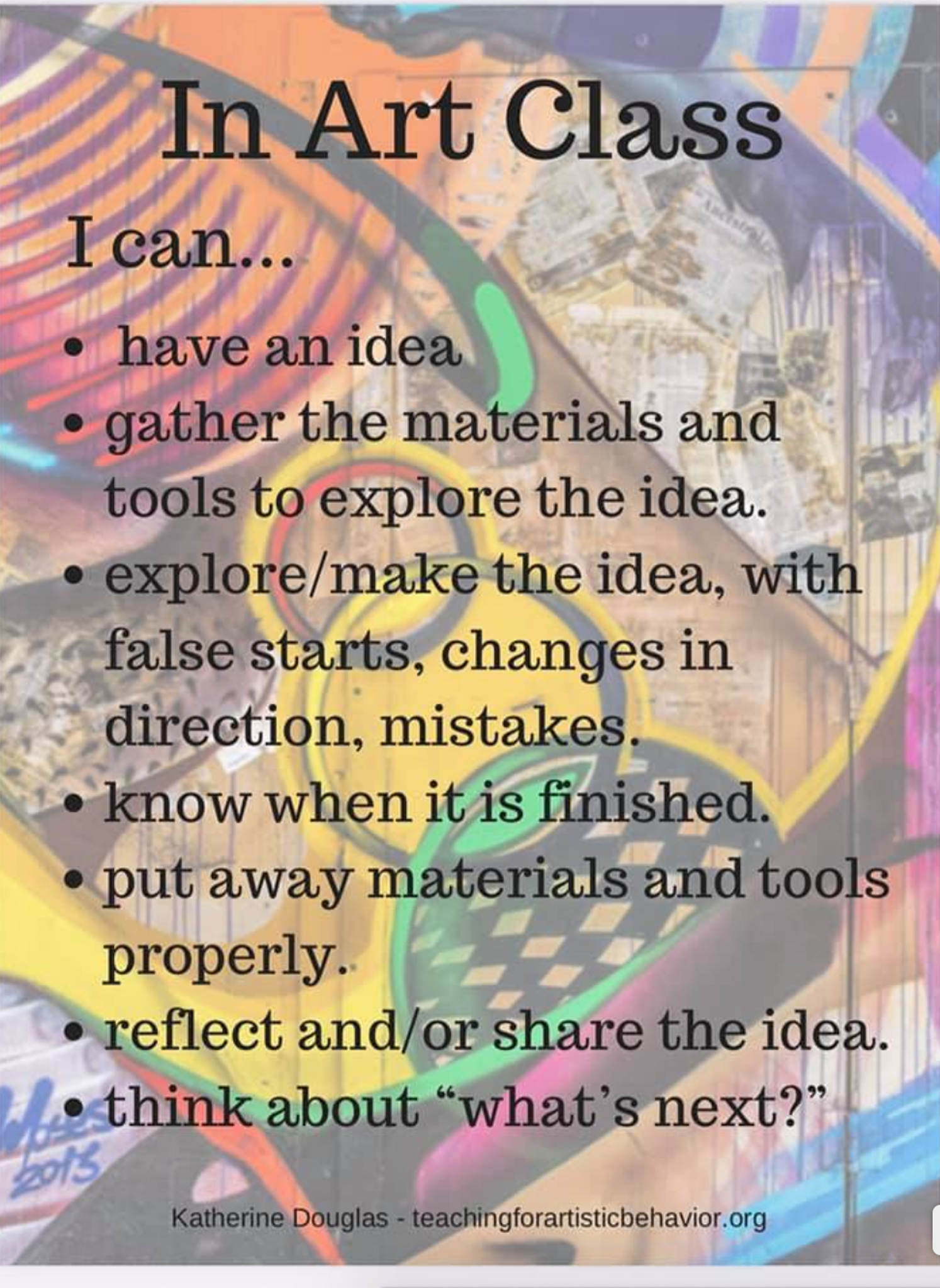
I based my rubric on the 7 Goals of Art Class from Katherine Douglas. I thought that while the goals were created those for elementary students, they apply to any studio practice. I created a rubric that is based on these studio habit goals that are incorporated into the ATP (Artistic Thinking Process) stages. Coming up with a point system was a not so easy task, but I ultimately decided that every habit is equally important. Engagement is the highest because that really reflects their attitudes and productivity during the studio time each week. I use this rubric to determine my bi-weekly major grade for my upper level classes. 

Studio Habits Bi-Weekly Grade

As time goes on and I reflect upon my students and my teaching, I keep tweaking the rubric to be a better reflection of what I hope they are learning and practicing as emerging artists. But so far, this has worked well and I think is an accurate reflection of my students’ studio habits and practices. 

The Art of Being Observed

Standard

Every year it happens…the official observation that one of your administrators must do so you can be evaluated about how good of a teacher you are.  There is always much discussion on this in teacher groups…no matter what subject you teach. Some teachers are all about the dog and pony show–changing lesson plans or adding in things that wouldn’t normally occur on that day.  Others take a more “I’m just gonna go about my business” type attitude.  This is how I teach, come and get it.  This latter camp is where I fall.

Yes, I choose the day based on what we are doing.  And yes, I try to have my observer come in during my best class.  But other than that, I don’t change a thing.  I try to ask for a date where we might be doing something other than just a complete work day, but if I don’t have one of those, I let the observer know and I roll with it.

I don’t agree with the dog and pony show.  I don’t understand stopping what you are doing to show some “home run” lesson. It doesn’t seem honest and authentic to me.  Why would I want an evaluation that isn’t really based on how I am as a teacher?  If it is not something I do everyday, then it’s not me.  I want to show what it is like in my classroom, every day.  I want to know if there are practices I am doing well or practices that need improvement.

I’ve heard some teachers say they show the admin what they want to see so that admin will just leave the teacher alone the rest of the time to do what they (teacher) thinks is good and what they want to do.  This doesn’t make sense to me either. Why would you want others to think you’re something you aren’t?  If you feel you have to change for an evaluation, why is that?  Are you not comfortable with how you run your classroom?

I had my formal observation last week.  I finally received the evaluation on it today.  It confirmed what I had known, that I was doing good things in my classroom.  She saw the learning and creativity that happens every day in room because we ran the room like we did every day.  Nothing changed.  My students did exactly what I thought they would–the participated, they talked, they joked around, they learned, they made art.  They did that the day before my observation.  And, they did it the day after.